

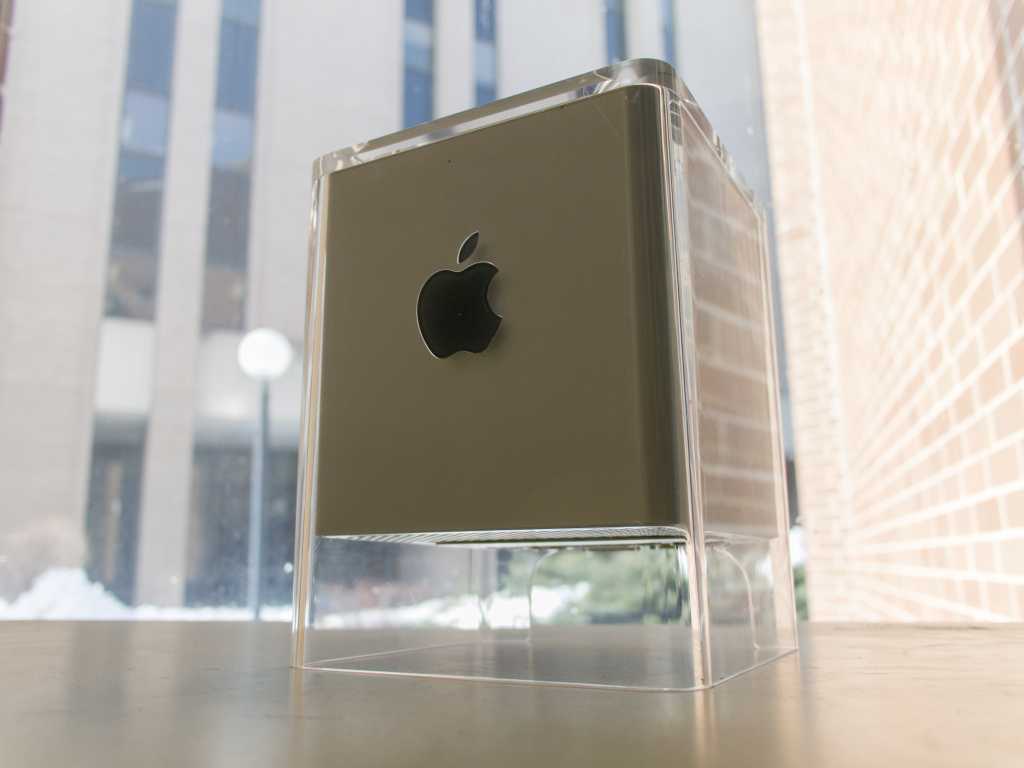
Apple is famous for its design sense, having produced a bewildering array of gorgeous gadgets over the years. But perhaps no device has embodied that sense as truly as the Power Mac G4 Cube, a sleek block of aluminum and plastic that turned heads and wowed onlookers when it launched in July 2000.
Unfortunately, it was also a commercial flop, lasting just one year until it was discontinued forever. Steve Jobs later admitted that it was overdesigned and overpriced, and while it stands a perhaps the purest expression of Apple’s design sensibilities, it’s also a cautionary tale of what can go wrong in the world of computer design.
Now, 25 years to the day since it was released, we can look back and realize there are plenty of lessons we can learn from this stunning, divisive machine.
Looks aren’t enough
If you’re pitching a high-end device to demanding power users, you need to make sure it’s plenty powerful. That might seem obvious, but this was perhaps the Power Mac G4 Cube’s biggest stumbling block: it didn’t offer enough bang for the buck.
Priced at $1,799 (roughly $3,350 today) for the base model, the Power Mac G4 Cube landed squarely at the top end of the market. Yet despite that, it had to make sacrifices to prevent the price from spiraling upwards even further. You couldn’t expand its storage or capabilities, for example, something many pros saw as essential.
But at the same time, the device also proved that professional computers could be elegant. With the iMac, the traditional PC design playbook had been ripped apart, but the power-user end of the spectrum was relatively untouched by this idea until the Power Mac G4 Cube came along. With its tiny frame and innovative use of materials, it was a miniature artwork for your desk and showed that you didn’t need a huge machine to get performant components.
That’s a concept you can see today in the Mac mini and the Mac Studio, the latter of which especially feels like the spiritual successor of the Power Mac G4 Cube. It’s a lesson that Apple has learned well.
Speedy storage matters
These days, Macs come with some of the fastest storage drives on the market, but it wasn’t always this way. For far too long, entry-level Macs were equipped with painfully slow hard disk drives (HDDs) that were notably more sluggish than the upgraded versions you could get if you forked out extra.
Apple used 5400 rpm hard drives in the G4 Cube. That was a mistake.
Christopher Phin/Foundry
That’s exactly what happened with the Power Mac G4 Cube, where entry-level models packed in a ponderous 5400 rpm HDD. It was immediately obvious that this was far inferior to the 7200 rpm drives that were available at the time, yet Apple continued to use the slower drives, despite the Mac’s high price.
While this helped to keep costs down, it was a poor introduction to the Mac for anyone who didn’t have the cash to splash on upgrades. Considering most people aren’t power users, that’s a lot of users to bog down with slow storage.
Thankfully, the age of blazing-fast SSDs means that all of Apple’s Macs now come with storage that’s suitably up to speed.
Risks are good
When it launched, many members of the public saw the Power Mac G4 Cube as a thing of beauty, equal parts sculpture and computer. But they weren’t the only ones with strong opinions on its design.
While the Power Mac G4 Cube was released 25 years ago, the philosophy behind its design lives on.
Willis Lai/Foundry
At the same time as it was receiving this effusive praise, the device was the butt of jokes among many punters for its usual design, with some saying it looked eerily like a tub for a box of tissues. Even Jony Ive and his team could see the funny side, and they started using old G4 Cube chassis as tissue boxes.
But Apple has never been fussed about this sort of thing. It’s long pushed the boundaries of what computers should look like and what features they should have. Just look at the “trash can” Mac Pro (which could be argued is derived from the Cube) and the MacBook Pro’s Touch Bar to see evidence of that.
Apple is still taking this approach today–look at the M4 Mac mini’s hidden power button. A divisive design gets people talking, and as they say, there’s no such thing as bad press.
Complexity comes at a cost
Speaking of the M4 Mac mini, there’s another Power Mac G4 Cube lesson to be found: it should be easy to use your device.
You had to tip the Power Mac G4 Cube to reach essential components–in this case, its ports. Not only did that risk people scratching or tipping over the device, but it created friction for users who have to perform an inconvenient task to be able to do something frequent and routine.
Forcing that in the name of beauty is not something that most people will be particularly fond of, no matter how good the device looks. In the case of the Power Mac G4 Cube, that was evidently a sacrifice that Apple felt was worth making. With the Mac mini, Apple provides two USB-C ports on the front, making it easy to plug in devices. Lesson learned.
The future can wait
One of my first smartphones was a slide-up Samsung device that came with touch-sensitive buttons. At first, my young brain thought this was the coolest thing in the world. But I soon realized that it was an incredible pain. I’d keep accidentally brushing the buttons with my fingers, which would delete texts I was writing or abruptly send me back to the home screen. It was a nuisance implemented in the name of cool.
The Power Mac G4 Cube suffered from a similar problem thanks to its touch-sensitive power button. It could be activated with the merest glancing touch, sending your Mac to sleep midway through your work. I do not doubt that Jony Ive and friends thought it was incredibly cool, but the Power Mac G4 Cube’s collision with reality proved otherwise. Thankfully, that’s one lesson Apple has learned well.
Apple has strayed from the four-quadrant philosophy that Steve Jobs came up with over 25 years ago.
Apple
Stay focused on what users want
Upon his return to Apple, Steve Jobs implemented his famous product quadrant, which stated that the firm should produce four kinds of Macs: desktops and laptops for consumers and professionals.
The Power Mac G4 Cube fit into none of these categories. It cost the same as a Power Mac but lacked its expandability. At the same time, it was much more expensive than even an upgraded iMac. In other words, both consumers and professionals lost out compared to Apple’s other devices.
The question on everyone’s lips was who was going to buy the Power Mac G4 Cube. Ultimately, the answer could be found in its sales figures.
In the years since Steve Jobs died, Apple has strayed further and further from the quadrant. While laptops have stayed tight and focused (Apple sells just the MacBook Air and MacBook Pro, for now at least), Apple’s desktop roster has been ever-expanding. You can now choose from the iMac, the Mac mini, the Mac Studio, and the Mac Pro. And there are rumors that the iMac Pro could even make a return, too.
The quadrant was an attempt to get Apple focused again, and it’s not a strict necessity these days–Apple is in a very different place now and can afford a little bloat. But the Power Mac G4 Cube shows the risks you take when that quadrant isn’t at least a consideration. Without a core audience, no product can hope to sell well.
