


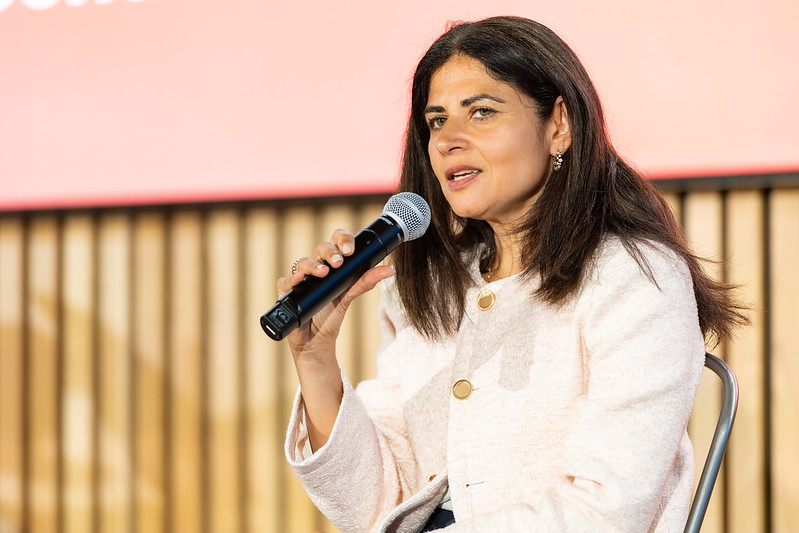
Sonali De Rycker, a general partner at Accel and one of Europe’s most influential venture capitalists, is bullish about the continent’s prospects in AI. But she’s wary of regulatory overreach that could hamstring its momentum.
At a TechCrunch StrictlyVC evening earlier this week in London, De Rycker reflected on Europe’s place in the global AI race, balancing optimism with realism. “We have all the pieces,” she told those gathered for the event. “We have the entrepreneurs, we have the ambition, we have the schools, we have the capital, and we have the talent.” All that’s missing, she argued, is the ability to “unleash” that potential at scale.
The obstacle? Europe’s complex regulatory landscape and, in part, its pioneering but controversial Artificial Intelligence Act.
De Rycker acknowledged that regulations have a role to play, especially in high-risk sectors like healthcare and finance. Still, she said she worries that the AI Act’s broad reach and potentially stifling fines could deter innovation at the very moment European startups need space to iterate and grow.
“There’s a real opportunity to make sure that we go fast and address what we’re capable of,” she said. “The issue is that we are also faced with headwinds on regulation.”
The AI Act, which imposes stringent rules on applications deemed “high risk,” from credit scoring to medical imaging, has raised red flags among investors like De Rycker. While the goals of ethical AI and consumer protection are laudable, she fears the net may be cast too wide, potentially discouraging early-stage experimentation and entrepreneurship.
That urgency is amplified by shifting geopolitics. With U.S. support for Europe’s defense and economic autonomy waning under the current Trump administration, De Rycker sees this moment as a decisive one for the EU.
“Now that Europe is being left to fend [for itself] in multiple ways,” she said, “we need to be self-sufficient, we need to be sovereign.”
That means unlocking Europe’s full potential. De Rycker points to efforts like the “28th regime,” a framework aimed at creating a single set of rules for businesses across the EU, as crucial to creating a more unified, startup-friendly region. Currently, the mishmash of labor laws, licensing, and corporate structures across the countries creates friction and slows down progress.
“If we were truly one region, the power you could unleash would be incredible,” she said. “We wouldn’t be having these same conversations about Europe lagging in tech.”
In De Rycker’s view, Europe is slowly catching up, not just in innovation but in its embrace of risk and experimentation. Cities like Zurich, Munich, Paris, and London are starting to generate their own self-reinforcing ecosystems thanks to top-tier academic institutions and a growing base of experienced founders.
Accel, for its part, has invested in over 70 cities across Europe and Israel, giving De Rycker a front-row seat to the continent’s fragmented but flourishing tech landscape. Still, on Tuesday night, she noted a stark contrast with the U.S. when it comes to adoption. “We see a lot more propensity for customers to experiment with AI in the U.S.,” she said. “They’re spending money on these kinds of speculative, early-stage companies. That flywheel keeps going.”
Accel’s strategy reflects this reality. While the firm hasn’t backed any of the major foundational AI model companies like OpenAI or Anthropic, it has focused instead on the application layer. “We feel very comfortable with the application layer,” said De Rycker. “These foundational models are capital intensive and don’t really look like venture-backed companies.”
Examples of promising bets include Synthesia, a video generation platform used in enterprise training, and Speak, a language learning app that recently jumped to a $1 billion valuation. De Rycker (who dodged questions about Accel’s reported talks with another big name in AI), sees these as early examples of how AI can create entirely new behaviors and business models.
“We’re expanding total addressable markets at a rate we’ve never seen,” she said. “It feels like the early days of mobile. DoorDash and Uber weren’t just mobilized websites. They were brand new paradigms.”
Ultimately, De Rycker sees this moment as both a challenge and a once-in-a-generation opportunity. If Europe leans too heavily into regulation, it risks stifling the innovation that could help it compete globally – not just in AI, but across the entire tech spectrum.
“We’re in a supercycle,” she said. “These cycles don’t come often, and we can’t afford to be leashed.”
With geopolitical uncertainty rising and the U.S. increasingly looking inward, Europe has little choice but to bet on itself. If it can strike the right balance, De Rycker believes it has everything it needs to lead.
Asked by an attendee what EU founders can do to be more competitive with their U.S. counterparts, she didn’t hesitate. “I think they are [competitive],” she said, citing companies Accel has backed, including Supercell and Spotify. “These founders, they look no different.”
You can catch catch the full conversation with De Rycker here :
