


This is a sponsored article brought to you by COMSOL.
Computer modeling and simulation has been used in engineering for many decades. At this point, anyone working in R&D is likely to have either directly used simulation software or indirectly used the results generated by someone else’s model. But in business and in life, “the best laid plans of mice and men can still go wrong.” A model is only as useful as it is realistic, and sometimes the spec changes at a pace that is difficult to keep up with or is not fully known until later in the development process.
Modeling and Simulation Is Great, But…
One of my favorite parts about working at a multiphysics software company is getting to see up close all of the clever and innovative ways our customers use simulation to move the world forward. There was the loudspeaker engineer who talked about turning an idea in their head into a viable product that passed both the technical spec and looked good, and they credited simulation for turbocharging their design iteration process. Another time, I spoke with someone who used our software for automating their process of designing boat landings for offshore wind turbines by creating their own library of parts, combining their learned experience with structural analysis. Someone else invited me into their impressive test lab where they showed off how they run experiments to generate material data, which they later used in their true-to-life computer models.
The benefits of getting a preview of the real-world outcome before you commit to a project plan or design transcend industry and product offerings. There are countless examples of how modeling and simulation speeds up innovation and reduces overall costs. That said, using simulation in the way it has largely been done over the past 30 years has required specific expertise and training on how to use the software of choice. So while companies that use it have a lot to gain, the total gain is still limited by the number of employees who have learned the necessary skills to build computational models. But that does not need to be the case.
Bringing Simulation to Greater Heights Through Custom Apps
Take a company that develops power transformer equipment, for instance. Powering the grid involves transporting electricity over long distances, which requires dangerously high voltages. To protect people in the community, transformers are placed near neighborhoods and buildings to decrease the voltage upon arrival. Transformers are inherently noisy, but they can be designed to be as close to silent as possible. As with most things in this world, transformers involve many interconnected physics — electromagnetics, acoustics, and structural mechanics, in this case — which means that multiphysics simulation software is the tool for the job when optimizing their designs.
When organizations build and distribute their own custom simulation apps, everyone in the workforce will be able to make decisions based on forecasts that account for real-world complexities and the underlying laws of physics.
The R&D engineers responsible for coming up with one manufacturer’s new transformer designs all knew how to use finite element analysis (FEA) software, but they worked closely with other teams and departments without such expertise. For example, the designers tasked with building the final transformers had no familiarity with FEA. Instead, they preferred to use spreadsheets and other tools based on statistics and empirical models, which worked well for transformers they build frequently, but not for new designs or scenarios where different dimensions are introduced. In that case, multiphysics simulation is absolutely necessary to get accurate predictions of how noisy the final transformer will be. Additionally, if the final design is too noisy, the company has to make costly modifications after the fact. They needed something better.
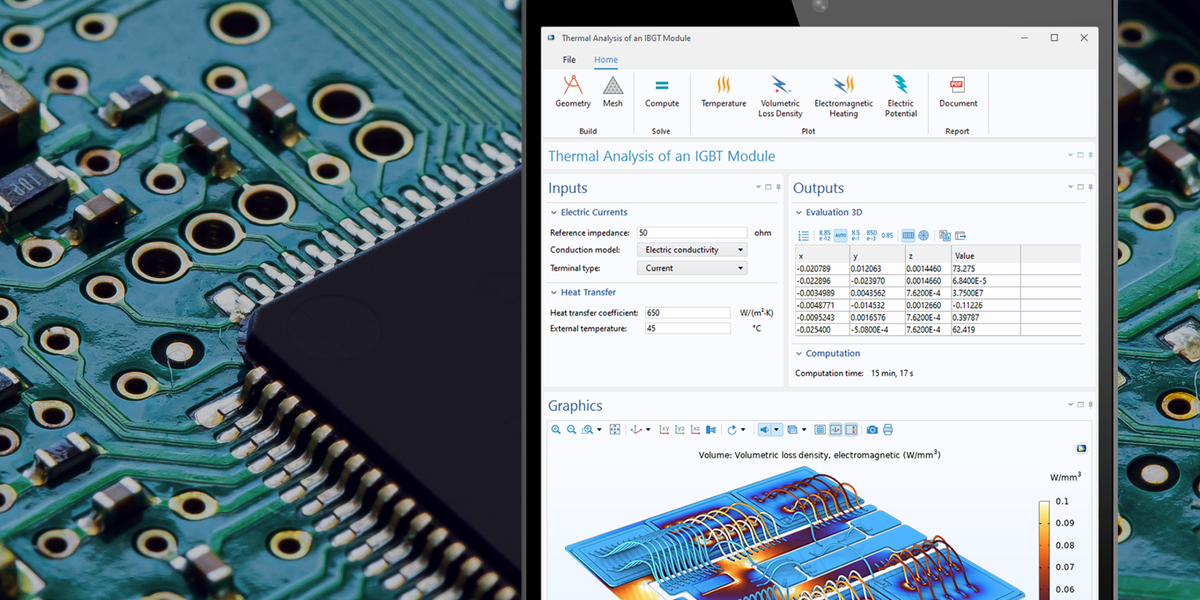
What did they do? They built their own custom simulation apps based on the finite element models. That way, their design team could enter parameters into input fields in a straightforward user interface — built by the engineers in-house, customized to suit the company’s needs. Since the apps are powered by their own underlying multiphysics models, the designers could then quickly and accurately analyze how their transformers would hum as a result of different combinations of geometry, material, and other design parameters.
An example of a custom app for developing high-voltage switchgears, where the user inputs the voltage and the results show the electric potential and electric field distribution based on an underlying computational model.COMSOL
Now, in this case, the apps were built by and for R&D teams to improve their own work. While this benefited the company and the team, it is still “just” another example of using modeling and simulation for R&D. Apps have the potential to break far beyond the traditional simulation software user groups and we have already started seeing real examples of that.
Making Decisions in the Field, Factory, and Lab
Even with proper design optimization by equipment manufacturers, the power grid still needs to be monitored and maintained to prevent and resolve outages and other issues. When it comes to power cables, for example, regular health checks are typically performed by field technicians using special testing equipment. In the event of cable failure, the technicians are tasked with troubleshooting and pinpointing what caused the failure. There are a lot of factors at work: the environment where the cable is located, cable structure and material, impurities in the cable, voltage fluctuations, and operating conditions. The structure is particularly complex, comprising multiple layers and a wire core of mutually insulated stranded wires. Getting a detailed understanding of cable failure involves being able to analyze the inside of the cables, which you can do using simulation software.
However, it is not practical or realistic to send a simulation engineer out with the technicians nor is it realistic to teach the technicians how to use simulation software. But it is possible to have a simulation engineer build a custom app for troubleshooting personnel to use out in the field. Simulation apps would allow them to assess cable failure based on both physics and their local onsite conditions and ultimately resolve the issue in real time. This is not a fictional example, by the way: a power grid company rolled out an app for this use several years ago.
Custom simulation apps would allow field engineers to assess failures based on both physics and their local onsite conditions and ultimately resolve the issue in real time.
Next, let’s consider a company focused on manufacturing. An indoor environment can be tightly controlled, but there are still there are still many uncertainties at play that can impact production outcomes. If you can predict them in advance, the business will be better off. Let’s take an additive manufacturing factory producing parts via metal powder bed fusion as an example. Back at the office, simulation engineers can optimize the designs ahead of production, but the end result might still not match the model if the facility conditions are not ideal at the time of production. Heat and humidity inside the facility can cause the metal powder to oxidize and pick up moisture while in storage, and this will alter how it flows, melts, picks up electric charges, and solidifies. Furthermore, the powder is flammable and toxic, even more so when it dries out. In other words, measuring and managing humidity levels in the factory impacts both product quality and worker safety.
One such company modeled their own factory and built simulation apps around it to monitor and predict factory conditions based on variables such as outside climate, how many machines are running, and how machines are positioned. Their staff can then use the apps on the spot to figure out how to adjust ventilation and production schedules to create the conditions they need for the best production results.
A simulation app for predicting manufacturing facility conditions.COMSOL
Now, if you are running direct experiments in a lab or using test rigs, you can, of course, see exactly what the real outcome is based on carefully selected inputs and a controlled setup. By coupling experimental testing with simulation, though, you can improve understanding and make faster predictions using your lab-generated results. For example, if you’re researching thermal elastohydrodynamic lubrication of gear contacts, you might learn through observation that a diamond-like carbon coating on the gears’ surface improves their efficiency, but that only shows you what happens, not why.
In this case, having a simulation app in the lab would allow you to easily input the details of your actual setup and get a multiphysics simulation of how the heat flows inside the system. A research team that did exactly this, understood from the model that the efficiency improvement stemmed from the fact that the coating traps heat in the contact, which lowers the lubricant’s viscosity and thereby decreases friction. They would not have known this using only the naked eye.
Simulation can be used as an effective decision-making tool in the office, field, factory, and lab. When organizations build and distribute their own custom apps, everyone in the workforce will be able to make decisions based on forecasts that account for real-world complexities and the underlying laws of physics — without having to first learn how to use simulation software or take up a lot of someone else’s time. The world is ever changing and simulation apps help companies and teams of all kinds keep pace.
Learn more about simulation apps in this suggested resource: https://www.comsol.com/benefits/simulation-apps
