

Close Menu
TechurzTechurz

    Subscribe to Updates

    Get the latest creative news from FooBar about art, design and business.

    What's Hot

    Why Garry Tan’s Claude Code setup has gotten so much love, and hate

    March 17, 2026

    Niv-AI exits stealth to wring more power performance out of GPUs

    March 17, 2026

    H&M wants to make clothing from CO2 using this startup’s tech

    March 17, 2026
    Facebook X (Twitter) Instagram
    Trending
    • Why Garry Tan’s Claude Code setup has gotten so much love, and hate
    • Niv-AI exits stealth to wring more power performance out of GPUs
    • H&M wants to make clothing from CO2 using this startup’s tech
    • Fuse raises $25M to disrupt aging loan origination systems used by US credit unions
    • Apple acquires video editing software company MotionVFX
    • Another deep tech chip startup becomes a unicorn: Frore hits $1.64B
    • Walmart-backed PhonePe shelves IPO as global tensions rattle markets
    • Google, Accel India accelerator choses 5 startups and none are ‘AI wrappers’
    Facebook X (Twitter) Instagram Pinterest Vimeo
    TechurzTechurz
    • Home
    • AI
    • Apps
    • News
    • Guides
    • Opinion
    • Reviews
    • Security
    • Startups
    TechurzTechurz
    Home»Startups»Most Extreme Solar Storm Hit Earth 14,350 Years Ago
    Startups

    Most Extreme Solar Storm Hit Earth 14,350 Years Ago

    TechurzBy TechurzMay 25, 2025No Comments4 Mins Read
    Share Facebook Twitter Pinterest LinkedIn Tumblr Reddit Telegram Email
    Most Extreme Solar Storm Hit Earth 14,350 Years Ago
    Share
    Facebook Twitter LinkedIn Pinterest Email

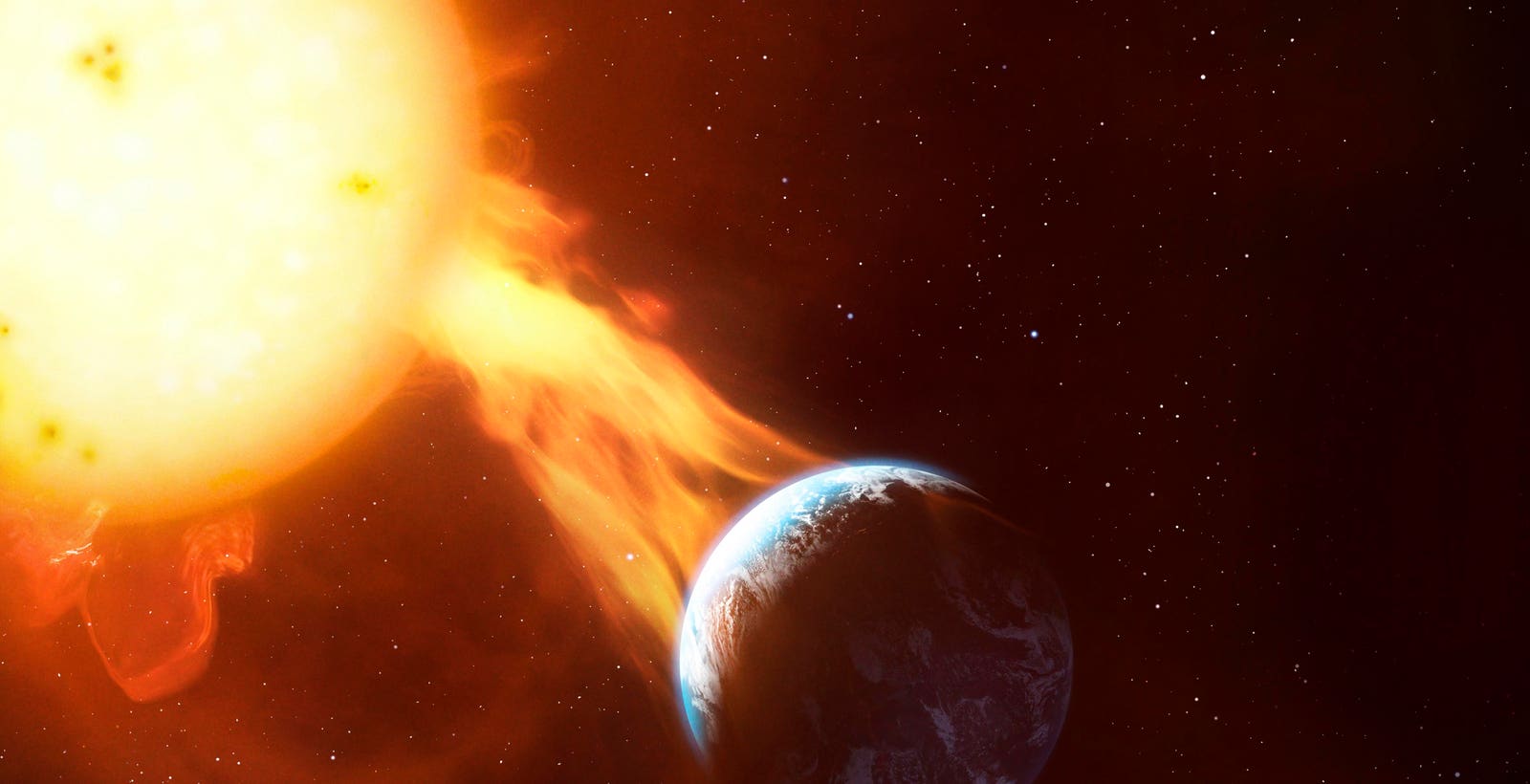
    Illustration of a solar storm impacting the Earth.

    getty

    Scientists have discovered a massive spike in radiocarbon levels 14,350 years ago by analyzing ancient tree-rings. The radiocarbon spike was caused by a solar storm — the biggest ever identified.

    In the study, Postdoctoral Researcher Kseniia Golubenko and Professor Ilya Usoskin at the University of Oulu, Finland utilized their newly developed chemistry–climate model called SOCOL:14C-Ex, specifically designed to reconstruct solar particle storms under ancient glacial climate conditions. The model confirmed that the detected solar event was approximately 18 percent stronger than the notorious AD 775 event — until now the strongest solar storm ever recorded in tree-ring archives.

    “Compared to the largest event of the modern satellite era — the 2005 particle storm — the ancient 12,350 BCE event was over 500 times more intense, according to our estimates”, explains Dr. Golubenko.

    Other large solar storms have occurred around 7,176 BCE, 5,259 BCE, 663 BCE and 994 AD. A few other events are still under investigation.

    Extreme solar storms (stars) known from isotopes, including the one of 12,350 BC (the red star in … More the upper-left corner). The strength of the events is normalized to a solar storm directly measured in 1956 (green circle in the bottom-right corner).

    Golubenko et al. 2025/Earth and Planetary Science Letters

    The new chronology used wood samples recovered from the Drouzet River in the French Alps. Here the river is cutting into ancient sediments, exposing fossil tree stumps dating back over 14,300 years ago.

    Looking at the individual tree-ring allows researchers to reconstruct environmental and chemical changes for almost every year the tree lived. By stacking sections of different trees together, scientists can reconstruct a tree-ring record spanning many thousands of years.

    Coronal mass ejections or flares are powerful outbursts of high-energy particles. When such a flare hits Earth, it can cause a solar storm. The particles coming from the sun collide with gases in Earth’s atmosphere, forming new isotopes like the radioactive beryllium-10 and carbon-14 (or radiocarbon). Trees absorb these isotope, creating an isotopic record with their tree-rings.

    “The ancient event in 12,350 BCE is the only known extreme solar particle event outside of the Holocene epoch, the past 12,000 years of stable warm climate”, says Golubenko. This discovery is not only of great importance to better understand how frequent extreme solar flares are, but also improves the use of radiocarbon to date archeological and biological samples. “Our new model lifts the existing limitation to the Holocene and extends our ability to analyze radiocarbon data even for glacial climate conditions.”

    “Miyake events (distinct spikes in past radiocarbon levels) allow us to pin down exact calendar years in floating archaeological chronologies”, adds Usoskin. Radiocarbon signals from such events have already enabled researchers to precisely date Viking settlements in Newfoundland and Neolithic communities in Greece.

    The largest observed solar storm occurred in 1859 and is known as the Carrington Event. Polar lights were observed during daylight as far as the equator. At the time, long before mobile telecommunications and the widespread use of electronic devices, damage was fortunately quite limited.The solar storm recorded in the fossil trees was an estimated ten to hundred times more powerful.

    Today the National Oceanic and Atmospheric Administration’s Space Weather Prediction Center monitors solar activity and its impact on our infrastructure. Electronics with no electromagnetic shielding are still at a high risk of interference and jamming. A similar massive event happening today could be catastrophic for our technology-based society.

    The study,“New SOCOL:14C-Ex model reveals that the Late-Glacial radiocarbon spike in 12350 BC was caused by the record-strong extreme solar storm,” was published in the journal Earth and Planetary Science Letters.

    Additional material and interviews provided by the University of Oslo.

    Earth Extreme Hit solar Storm years
    Share. Facebook Twitter Pinterest LinkedIn Tumblr Email
    Previous Article6 Tasks I Automate Every Month to Avoid Burnout
    Next Article Aqara Camera Hub G5 Pro review: security camera for Apple Home
    Techurz
    • Website

    Related Posts

    Opinion

    General Catalyst commits $5B to India over five years

    February 20, 2026
    Opinion

    As AI data centers hit power limits, Peak XV backs Indian startup C2i to fix the bottleneck

    February 16, 2026
    Opinion

    Harvey reportedly raising at $11B valuation just months after it hit $8B

    February 9, 2026
    Add A Comment
    Leave A Reply Cancel Reply

    Top Posts

    College social app Fizz expands into grocery delivery

    September 3, 20252,288 Views

    A Former Apple Luminary Sets Out to Create the Ultimate GPU Software

    September 25, 202516 Views

    The Reason Murderbot’s Tone Feels Off

    May 14, 202512 Views
    Stay In Touch
    • Facebook
    • YouTube
    • TikTok
    • WhatsApp
    • Twitter
    • Instagram
    Latest Reviews

    Subscribe to Updates

    Get the latest tech news from FooBar about tech, design and biz.

    Most Popular

    College social app Fizz expands into grocery delivery

    September 3, 20252,288 Views

    A Former Apple Luminary Sets Out to Create the Ultimate GPU Software

    September 25, 202516 Views

    The Reason Murderbot’s Tone Feels Off

    May 14, 202512 Views
    Our Picks

    Why Garry Tan’s Claude Code setup has gotten so much love, and hate

    March 17, 2026

    Niv-AI exits stealth to wring more power performance out of GPUs

    March 17, 2026

    H&M wants to make clothing from CO2 using this startup’s tech

    March 17, 2026

    Subscribe to Updates

    Get the latest creative news from FooBar about art, design and business.

    Facebook X (Twitter) Instagram Pinterest
    • About Us
    • Contact Us
    • Privacy Policy
    • Terms and Conditions
    • Disclaimer
    © 2026 techurz. Designed by Pro.

    Type above and press Enter to search. Press Esc to cancel.