


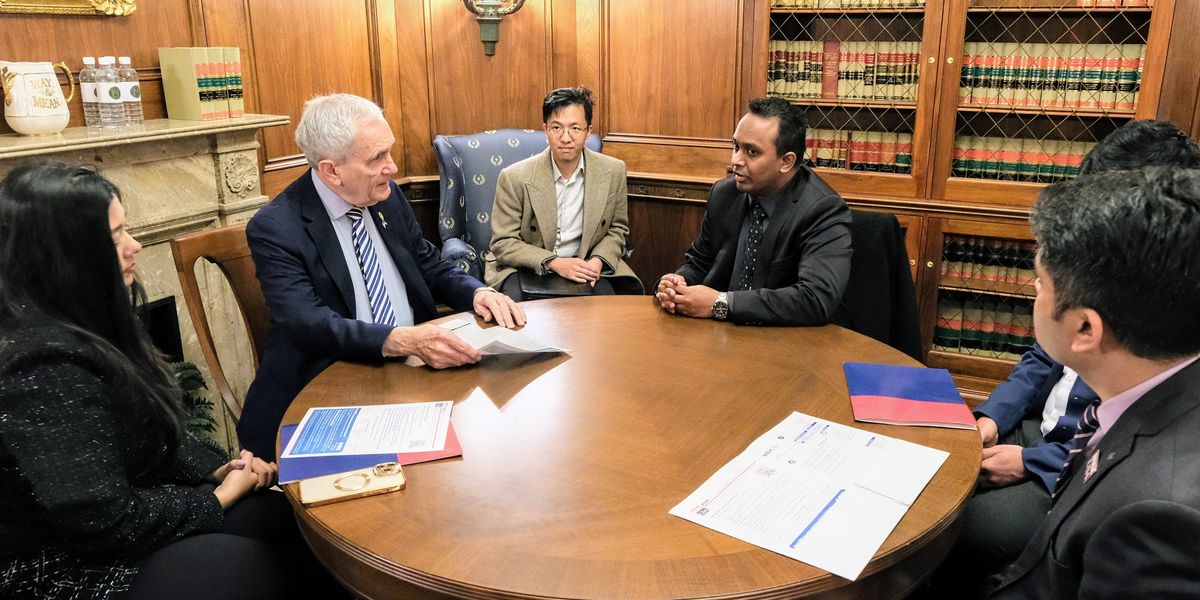
Standing in the hallowed halls of the U.S. Capitol Complex during IEEE-USA’s Congressional Visits Day on 9 April, representing the collective voice of 150,000 dedicated U.S. members, was an experience that resonated with me.
A daylong event, CVD 2025 drew an impressive turnout of 329 participants from 39 states, culminating in 240 impactful meetings with U.S. legislators and their staff. As part of the Texas team, I participated in four crucial discussions.
The event was pivotal, with the potential to help shape the future of innovation and technology in the United States. Engaging directly with lawmakers, along with esteemed IEEE leaders and members who are experts in their fields, brought critical issues impacting our field into sharp focus. I left with a renewed sense of urgency and purpose.
Funding federal scientific institutions
One of the most compelling aspects of our discussions underscored the vital role of sustained funding under the fiscal year 2026 appropriations budget through strategic investments in key federal research institutions such as the Energy Department’s Office of Science, the Defense Department’s Basic and Applied Research, NASA, the National Institute of Standards and Technology, and the National Science Foundation (NSF).
Having witnessed the groundbreaking technology and innovation-driven work emanating from those institutions and the fundamental discoveries that often seed transformative technologies, it’s clear to me that consistent investment would be not just beneficial but also essential for maintaining the country’s scientific and technological edge.
To consider diminishing the support in the current global landscape would be a detrimental step backward.
Funding programs for small businesses
Equally crucial was advocating for the reauthorization of the Small Business Innovation Researchand Small Business Technology Transferprograms. The initiatives are more than just funding mechanisms; they are catalysts for ingenuity, empowering small businesses and supporting nimble innovators as they translate cutting-edge ideas into concrete commercial products.
The SBIR and STTR programs are administered by the U.S. Small Business Administration, and 11 federal agencies participate in them. Congress must reauthorize funding for this year. The programs support approximately 4,000 businesses to the tune of about US $4 billion annually.
Their continued vitality is paramount because small businesses foster a dynamic ecosystem wherein trickle-down benefits significantly contribute to job creation and economic growth in addition to promoting innovation.
One conversation that struck a chord with me was on democratizing AI resources through the Creating Resources for Every American to Experiment With Artificial Intelligence (CREATE AI) Act. The proposal would permanently establish the National AI Research Resource pilot program, led by the NSF in coordination with the White House Office of Science and Technology Policy in partnership with federal and private organizations. It is a cloud computing resource that leverages the Energy Department’s computational assets including the Oak Ridge National Laboratory’s Summit supercomputer.
The CREATE AI Act’s vision of shared national infrastructure for the research community could level the playing field, enabling wider participation in the technology’s innovation and ensuring its benefits reach all sectors of society. It isn’t just about technological advancement; it’s about equitable access to future-defining resources.
Academic research is a top source for cited AI research, directly benefiting industry and even contributing to life-saving drugs—which highlights a symbiotic relationship that must be nurtured.
The industry trends we discussed with politicians serve as powerful evidence for our calls to action.
“We, as engineers, scientists, and innovators, have a crucial role to play in educating and advocating for policies that will foster a thriving ecosystem of innovation.”
The exponential rise in Food and Drug Administration-approved AI-based medical devices—from six in 2015 to more than 220 in 2023—isn’t just a statistic. It represents a revolution in health care, offering the potential for more accurate diagnoses, more personalized treatments, and saved lives. Similarly, the lower hardware costs fueling broader AI adoption across diverse sectors, including autonomous driverless vehicles and supply-chain optimization, signal a profound economic transformation on the horizon.
The compelling data the IEEE participants shared from Stanford’s 2025 AI Index Report showed a staggering 280 times drop in AI model inference costs in two years, from November 2022 to October 2024. The findings paint a clear picture: AI is no longer a distant frontier but an increasingly accessible tool.
A legislative aide, after hearing that statistic, remarked on the need to plan for the energy requirements and the diversified sources that could be leveraged, including nuclear energy.
It would be a missed opportunity of significant scientific, economic, and strategic consequence if the momentum is not leveraged for the nation’s benefit.
Strengthening STEM roots
We must continue to champion strengthening the science, technology, engineering, and mathematics talent pipeline through robust funding and sustained support for the 2022 CHIPS and Science Act. The country’s ability to lead in technology hinges on the next generation of skilled professionals.
To that end, it is crucial that the United States expand the employment-based immigrant visa program for highly skilled, qualified individuals to ensure a sustained supply of talent required for industry and academia through legislation such as the Keep STEM Talent Act. My own experiences, including my engagement with Northwestern University and its STEM master of engineering management program advisory board, have underscored the critical link between academia and industry.
Witnessing the bipartisan engagement and the genuine interest from lawmakers and their staff last month, including influential figures serving on key congressional committees, was inspiring. It underscored that the importance of technological innovation transcends political divides. The engagement must translate into concrete action in Congress and by the administration.
My experience on Capitol Hill was more than just a privilege; it was a stark reminder of our collective responsibility.
The future of U.S. technological leadership is not a passive outcome. It demands active engagement between multiple stakeholders and unwavering support from our policymakers.
We, as engineers, scientists, and innovators, have a crucial role to play in educating and advocating for policies that will foster a thriving ecosystem of innovation.
The time for congressional intervention is now. We cannot afford to be complacent. The global landscape is rapidly evolving, and maintaining U.S. leadership in technology depends on strategic investments and forward-thinking policies.
For U.S. lawmakers, the importance of current technological changes serves as a call to action. The elected officials have a responsibility to ensure the United States remains at the forefront of technological advancement for generations to come.
My experience last month on Capitol Hill reinforced the power of our collective voice, and I am grateful to IEEE-USA for the esteemed opportunity to participate.
From Your Site Articles
Related Articles Around the Web
