


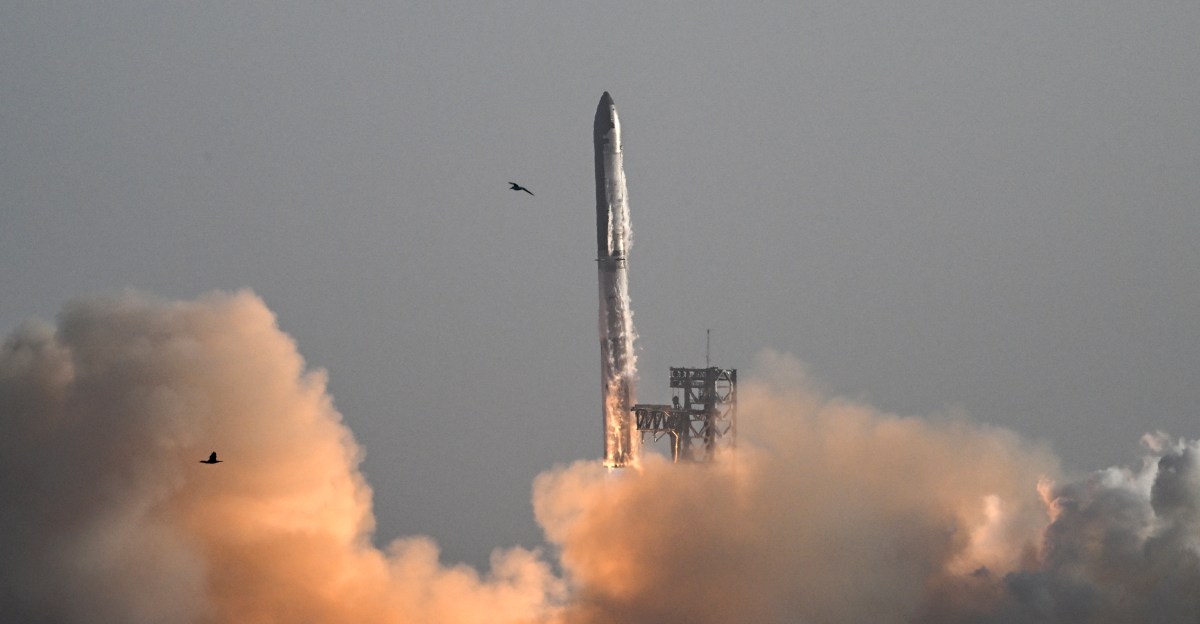
With yet another failed Starship test this week, in which the ambitious heavy rocket exploded once again, you might reasonably suspect that luck has finally run out for SpaceX.
But this degree of failure during a development process isn’t actually unusual, according to Wendy Whitman Cobb, a space policy expert with the School of Advanced Air and Space Studies, especially when you’re testing new space technology as complex as a large rocket. However, the Starship tests are meaningfully different from the slow, steady pace of development that we’ve come to expect from the space sector.
“The reason a lot of people perceive this to be unusual is that this is not the typical way that we have historically tested rockets,” Whitman Cobb says.
Historically speaking, space agencies like NASA or legacy aerospace companies like United Launch Alliance (ULA) have taken their time with rocket development and have not tested until they were confident in a successful outcome. That’s still the case today with major NASA projects like the development of the Space Launch System (SLS), which has now dragged on for over a decade. “They will take as long as they need to to make sure that the rocket is going to work and that a launch is going to be successful,” Whitman Cobb says.
“This is not the typical way that we have historically tested rockets.”
SpaceX has chosen a different path, in which it tests, fails, and iterates frequently. That process has been at the heart of its success, allowing the company to make developments like the reusable Falcon 9 rocket at a rapid pace. However, it also means frequent and very public failures, which have generated complaints about environmental damage in the local area around the launch site and have caused the company to butt heads with regulatory agencies. There are also significant concerns about the political ties of CEO Elon Musk to the Trump administration and his undemocratic influence over federal regulation of SpaceX’s work.
Even within the context of SpaceX’s move-fast-and-break-things approach, though, the development of the Starship has appeared chaotic. Compared to the development of the Falcon 9 rocket, which had plenty of failures but a generally clear forward path from failing often to failing less and less as time went on, Starship has a much more spotty record.
Previous development was more incremental, first demonstrating that the rocket was sound before moving onto more complex issues like reusability of the booster or first stage. The company didn’t even attempt to save the booster of a Falcon 9 and reuse it until several years into testing.
Starship isn’t like that. “They are trying to do everything at once with Starship,” Whitman Cobb says, as the company is trying to debut an entirely new rocket with new engines and make it reusable all at once. “It really is a very difficult engineering challenge.”
“They are trying to do everything at once with Starship.”
The Raptor engines that power the Starship are a particularly tough engineering nut to crack, as there are a lot of them — 33 per Starship, all clustered together — and they need to be able to perform the tricky feat of reigniting in space. The relighting of engines has been successful on some of the previous Starship test flights, but it has also been a point of failure.
Why, then, is SpaceX pushing for so much, so fast? It’s because Musk is laser-focused on getting to Mars. And while it would theoretically be possible to send a mission to Mars using existing rockets like the Falcon 9, the sheer volume of equipment, supplies, and people needed for a Mars mission has a very large mass. To make Mars missions even remotely affordable, you need to be able to move a lot of mass in one launch — hence the need for a much larger rocket like the Starship or NASA’s SLS.
NASA has previously been hedging its bets by developing its own heavy launch rocket as well as supporting the development of Starship. But with recent funding cuts, it’s looking more and more likely that the SLS will get axed — leaving SpaceX as the only player in town to facilitate NASA’s Mars plans.
But there’s still an awful lot of work to do to get Starship to a place where serious plans for crewed missions can even be made.
“There’s no way that they’re putting people on that right now.”
Will a Starship test to Mars happen by 2026, with a crewed test to follow as soon as 2028, as Musk said this week he’s aiming for? “I think it’s completely delusional,” Whitman Cobb says, pointing out that SpaceX has not appeared to be seriously considering issues like adding life support to the Starship or making concrete plans for Mars habitats, launch and landing pads, or infrastructure.
“I don’t see SpaceX as putting its money where its mouth is,” Whitman Cobb says. “If they do make the launch window next year, it’s going to be uncrewed. There’s no way that they’re putting people on that right now. And I seriously doubt whether they will make it.”
That doesn’t mean Starship will never make it to Mars, of course. “I believe SpaceX will engineer their way out of it. I believe their engineering is good enough that they will make Starship work,” Whitman Cobb says. But getting an uncrewed rocket to Mars within the next decade is a lot more realistic than next year.
Putting people on the rocket, though, is another matter entirely. “If they’re looking to build a large-scale human settlement? That’s decades,” Whitman Cobb says. “I don’t know that I will live to see that.”
