


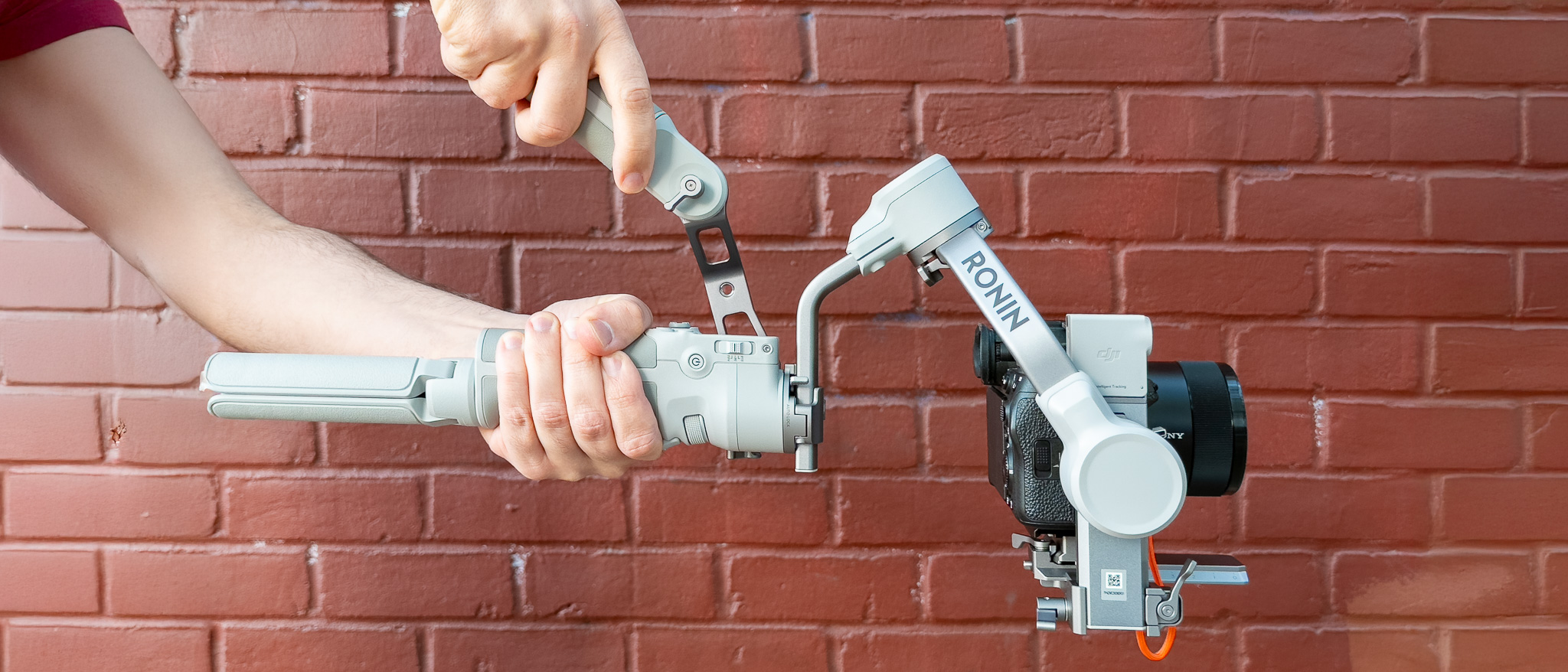
I’ve been using gimbals professionally since 2016 — everything from weddings to commercials to YouTube shoots. I’m always looking for gear that saves time, packs light, and still delivers smooth, reliable results. The DJI RS 4 Mini is the latest piece of kit to catch my attention.
It hits a sweet spot: compact enough for travel but somehow still able to handle many of the best mirrorless cameras, including my heavier Sony A7SIII with a Sigma 24–70mm zoom lens — though it’s definitely pushing the upper limit.
An evolution of the RS 3 Mini, the RS 4 Mini doesn’t just shrink down DJI’s flagship RS 4 — it borrows key features that actually matter in the field. You’re getting upgraded axis locks that automatically engage and disengage when powering the gimbal on or off, physical switches for changing modes, and a redesigned camera plate system that makes horizontal and vertical switching a lot less painful.
You may like
It officially supports both mirrorless cameras and smartphones (with an optional phone mount), and if you pair it with the new Intelligent Tracking Module, you unlock face-tracking — a huge win for solo shooters like myself. For the complete breakdown, read my full DJI RS 4 Mini review below.
- DJI RS4 Mini (Download) at Amazon for $363
DJI RS 4 Mini review: Cheat Sheet
What is it? The fourth iteration and latest addition to DJI’s compact mirrorless camera gimbal series
Who is it for? For solo creators, run-and-gun shooters, and hybrid content pros who want pro-grade stabilization in a compact, travel-friendly package
How much does it cost? The DJI RS 4 Mini starts for $369/ £339
What do we like? The smarter ActiveTrack module, fast setup with auto-locking axes, and solid battery life
What don’t we like? The non-standard mounting plate, non-removable battery, and limited headroom for larger full-frame rigs
DJI RS 4 Mini review: Specs
Swipe to scroll horizontally
Specs
DJI RS 4 Mini
Weight
890g (2lbs)
Max Payload
2kg (4.4lbs)
Axis Locks
2nd-Gen Automated
Axis Arm Material
Teflon Aluminum Alloy
Display
1.4-inch LCD Full-Color
Vertical Shooting
3rd-Gen Native Vertical Shooting
Battery
13 Hours, Non-Detachable
Subject Tracking
Available with optional RS Intelligent Tracking Module
DJI RS 4 Mini review: Price and availability
The base DJI RS 4 Mini retails for $369/ £339, while the Combo Kit — which includes the Intelligent Tracking Module and Briefcase Handle — goes for $459 / £419.
DJI also sells a Creator Combo that jumps to $478 that basically only adds a phone mount. That extra $29 feels a bit unnecessary for something that probably should’ve just been bundled in the main combo.
On the bright side, I appreciate that the new tracking module is available à la carte for $69, so you can always add it later without overcommitting upfront.
If you’re on a tighter budget or don’t need the latest features, last year’s RS 3 Mini is a really solid option too. You miss out on the big updates, like automatic axis locks, faster vertical shooting, and support for the new tracking module — not to mention three fewer hours of battery life.
However, the older model still delivers comparable stabilization, weighs slightly less, and supports the same max payload. And with prices dipping as low as $237, it’s a compelling alternative if you don’t need the latest bells and whistles.
DJI RS 4 Mini review: Setup and Balancing
(Image credit: Future)
Setup still starts with balancing the axes, but thanks to the DJI RS 4 Mini’s upgraded Teflon-coated arms, the brackets now glide more smoothly — even with a heavier camera rig already mounted.
There’s also a new fine-tuning knob for adjusting the camera’s forward/backward position on the gimbal arm. Dialling in those micro-adjustments feels less like a chore, which is great when you’re swapping lenses mid-shoot.
(Image credit: Future)
Switching to vertical shooting is also faster this time around. Instead of removing the whole camera, you just loosen and press a knob to detach and remount the plate vertically, keeping the camera in place. Clearance is definitely tight with bulkier setups, but it saves a ton of time — especially compared to older gimbals where, to me, it was usually more trouble than it was worth.
Yes, the RS 4 Mini also supports smartphones, but let’s be honest: this is way more gimbal than you need for mobile shooting. If your main camera is a phone, you’ll be much better served by something like the DJI Osmo Mobile 7P ($153), which I tested a few months ago over on our YouTube channel.
It’s lighter, smaller, and purpose-built for phones. The RS 4 Mini, by comparison, is going to feel bulky and excessive unless you’re regularly switching between a phone and a more serious camera rig.
Image 1 of 4
(Image credit: Future)(Image credit: Future)(Image credit: Future)(Image credit: Future)
Now, here’s the catch: the RS4’s redesigned mounting system now uses a non-standard quick-release plate, and I’m not a fan. I realized pretty quickly that it’s not compatible with Arca-Swiss gear — including the SmallRig cage on my Sony A7SIII.
So instead of just sliding the camera cage on without the quick release plate like I easily can with my DJI RS 3 and RS 2 Pro, I now had to install DJI’s new plate. The plate size difference is minimal — we’re talking millimeters — so I have no idea why DJI made this change. It feels like an unnecessary limitation on what’s otherwise a really smart upgrade.
Image 1 of 3
(Image credit: Tom’s Guide / Paul Antill)(Image credit: Tom’s Guide / Paul Antill)(Image credit: Tom’s Guide / Paul Antill)
As for other design changes, the new physical switch for changing the gimbal’s modes is a nice upgrade. Instead of tapping through menus, you can quickly toggle between Pan Follow (PF), Pan and Tilt Follow (PTF), and FPV with a flick of your thumb. It’s faster, more reliable and much easier to do mid-shoot without needing to fiddle with the screen.
DJI RS 4 Mini review: Max Payload
(Image credit: Tom’s Guide / Paul Antill)
Don’t let the compact frame fool you — the DJI RS 4 Mini is deceptively strong. Like its predecessor, it supports a maximum payload of 4.4lbs. That’s a solid figure for a gimbal this size, even if it doesn’t quite stack up to the 6.6lbs of the full-sized RS 4 or the beastly 10lbs of the RS 4 Pro.
My main rig — the Sony a7S III, Sigma 24–70mm F2.8, and a SmallRig cage — weighs in at around 3.85lbs. Still under the RS 4 Mini’s max payload, but in order to balance it all, I’m usually pushing the axes right to their limits — especially the tilt and roll arms — to make it all fit.
The gimbal still performs well, but I can definitely notice the motors working harder, compared to my much smaller APS-C Sony a6600 setup. That’s why max payload ratings don’t tell the whole story. It’s not just about whether a gimbal can hold your rig; it’s about how comfortably it does so.
Having more headroom means your setup handles motion better — whether that’s running, quick panning, or just slightly lazy balancing (we’ve all done it). The RS 4 Mini holds up well for its size, but if you’re pushing it close to the limit with full-frame glass and accessories, expect tighter tolerances and less room for error.
DJI RS 4 Mini review: Optional tracking module is a big deal
(Image credit: Tom’s Guide / Paul Antill)
One of the most exciting additions to the DJI RS 4 Mini ecosystem is the new Intelligent Tracking Module, which magnetically attaches to the top of the mounting arm.
One of the most exciting additions to the DJI RS 4 Mini ecosystem is the new Intelligent Tracking Module, which magnetically attaches to the top of the mounting arm. It uses onboard AI to recognize and track faces, activating the gimbal’s motors to follow the subject automatically.
t features its own camera sensor and uses onboard AI to recognize and track faces, activating the gimbal’s motors to follow the subject automatically. This allows the RS 4 Mini to follow people hands-free — up to 10 meters away — even without needing to connect to the DJI Mimo app which I love.
It’s genuinely impressive how well it works. I was able to walk around, perform actions, and the gimbal kept me centered in frame. For solo creators, this is a huge deal. With the RS 4 Mini mounted, you can move around freely and the gimbal will pan smoothly to follow you, making it perfect for talking head videos or dynamic B-roll where you don’t want to be stuck behind the camera.
It also supports gesture controls — you can initiate tracking or start recording just by holding up your hand with the right signal. When ActiveTrack is enabled, the module’s ring light turns from red to green to confirm it’s locked on.
Image 1 of 3
(Image credit: Future)(Image credit: Future)(Image credit: Future)
Compared to DJI’s RavenEye video transmission module, which I’ve been using for years, the new Tracking Module has some key pros and cons. It relies on its own built-in camera, making it far faster to set up and doesn’t require any HDMI connections or camera pairing — just mount it, power on, and it’s ready to track.
At the time of writing, it can only track people, not other subjects like cars or objects. With my RavenEye and the DJI Ronin app, I can manually draw a box around any subject in my camera’s video feed and the gimbal will try to keep it in frame — something I often use for capturing smooth product B-roll in my studio.
But for quick, on-the-go shoots, weddings, or commercial work where I need reliable subject tracking without setup headaches, the Tracking Module is incredibly convenient. And at $69 (or bundled with the Combo Kit), it’s a no-brainer add-on if you want to get the most out of the new RS4 Mini.
DJI RS 4 Mini review: Battery Life
(Image credit: Future)
Battery life also gets a small but welcome upgrade this year. The RS 4 Mini packs a 3,100mAh battery, which DJI claims can last up to 13 hours — up from 10 hours on the RS 3 Mini.
That figure is based on the gimbal being stationary, though, which isn’t exactly realistic for most shoots. In my own testing, I averaged closer to half of that with regular use, but that’s still a step up from the last model.
What’s more helpful is the faster recharge time: DJI shaved about an hour off, bringing the full charge time down to 1.5 hours. That might not sound like much, but when you’re bouncing between shoots, every bit of downtime saved counts.
What hasn’t changed, though, is that the battery still isn’t removable. I’ve never had battery issues with my DJI RS2 Pro — which still runs great years later — but I’ve also come to really value its swappable battery design. Not only does it give you peace of mind in case something goes wrong, it also makes long days easier.
If you don’t want to tether the gimbal to a power bank mid-shoot — something I don’t personally mind, but I know others do — having a spare battery can be a real lifesaver.
Plus, removable batteries make the gimbal easier to pack. When I’m cramming gear into a tight bag or suitcase, every little space-saving trick helps. And if the battery ever degrades, or the gimbal locks up and needs the classic “pull the battery and reset” trick, well… you’re out of luck here.
DJI RS4 Mini review: Verdict
The RS 4 Mini is a strong follow-up that fine-tunes what made the RS 3 Mini so appealing. It’s compact, surprisingly powerful, and packed with thoughtful upgrades — from quicker setup to longer battery life and the optional ActiveTrack module. At $369, it’s priced right for creators who want pro-level stabilization without the bulk.
If you’re already using the RS 3 Mini, the improvements are nice but not essential. But for new buyers or anyone wanting a smoother, more convenient workflow, the RS 4 Mini is the better pick.
There are trade-offs — the proprietary mounting plate isn’t ideal, and it’s not exactly built for beefy camera rigs. But if you’re in that sweet spot of needing something portable that still punches above its weight, this is one of DJI’s best-balanced gimbals to date.
DJI RS4 Mini: Price Comparison
