

Close Menu
TechurzTechurz
    What's Hot

    Asian AI startups launch Mythos-like models as Anthropic’s export ban drags on

    June 27, 2026

    Corgi, the buzzy Y Combinator-backed insurance tech startup, says it didn’t steal an open source product

    June 26, 2026

    OpenAI poaches Uber India chief to lead its biggest market outside the US

    June 26, 2026
    X (Twitter) Pinterest YouTube LinkedIn WhatsApp
    Tech Pulse
    • Asian AI startups launch Mythos-like models as Anthropic’s export ban drags on
    • Corgi, the buzzy Y Combinator-backed insurance tech startup, says it didn’t steal an open source product
    • OpenAI poaches Uber India chief to lead its biggest market outside the US
    • Early Bird pricing ends tonight for Founder Summit
    • Robotaxis drive miles just to get cleaned and charged; this new startup wants to fix that
    X (Twitter) Pinterest YouTube LinkedIn WhatsApp
    TechurzTechurz
    • Home
    • Tech Pulse
    • Future Tech
    • AI Systems
    • Cyber Reality
    • Disruption Lab
    • Signals
    TechurzTechurz
    Home - AI - Inside the race to find GPS alternatives
    AI

    Inside the race to find GPS alternatives

    TechurzBy TechurzJune 6, 2025Updated:May 10, 2026No Comments3 Mins Read
    Share Facebook Twitter Pinterest LinkedIn Tumblr Reddit Telegram Email
    Inside the race to find GPS alternatives
    Share
    Facebook Twitter LinkedIn Pinterest Email

    “Just because of this shorter distance, we will put down signals that will be approximately a hundred times stronger than the GPS signal,” says Tyler Reid, chief technology officer and cofounder of Xona. “That means the reach of jammers will be much smaller against our system, but we will also be able to reach deeper into indoor locations, penetrating through multiple walls.”

    A satnav system for the 21st century

    The first GPS system went live in 1993. In the decades since, it has become one of the foundational technologies that the world depends on. The precise positioning, navigation, and timing (PNT) signals beamed by its  satellites underpin much more than Google Maps in your phone. They guide drill heads at offshore oil rigs, time-stamp financial transactions, and help sync power grids all over the world.

    But despite the system’s indispensable nature, the GPS signal is easily suppressed or disrupted by everything from space weather to 5G cell towers to phone-size jammers worth a few tens of dollars. The problem has been whispered about among experts for years, but it has really come to the fore in the last three years, since Russia invaded Ukraine. The boom in drone warfare that came to characterize that war also triggered a race to develop technology for thwarting drone attacks by jamming the GPS signals they need to navigate—or spoofing the signal, creating convincing but fake positioning data. 

    The crucial problem is one of distance: The GPS constellation, which consists of 24 satellites plus a handful of spares, orbits 12,550 miles (20,200 kilometers) above Earth, in a region known as medium Earth orbit. By the time their signals get all the way down to ground-based receivers, they are so faint that they can easily be overridden by jammers.

    Other existing Global Navigation Satellite System constellations, such as Europe’s Galileo, Russia’s GLONASS, and China’s Beidou, have similar architectures and experience the same problems.

    But when Reid and cofounder Brian Manning founded Xona Space Systems in 2019, they didn’t think about jamming and spoofing. Their goal was to make autonomous driving ready for prime time. 

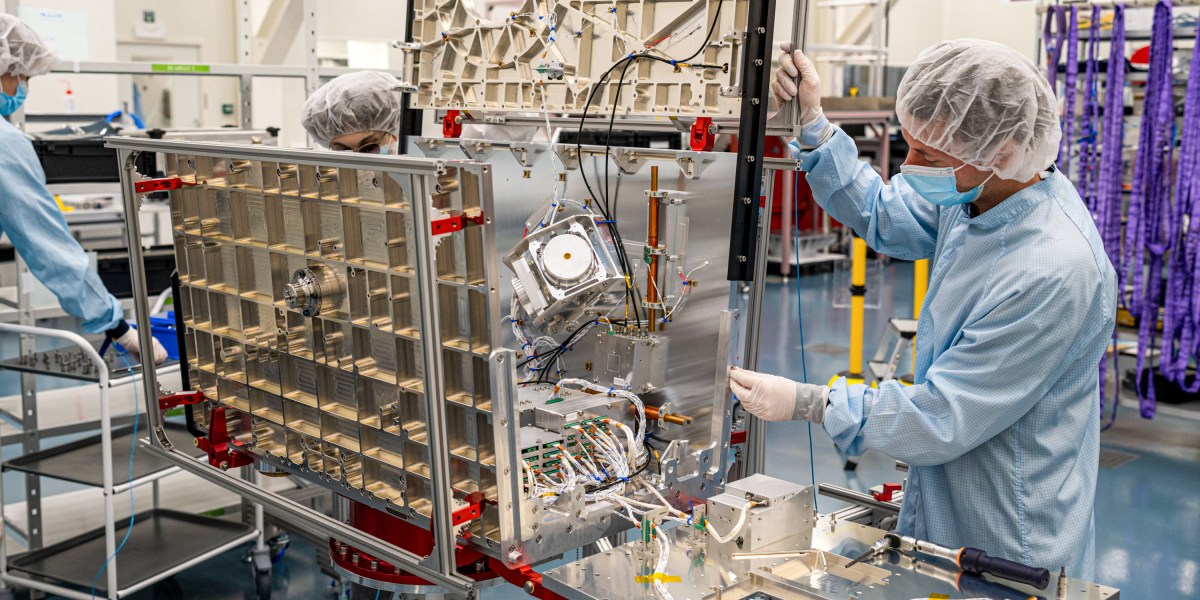
    Xona Space System’s completed Pulsar-0 satellite is launching this June.

    AEROSPACELAB

    Dozens of robocars from Uber and Waymo were already cruising American freeways at that time, equipped with expensive suites of sensors like high-resolution cameras and lidar. The engineers figured a more precise satellite navigation system could reduce the need for those sensors, making it possible to create a safe autonomous vehicle affordable enough to go mainstream. One day, cars might even be able to share their positioning data with one another, Reid says. But they knew that GPS was nowhere near accurate enough to keep self-driving cars within the lane lines and away from other objects on the road. That is especially true in densely built-up urban environments that provide many chances for signals to bounce off walls, creating errors.

    “GPS has the superpower of being a ubiquitous system that works the same anywhere in the world,” Reid says. “But it’s a system that was designed primarily to support military missions, virtually to enable them to drop five bombs in the same bowl. But this meter-level accuracy is not enough to guide machines where they need to go and share that physical space with humans safely.”

    Alternatives Find GPS race
    Share. Facebook Twitter Pinterest LinkedIn Tumblr Email
    Previous ArticleI Bought an $8,000 Point-and-Shoot Camera and Don’t Regret It. Here’s Why
    Next Article The Switch 2 is out!
    Techurz
    • Website

    Related Posts

    Opinion

    As AI companies race to go public, who else is along for the ride?

    June 14, 2026
    AI Systems

    The Future of AI Systems: 7 Architectural Shifts Driving the AI Revolution

    June 13, 2026
    Opinion

    As the browser wars heat up, here are the hottest alternatives to Chrome and Safari in 2026

    May 30, 2026
    Add A Comment
    Latest Tech Pulse

    College social app Fizz expands into grocery delivery

    September 3, 20252,290

    SolarSquare in talks to raise up to $60M as India’s rooftop solar market draws major VC interest

    May 23, 202622

    Future of Digital Privacy and Security: 7 Truths Nobody Tells You

    May 25, 202619
    Stay In Touch
    • YouTube
    • WhatsApp
    • Twitter
    • Pinterest
    • LinkedIn

    Techurz helps readers stay ahead of digital change with clear, practical, future focused technology intelligence written today,searched tomorrow.

    X (Twitter) Pinterest YouTube LinkedIn WhatsApp
    Company
    • About Us
    • Contact Us
    • Our Authors / Editorial Team
    • Write For Us
    • Advertise
    Policy
    • Editorial Policy
    • Privacy Policy
    • Terms and Conditions
    • Affiliate Disclosure
    • Cookie Policy
    • Disclaimer
    • DMCA
    Explore
    • AI Systems
    • Cyber Reality
    • Future Tech
    • Disruption Lab
    • Signals
    • Tech Pulse
    • Sitemap

    Join the Techurz Brief

    The future does not arrive suddenly.
    Stay ahead with fast, sharp tech signals.

    Type above and press Enter to search. Press Esc to cancel.