


“If Digit’s going to walk out into an aisle in front of you, you don’t want to be surprised by that,” he says. The robot could use voice commands, but audio alone is not practical for a loud industrial setting. It could be even more confusing if you have multiple robots in the same space—which one is trying to get your attention?
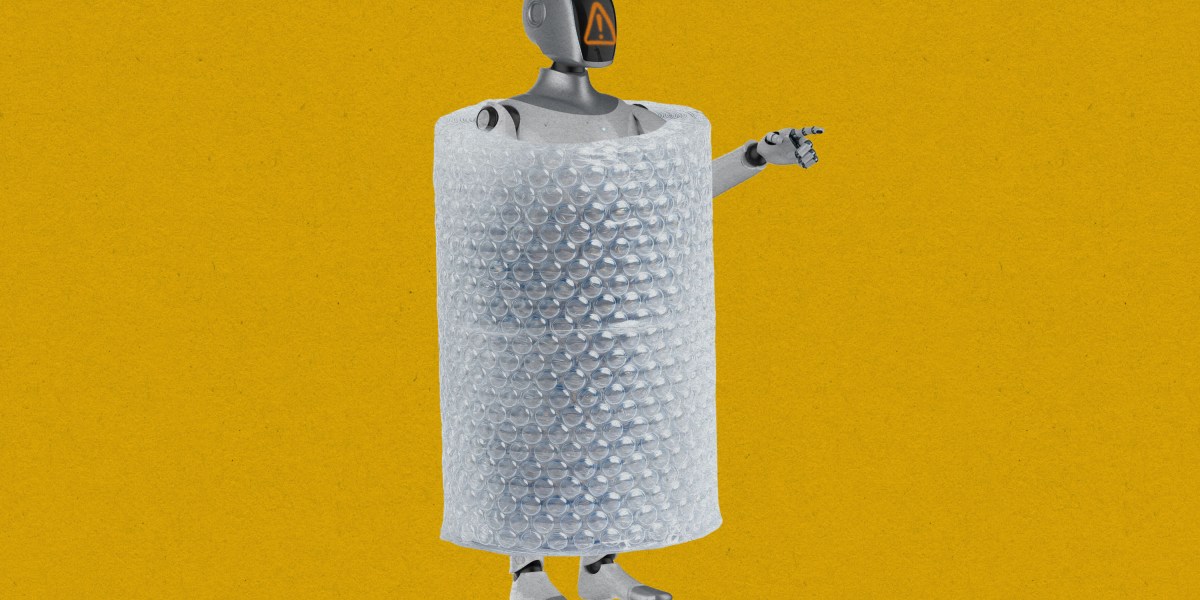
There’s also a psychological effect that differentiates humanoids from other kinds of robots, says Prather. We naturally anthropomorphize robots that look like us, which can lead us to overestimate their abilities and get frustrated if they don’t live up to those expectations. “Sometimes you let your guard down on safety, or your expectations of what that robot can do versus reality go higher,” he says. These issues are especially problematic when robots are intended to perform roles involving emotional labor or support for vulnerable people. The IEEE report recommends that any standards should include emotional safety assessments and policies that “mitigate psychological stress or alienation.”
To inform the report, Greta Hilburn, a user-centered designer at the US Defense Acquisition University, conducted surveys with a wide range of non-engineers to get a sense of their expectations around humanoid robots. People overwhelmingly wanted robots that could form facial expressions, read people’s micro-expressions, and use gestures, voice, and haptics to communicate. “They wanted everything—something that doesn’t exist,” she says.
Escaping the warehouse
Getting human-robot interaction right could be critical if humanoids are to move out of industrial spaces and into other contexts, such as hospitals, elderly care environments, or homes. It’s especially important for robots that may be working with vulnerable populations, says Hilburn. “The damage that can be done within an interaction with a robot if it’s not programmed to speak in a way to make a human feel safe, whether it be a child or an older adult, could certainly have different types of outcomes,” she says.
The IEEE group’s recommendations include enabling a human override, standardizing some visual and auditory cues, and aligning a robot’s appearance with its capabilities so as not to mislead users. If a robot looks human, Prather says, people will expect it to be able to hold a conversation and exhibit some emotional intelligence; if it can actually only do basic mechanical tasks, this could cause confusion, frustration, and a loss of trust.
“It’s kind of like self-checkout machines,” he says. “No one expects them to chat with you or help with your groceries, because they’re clearly machines. But if they looked like a friendly employee and then just repeated ‘Please scan your next item,’ people would get annoyed.”
Prather and Hilburn both emphasize the need for inclusivity and adaptability when it comes to human-robot interaction. Can a robot communicate with deaf or blind people? Will it be able to adapt to waiting slightly longer for people who may need more time to respond? Can it understand different accents?
There may also need to be some different standards for robots that operate in different environments, says Prather. A robot working in a factory alongside people trained to interact with it is one thing, but a robot designed to help in the home or interact with kids at a theme park is another proposition. With some general ground rules in place, however, the public should ultimately be able to understand what robots are doing wherever they encounter them. It’s not about being prescriptive or holding back innovation, he says, but about setting some basic guidelines so that manufacturers, regulators, and end users all know what to expect: “We’re just saying you’ve got to hit this minimum bar—and we all agree below that is bad.”
The IEEE report is intended as a call to action for standards organizations, like Vicentini’s ISO group, to start the process of defining that bar. It’s still early for humanoid robots, says Vicentini—we haven’t seen the state of the art yet—but it’s better to get some checks and balances in place so the industry can move forward with confidence. Standards help manufacturers build trust in their products and make it easier to sell them in international markets, and regulators often rely on them when coming up with their own rules. Given the diversity of players in the field, it will be difficult to create a standard everyone agrees on, Vicentini says, but “everybody equally unhappy is good enough.”
