


He’s also not the only researcher working to expose plants to higher radiation levels than previously studied. Porterfield, who is one of the scientists working on NASA’s LEAF mission—a lunar plant-growth experiment that will go to the moon with Artemis III in 2027—says we know “almost nothing” about the impact of radiation exposure beyond low Earth orbit. Understanding how variability in radiation impacts plants will be a “critical focus” of the LEAF mission.
“We’ve been trapped in lower orbit for the last 30 years and haven’t advanced a lot of the basic research that we need to go to deep space, where you find galactic cosmic radiation,” he says. “There may be some unexpected responses from this variable source of radiation. Plant responses to these radiation issues are going to be important for future agricultural systems on the moon.”
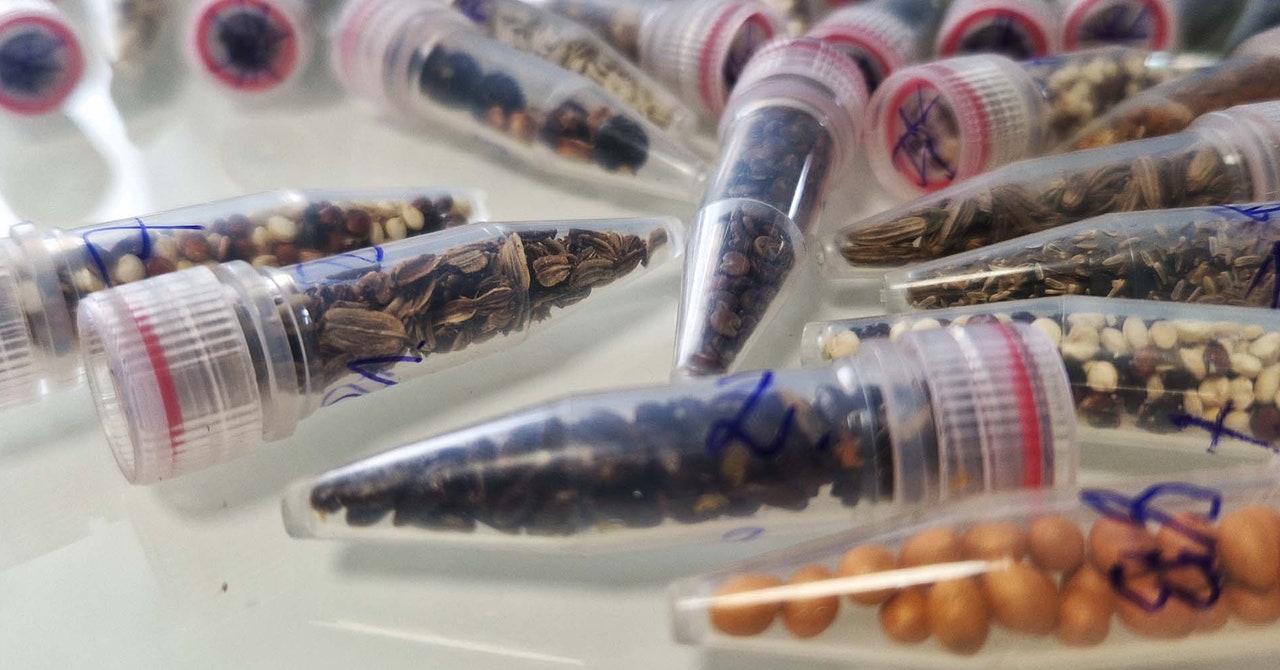
Once MayaSat-1 has returned, for the next two years Radišič and his team will work with the Faculty of Health Sciences at the University of Ljubljana in Slovenia to breed generations of clones from the space seeds to study genetic changes and plant adaptations, including “alterations in cannabinoid profiles”—how much CBD, THC, and other compounds the plants go onto develop. The second phase of their study will then involve simulating Martian soil conditions and growing plants in controlled low-gravity environments on Earth.
Lumír Ondřej Hanuš, a chemist at Palacký University Olomouc in Czechia and Hebrew University of Jerusalem, has been studying the cannabis plant since the 1970s. A research adviser on the project, he believes that there are “many possibilities” for scientific investigation once the seeds have returned.
As well as potential genetic and epigenetic changes, the Martian Grow team will look for structural and physiological changes, such as differences in leaf size, chlorophyll content, root architecture, photosynthetic rates, and water use. They will examine what happens after the plant is exposed to stressors such as disease, and analyze the activity of enzyme hormones and secondary metabolites, which could lead to the identification of new compounds.
“Whether there are changes or not, both results will be important for the future, so we know how to grow cannabis in the space environment,” Radišič adds.
We’re still some way off from actually growing cannabis on Mars, though, or any plant for that matter. Microgravity, extreme temperatures, lack of nutrients, and toxins in the soil do not make favorable conditions for cultivation.
“We will have to adapt to the environment on Mars, and slowly adapt our plants for them to survive,” says Petra Knaus, the CEO of Genoplant. “For now, we believe it will only be possible [to grow plants] in a closed system container with the conditions adapted.” For future missions, Genoplant is developing a new space capsule in this vein, scheduled for its first reentry test in 2027, that will enable researchers to grow seeds in space and monitor them for several years.
While cannabis could potentially be a supercrop for the space age, back on Earth, it is still predominantly thought of as a recreational drug (albeit one widely used for medicinal purposes), which has prevented regulators and researchers from fully acknowledging its scientific potential. Hanuš is optimistic that the findings from the project, whatever they look like, could dispel some of this stigma and speed up its scientific acceptance.
“If interesting results are published, it could speed up our understanding of cannabis,” he says. “It is a very important plant, which I think has a big future if humanity ever crosses into space and starts life on another planet.”
