


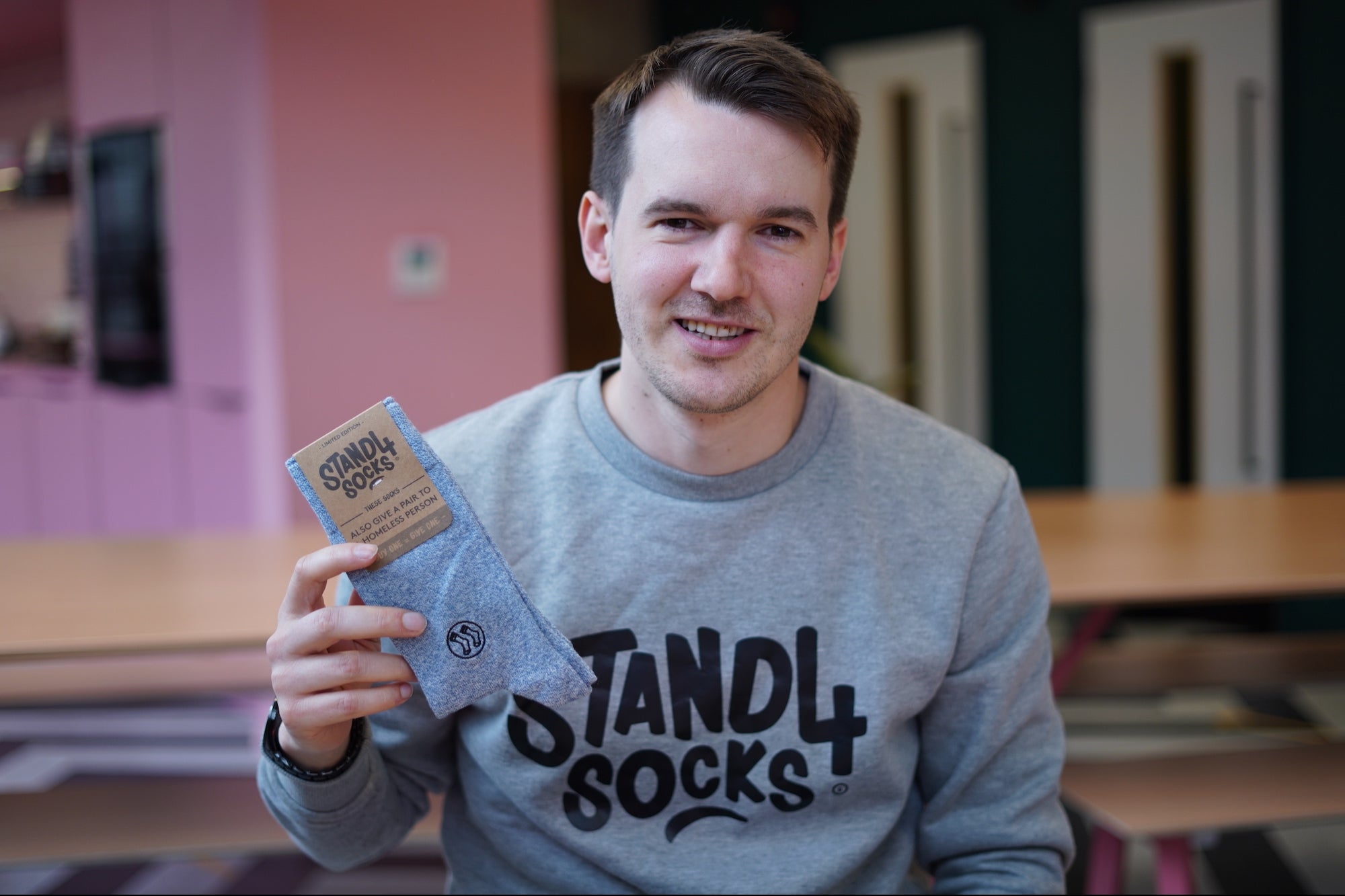
This Side Hustle Spotlight Q&A features New York City-based entrepreneur Josh Turner, 34. Turner is the founder of Stand4Socks, a sock company that, for every pair sold, donates another to someone in need. The B Corporation has distributed more than 750,000 pairs across the UK, Europe, and most recently, Ukraine. Stand4Socks now sees more than $1 million in revenue a year. Responses have been edited for length and clarity.
Image Credit: Courtesy of Stand4Socks. Josh Turner.
What was your day job or primary occupation when you started your side hustle?
I’ve been entrepreneurial since the age of 8, starting little businesses throughout my early years of life. When I was still in school, I did club nights, eBay, power selling, etc., and this laid the foundation for being a lifetime entrepreneur.
Being dyslexic, I eventually had the opportunity to spend a lot of time with Richard Branson, one of the most famous British entrepreneurs who also has dyslexia, and he has been a real inspiration throughout my life.
Related: After a 12-Year-Old’s Side Hustle Made Over $4,000 in 1 Day, He and His Dad Grew the Business to Nearly $50,000 a Month: ‘It Takes Commitment’
I studied business at university, and when I started my career, I went to an entrepreneur accelerator program called NEF (New Entrepreneurs Foundation). I was placed in a big corporate job and, unfortunately, fired within six months on Christmas Eve. I never wanted to work in a big company, but as I looked for another job while on welfare benefits, I had the opportunity to launch this side project. In the UK, they give a little extra money to start a company on welfare. That was the starting point — being close to homelessness — but the extra money and time I had to pursue this when I lost my job was the launchpad.
When did you start your side hustle, and where did you find the inspiration for it?
In 2015, TOMS Shoes was huge at the time for its “buy one, give one” concept, and I saw how the mash-up of business and charity was actually an attainable and scalable concept. I liked the idea of a hybrid model of doing good as you do business, not the old school definition of “make money, then give to charity.” Rubber wristbands like Livestrong were also popular at the time, raising money, showing support and spreading awareness. However, at the end of the day, they were just rubber wristbands, and I figured there had to be a more meaningful and sustainable way to wear your values. That’s when the idea clicked: Why not use colorful socks to show what we stand for?
We started in 2015 doing donations linked to the United Nations Global Goals. You wear one sock, and we plant 10 trees. Another sock supports gender equality and educates a child in Afghanistan. A third reduces child mortality; sales of the baby blue sock would help vaccinate kids against measles. One HIV and AIDS design wasn’t popular in the middle of 2016, so I started donating them to homeless shelters. I was quick (and surprised) to learn that throughout this donation process, many shelters told me no one ever donates socks — yet socks are the most requested item. Homeless people walk up to 10 miles a day, and not having fresh socks can lead to very severe foot health issues. That’s when the penny dropped. I realized we were putting so much effort into supporting causes worldwide, but we had missed something close to home: homelessness. We still do 10% of other causes (Ukraine, dyslexia, NHS socks, etc.). But now, the majority of our “buy one, give one” model supports people experiencing homelessness, which we use broadly to help refugees, people in Ukraine, children in poverty, older people and more.
Image Credit: Courtesy of Stand4Socks
What were some of the first steps you took to get your side hustle off the ground?
At the time, I was a 23-year-old millennial who saw the power of the internet and how big of a factor that could be on the success of my business. One of the first things I did was learn to code and build a website; this was before even having socks or a factory. In my mind, I thought getting socks would be easy (turns out it wasn’t) and learning to code would be one of the harder business challenges to overcome. Secondly, I couldn’t afford a graphic designer or really any external expertise. So, I took it upon myself to learn graphic design using Illustrator and how to design socks. I used YouTube to learn both things, not courses, because I couldn’t afford them.
Related: This Nashville Mom Started a Flexible Side Hustle on Facebook — Then Grew It From $1,000 to $275,000 a Month: ‘Like a Scavenger Hunt’
I saved up my welfare money to use on travel to go to big trade shows to find a factory for sock production. I went to Paris, Hong Kong and Turkey for trade shows, staying in hostels and taking cheap buses (at the time I couldn’t afford direct flights or hotels). I would speak with people on site and say, “We’re from Stand4 Socks,” and we’d receive the same reaction: They had never heard of us. They knew of the big brands, but not us, because we didn’t have a factory yet. While not surprising, it presented a challenge for 23-year-old me, as it was a bit of a chicken-and-egg situation to get a factory to believe in us. After a lot of hard work, we eventually landed a factory that believed in us, one that we still have a longstanding relationship with now. They took a chance on us when no one else did. And now the people there are like family — they even came to my wedding!
Are there any free or paid resources that have been especially helpful for you in starting and running this business?
As I mentioned earlier, YouTube was massive for us. I frequently call it my co-founder. It taught me anything I needed to learn. Being dyslexic, I learn best from visuals and at my own pace. If I got lost, I could rewind or find another video on the topic. Shopify has also been a game-changer, especially as we’ve grown. It allowed us to launch a website quickly. As we expanded, we added apps and features to compete with bigger companies, which took time but has helped us scale effectively.
If you could go back in your business journey and change one process or approach to save you time, energy or just a headache, what would it be, and how do you wish you’d done it differently?
To save time and energy, I would get a grip on our financial numbers earlier. I’ve had mentors who emphasize financial details, and my dad has an accounting background. I’ve had times when we nearly ran out of money because we donated socks before sales came in or spent too much on stock without adequate cash flow. Using the accounting software Xero has been phenomenal for our business. It allows me to see our balance sheet in seconds, compare year on year and month on month, providing real-time financial insights and comparisons. Instead of having just annual business plans and cash flow forecasts, we are now able to review our numbers on a weekly or monthly basis, empowering us to stay closely attuned to the numbers. This, in turn, has created opportunities for us to take more calculated risks, know when things are tight and change strategy when needed.
Image Credit: Courtesy of Stand4Socks
When it comes to this specific business, what is something you’ve found particularly challenging and/or surprising that people who get into this type of work should be prepared for, but likely aren’t?
We were fortunate enough to pitch on the UK’s version of Shark Tank called Dragon’s Den. One of the biggest obstacles we stumbled on was how we presented and understood our financial numbers. As someone with dyslexia, handling many different numbers under pressure was difficult, especially when we were thrown a ton of questions all at once. Since filming in 2019, we’ve grown significantly and recognized the value of having a grip on our numbers year-round as opposed to waiting until year-end. This is something we weren’t acutely aware of in the earlier stages of our business, but have grown to recognize how tremendous a difference it can make.
Related: This Former Firefighter’s ‘Hidden’ Side Hustle Turned Full-Time Business Helps Keep Homes Safe — and Saw ‘Explosive Growth’ to Over $27 Million Revenue
Can you recall a specific instance when something went very wrong? How did you fix it?
Given how unexpected the pandemic was, challenges in our business escalated quickly, despite being an online business. Our factory shut down, and our supply chain was severely disrupted. We came up with the idea of launching a special “Help for Health Heroes” sock to support frontline workers and to address the PPE gap with quality socks. We started by launching a pre-sale as a way to support frontline workers and keep our lights on, with the caveat to customers that they likely wouldn’t get the socks for three months. We sold over 30,000 pairs of socks in that period, which helped keep our business alive and support a worthy cause. It really taught us the strength of our customers and mission and showed that a little creativity can go a long way.
How long did it take you to see consistent monthly revenue? How much did the side hustle earn?
It took about five years before we had consistent monthly revenue. For the first five years, I put a majority of my time into this business, but my income came from freelance work with digital marketing consulting for brands and other big companies. I actually learned these skills from building my business, and that’s how I was able to sustain myself and the business in the early days. I worked from my mom’s shed for the first five years, which helped me keep costs low and save up to eventually move out and continue to grow the business. This time period was invaluable for learning how the business operates, enabling more rapid and sustainable growth in the subsequent five years.
What does growth and revenue look like now?
We’re now a consistently seven-figure business annually and profitable. We’ve remained bootstrapped, though, and haven’t taken any outside investment. Our focus is to prioritize sustainable growth, our bottom line and profitability. With our expansion to the U.S. market, we expect 3x growth of the whole global business, and 10x in the next five years is what we’re working towards.
What do you enjoy most about running this business?
What I enjoy most about my business is also what makes it the hardest: No one tells you what to do. On one hand, you have to figure out everything yourself. There isn’t a playbook; no one is handing you a to-do list. But on the other hand, that’s exactly what makes it so rewarding. You get to set the direction, trust your gut and follow your instincts, rightly or wrongly. When working for a large corporation, I often saw inefficient decision-making. At this stage in my career, being so junior, I had no say, even though my gut was telling me there was a better way. Running my own business gives me an opportunity to take risks and course correct in real time. Sometimes those risks lead to flops, but other times, they’ve led to great success. The sense of freedom to build something your way is what keeps me going.
Related: She Quit Her Job at Trader Joe’s After Starting a Side Hustle With $800 — Then She and Her Brother Grew the Business to $20 Million
What is your best piece of specific, actionable business advice?
Enjoy the journey. It’s going to be way harder than you think when you set out, but also way more rewarding than you’d ever expect. Don’t get overly caught up in milestones — appreciate the process.
Also, the answer is always “no” if you don’t ask the question. So many people stop themselves from reaching out because of the fear of being rejected. But if the answer is already “no” in your head, and you reach out and get a “no,” then nothing’s changed. Don’t be afraid to reach out to people because you might just get a yes.
Image Credit: Courtesy of Stand4Socks
That mindset has taken me to some wild places. One of the most surreal examples? I ended up spending a week with Sir Richard Branson on his private Necker Island. That experience didn’t come from deep connections or privilege: It came from asking bold, often unreasonable questions and walking through doors some may have felt they had no business knocking on.
Richard gave me a piece of advice that has stuck with me: “Hire people smarter than you, and then get out of their way.” It’s brilliant in theory, but when you bootstrap and are living in places like New York City, you often can’t afford to hire those people. So my approach has been to learn just the basics — whether development, sock design, marketing, etc. — and then delegate effectively. Don’t try to be an expert in everything, but have enough foundational knowledge to guide someone who is.
Want to read more stories like this? Subscribe to Money Makers, our free newsletter packed with creative side hustle ideas and successful strategies. Sign up here.
