


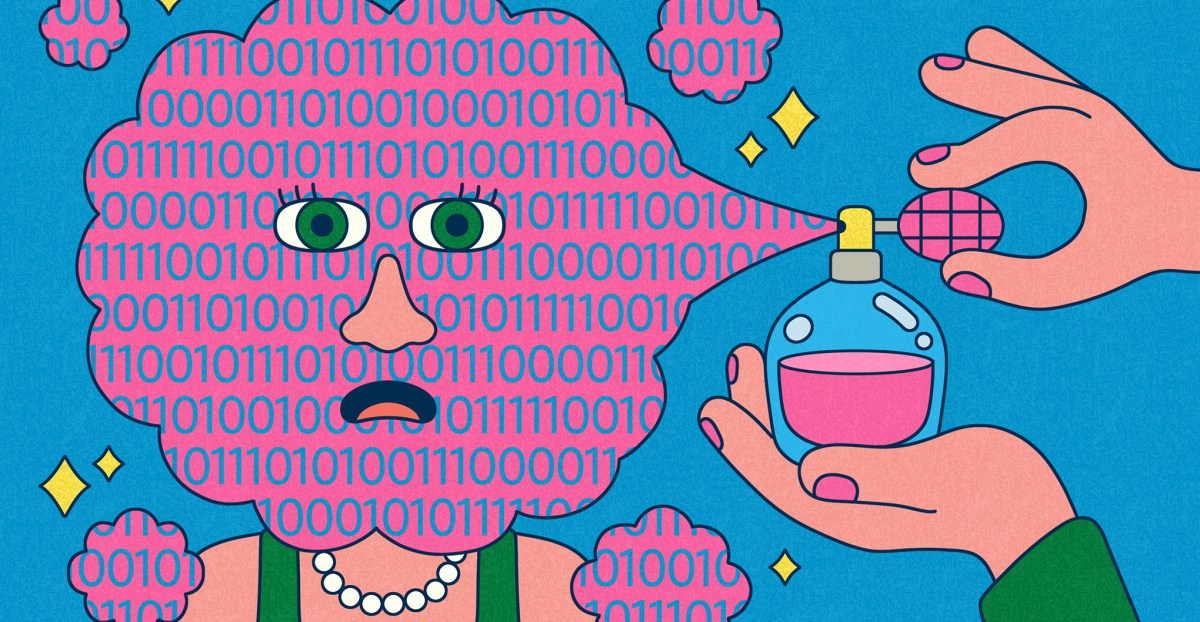
At a pristine, multimillion-dollar lab on the Manhattan waterfront, just down the street from a men’s homeless shelter and the medical examiner’s office, a slice of summer plum is being converted into fragrance code. This is the work of Osmo, a fragrance tech startup claiming to build artificial olfactory intelligence. Osmo has parlayed this innovation into offering turnkey fragrance compounding that promises a 48-hour sample turnaround from initial client prompt. In the time it takes your Amazon Prime order to arrive, you may now order a custom perfume.
Traditionally, creating a fragrance isn’t fast. After a client provides a brief — usually a mood, memory, or concept — a perfumer begins weeks or months of formulation trials, compounding and revising dozens of modifications, or “mods.” Each must settle before it can be evaluated for balance, projection, and drydown. Raw materials often need years of cultivation. Bottling, regulatory reviews, packaging, and testing follow. From concept to shelf, a single perfume can take six to 18 months — even longer in luxury. And like fine wines, fragrance materials vary with climate concerns. One year’s yield will not smell like the next one, or the one before.
Osmo built its shiny new empire, hoping to disrupt the fragrance market, on its digitization of a plum and the speed with which it can analyze and transport odor molecules. Its goal: to disrupt the fragrance market with AI-powered scent creation. I first encountered the smell of this “digitized plum” at a scent conference, handed to me by an independent perfumer like contraband. A group gathered around the blotter, whispering: it was too medicinal, too clean. “Where’s the bruising, the rot — the heat?” someone asked.
“Where’s the craftsmanship? Where’s the perfumer?”
I’ve judged hundreds of perfumes blindly for international fragrance awards and worked on machine learning systems at tech startups. I know the pull of scent well formulated — and the allure of tech’s frictionless promises. To me, the plum smelled real, if strangely large and genetically modified. I could smell it from yards away — James and the Giant Plum, rolling toward me from a Roald Dahl retelling. But the question hanging in the air was larger than a fruit: as AI enters perfumery, are we expanding access to beauty — or automating the soul out of it?
AI isn’t coming to fragrance — it’s already here, and in most things that the average consumer smells. The four fragrance conglomerates responsible for most of what the world smells — DSM-Firmenich, Givaudan, IFF, and Symrise — all integrate AI into their pipelines. Givaudan’s Carto system helps perfumers refine formulas. DSM-Firmenich’s EmotiON claims to produce scents that improve well-being. These systems are used not just in product labs but in fragrance education worldwide. The hairsprays and soaps and cleaning products and luxury fragrances that line your shelves — all of these have been touched by these four powerhouses of perfume and, so too, the AI involved in their processes. The principal perfumer at DSM-Firmenich, Frank Voelkl, who is behind the fragrances that make up so much of our current odor aura — Le Labo’s Santal 33, Glossier’s You, Tom Ford’s Tuscan Leather — uses AI on a daily basis as part of his creative process. “When I began as a perfumer, there were no emails — we were still communicating with fax machines, you know. I started by handwriting my formulas. The beauty of AI is that it manages regulatory concerns, issues around stability, phasing, performance. These tools are tremendously helpful in resolving technical issues so I can focus much more on the creative part, which requires my imagination, emotions, intuition, and the human factor. It’s like a clerk.”
Heather, a perfumer-in-training in France, tells me AI use is now standard among her peers. “Most, if not all my classmates, have used AI for every project or question. Gen Z uses it like an operating tool — older generations use it like a browser.” When Heather says Gen Z uses AI “like an operating tool,” she means they rely on it as a functional extension of the creative process — from selecting materials to refining accords. Older generations, meanwhile, still treat it as a secondary resource, like a search engine or inspiration board. For new creators, AI isn’t just assistance — it’s infrastructure, taking over essential parts of the perfumery processes.
Pierre Vouard, a professor at FIT, sees both opportunity and loss: “Compounding by hand, knowing the exact amount of each material, weighing it yourself — that’s going to disappear. But is it crucial?” He knows AI is used in his own classroom. “Perhaps this will be true democratization of fragrance because it drastically reduces the cost of creating one. But it does make you ask: Where’s the craftsmanship? Where’s the perfumer?”
“There’ve only been about 100,000 fragrances ever made. I want there to be millions.”
That question concerns perfumer Michael Nordstrand, too. “AI-based fragrance companies are circumventing professionals and targeting people who don’t know how to assess a scent beyond ‘yes or no.’ And they won’t say what datasets or formulas they’re using.” He adds that Osmo, despite repeated requests, has declined to clarify what metrics or creative works are behind its models. Osmo declined to answer these questions with specific metrics when I asked, too, stating only that it is “still currently developing the system.” While Osmo champions the work of its head perfumer, Christophe Laudamiel, it has declined to provide names of any other perfumers within its ecosystem.
In 1995, just under 400 new fragrances launched globally. In 2023, the number exceeded 3,000. Osmo’s founder, Alex Wiltschko, wants that number to grow exponentially. “There’ve only been about 100,000 fragrances ever made. I want there to be millions,” he tells me. “New tools are an important part of increasing the amount of beauty in the world.”
But growth comes at a cost — especially an environmental one. When I ask about energy use, Wiltschko says Osmo’s graph neural networks consume far less power than models like ChatGPT. “It’s vanishingly small,” he says. “We don’t need data centers. Our graph neural network model takes under an hour to train, compared to months for the world’s largest LLMs right now.” Yet he also says Osmo doesn’t track the energy consumption of its systems at all, and the company declined to share life cycle assessment tests to compare to traditional fragrance house reports.
So which is it — low enough to ignore, or too opaque to report?
The reality is: most consumers have no idea how much AI is already embedded in their beauty products, or the energy it is costing us all. And the mystery around it is growing. Some indie brands, like House of Bo, are even using deepfake AI videos to simulate founder messages to customers — without disclosing it. “I feel condescended to,” says LC James, a fragrance consultant. “It hides the labor — and the environmental cost.” Some online retailers go further still. Perfumer Teddy Haugen has had his likeness used without his consent in multiple advertisements for perfumes he wasn’t involved in. He shows me videos he never filmed, where his voice patterns were replaced with someone else’s, the words coming out of his artificially smoothed face — things he’s never spoken, for perfumes he’s never smelled. The number of unauthorized videos continues to grow.
Perfume’s origins lie far from data centers. Orris root takes years to cure before it’s ready for formulation. Sandalwood also takes years to be ready for cultivation. Natural materials must be harvested, aged, blended. AI compounding labs like Osmo can ship a custom sample within two days. That frictionless speed, while exciting, risks further detachment from the raw, physical world beauty emerges from.
Stéle, a New York City fragrance retailer, sees that tension firsthand. “We’re often being misled,” says Matt Belanger, co-owner of the stores. “Some brands say they’re perfumer-led but are really using generators to copy existing work. What we love about fragrance is that it takes time, courage, and power to decide on your journey. That’s different from pushing a button and getting something quickly.” Jake Levy, his partner in life and at Stéle, adds, “So many people work with companies that are just a robot and a receptionist. If brands were simply transparent about the usage, we’d respect it far more.” The Stéle team regularly audits the backgrounds of every brand they stock. “If we don’t take the reins and start having a conversation about the place of AI in perfumery,” warns Nordstrand, “then it’s going to get away from us … It’s like Jurassic Park. We were so busy thinking about whether we could, no one stopped to ask if we should.”
