


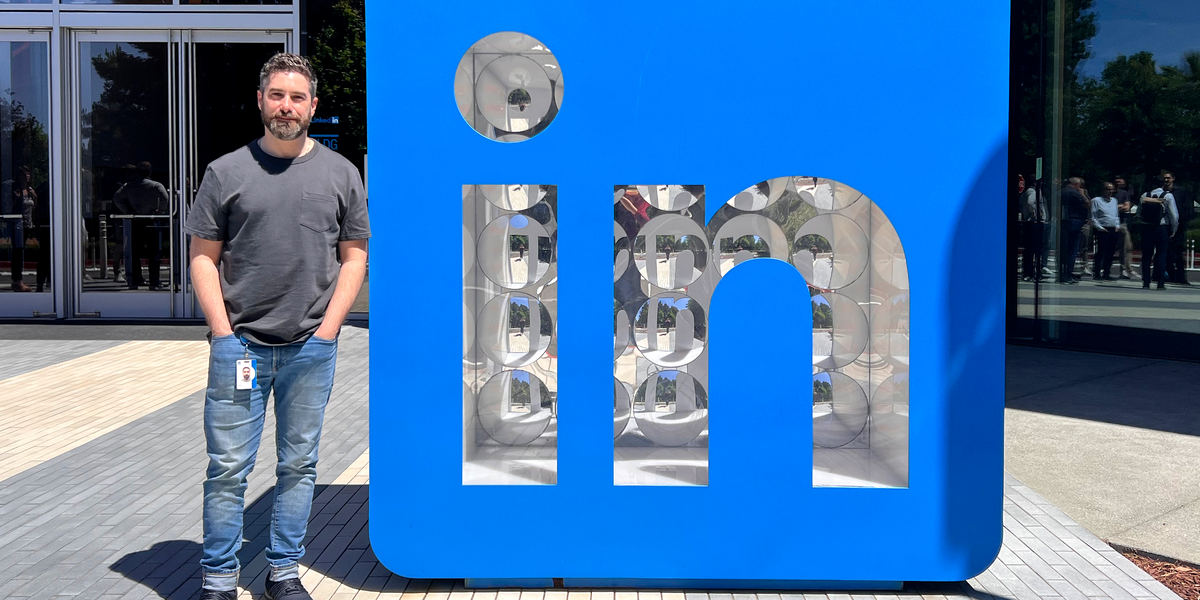
Music and engineering might seem like career paths that are almost diametrically opposed. But for Javier Orman the transition from professional violinist to a machine learning engineer at LinkedIn was a surprisingly natural one.
Growing up in Montevideo, Uruguay, Orman excelled at both music and math, and he double-majored in the subjects at college. But music was his true passion and after university he pursued a career as a professional violinist, performing, teaching, and helping to record and produce other artists.
Javier Orman
Employer:
Occupation:
Machine learning engineer
Education:
Bachelor’s degrees in music and mathematics, College of Charleston; master’s degree in music, University of Michigan
But during the turmoil of the COVID-19 pandemic, a conversation with a grad-school friend who had given up music for software development piqued his curiosity. After taking some free online courses in Python and machine learning, he quickly became immersed in a fascinating new world of data and algorithms. It didn’t take long for him to realize he wanted to make a career of it.
Machine learning algorithms were “almost like magic” to Orman. “I became enamored by the methodology, the math behind it.”
A Double Prodigy
Orman’s unusual career trajectory can be traced back to his early childhood. Both of his parents were software engineers and he grew up with computers around the house from an early age. But they were also a musical family. His mother enjoyed playing the piano, and his father the trumpet.
Orman’s path from music to machine learning shows how those with nontechnical backgrounds can succeed in software.Desmond “Des Money” Owusu/Instagram
His musical journey started at 4 years old when he saw a class of around 100 children playing violin as a group. Orman was captivated and immediately told his mother he wanted to play the violin too. By his teens he had begun touring with Uruguay’s national youth orchestra and entering music competitions. At the same time though, he had discovered a natural aptitude for math and was entering Math Olympiads. But Orman says math was essentially a hobby he did on the side while he focused on his music career.
After completing two degrees, in music and math, at the College of Charleston in South Carolina in 2006, Orman went on to a master’s degree in music at the University of Michigan. By 2009, he was playing in orchestras at Carnegie Hall in New York City and touring South America with a chamber music group.
Interested in pursuing a more creative avenue, Orman started composing music for short films and taught himself music production, eventually building a small studio where he would record and produce other artists. Over time, he built up a sustainable music career by combining this patchwork of creative projects with teaching violin.
A New Direction
In early 2020, as COVID-19 was upending the world, Orman found himself reevaluating his future and looking for new challenges. Near the start of the pandemic, he spoke to a friend from graduate school who had recently made the transition from professional violinist to software engineer. She told him about programming languages and what the career was like, and out of curiosity he decided to take an online Python course. Soon after he also began exploring the world of machine learning.
“I started taking online courses, but I also started looking for data on things that just interested me,” he says. For example, Orman created an animated heat map showing the rate of COVID-19 hospitalizations in each state. “Once I figured out how to make cool plots and investigate the data a bit more, that became actually fun to do.”
Within six months, Orman realized this was something he wanted to pursue as a career. “I noticed that I was having a hard time stopping for meal breaks or to go to sleep,” he says. “So I began to take it seriously.”
In April 2021, Orman got a job doing data preparation at New York City–based startup Koios Medical, which develops cancer-detection algorithms. But his big break came just a few months later when he discovered LinkedIn’s Reach apprenticeship program, which provides a way into the tech industry for people with nontraditional educational or career backgrounds. He applied and started as an apprentice in machine learning software engineering that July.
Learning Machine Learning
Orman was assigned to LinkedIn’s Feed AI team, which develops the recommendation algorithms that determine what posts a user is shown. There are multiple layers to this system, which gradually filters down millions of potential posts to determine those most of interest to a specific user.
In 2022, after one year in the Reach program, Orman was promoted to software engineer and now works on a model known as the “second-pass ranker,” the final layer of AI in this system. It decides what posts are most relevant to the user based on factors like their propensity to click or comment on similar kinds of posts.
Much of his work involves experimenting with new machine learning techniques or making small tweaks to the model to squeeze out extra performance. “It’s a pretty complex system,” says Orman. “It’s also a very mature system, so we measure gains in terms of tenths or hundreds of a percentage.”
But he relishes the challenge and the push to continually learn new things. That’s something he believes his background in music, which requires constant dedication and practice, has set him up well to do.
There are also profound mathematical underpinnings to music, and Orman thinks those connections have helped in his new career. “Those intersections run deep and they are hard to describe,” he says. “But they do feel like they both tickle my brain in a particular way.”
And Orman has some advice for others coming to engineering from nontechnical backgrounds: Focus on developing an intuition for how a technology works before diving into the nitty-gritty details. “Spending time understanding and just getting a feel for how things work on an intuitive level just makes everything easier,” he says. “And then you start practicing the nuts and bolts.”
One day, he hopes to marry his two major passions by working on recommendation algorithms for music. In the meantime, he’s content for them to play separate but complementary roles in his life. “I like to take breaks from my job and play Bach,” he says. “It just feels like a nice balance to go back and forth between the two.”
From Your Site Articles
Related Articles Around the Web
