


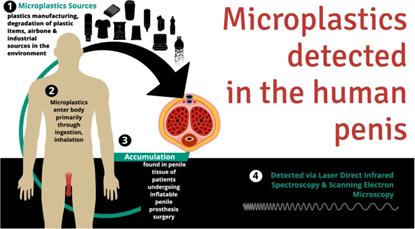
For those unaware of the extent of the problem, microplastics (MPs) are said to be in essentially every person in every part of the world. Ice samples from the poles and tissue samples from the penis show the extent of penetration. Given that these pieces of plastic have been found in placenta samples and reproductive organs, we can say that children are being subjected to plastic exposure from birth.
To what degree these nano and microplastics will hurt humans is still debated and research is ongoing, and the FDA states that they’ll take regulatory action when adverse effects are known. However, the reason that people prefer to avoid becoming plasticized is the conventional wisdom that having small pieces of plastic within our immune cells, nerve cells, and altering which genes are expressed is something we’d want to avoid. There’s certainly no known benefit.
Microplastics have ben detected basically everywhere, including the brain and penis.
International Journal of Impotence Research
Recent studies discuss the “ubiquitous” extent of microplastics and their varied effects. Kidney death, liver inflammation, oxidative stress, cellular toxicity, alterations in gene expression and changes to the DNA itself are some of the observed effects of microplastic exposure.
I will hypothesize that there’s potentially a link between nanoplastics and mental wellbeing. Not just from the obvious observation that plastics in the brain are bad, although this is true; I instead refer to the interference that our gastrointestinal microbiota are suffering with their extracellular vesicles because of microplastics. Understanding the brain-gut-microbe axis and the effect that our intestinal flora there have an impact on our neurological function, one may observe that altering this intestinal environment with nanoplastics can have an effect on mental wellbeing. If you do start depressed, try milk aromatherapy. It shows promise in rats depressed because of gut-brain issues.
The Dentist
For those of us who don’t enjoy visits to the dentist, we have reasons to be validated. Different materials are used in different dental practices, but a lot of them are plastic or packaged in plastic. By the nature of installing implants that will be subjected to the wear and tear of using one’s mouth in daily life, microplastics are created and ingested. Other procedures like polishing restorations, ceramic crowns, using elastics, orthodontic appliances, and so on can generate particles. Think about the plastic fibers on the plastic toothbrush you grind against your teeth twice a day. Should we go back to chewing spruce sap?
Remedies
Chitin is a compound found in mushrooms and the exoskeletons of crustaceans and insects. Chitosan is easily made from chitin. It’s used as a dietary supplement and sold to help consumers feel full, block fat absorption and lower cholesterol. Good for wound care as well. We ought to produce more of it and make it mainstream because we have another important reason to like it. A new study has shown that it can benefit our well-being in a novel and needed way: ridding our bodies of microplastics. The study was short but revealing, and I hope it will be reproduced with longer durations and human subjects.
The researchers share two important conclusions. For even short periods of ingestion, microplastics accrue in the digestive tract, primarily the cecum which is the pouch between the small intestine and colon. Assuming that chemicals can leach from these plastics and that the particles themselves will eventually absorb into the wider body, it’s clearly advantageous to expel this poison before it accrues/accumulates. The group of rats that was fed a diet supplemented with chitosan expelled more MPs that any of the other groups. Intriguingly and encouragingly for me, over a few days the rats released more MPs than they took in. This suggests that chitosan won’t just block absorption of current MPs, but in fact facilitate the cleansing of the colon of recently ingested microplastics. Further, after the rats were euthanized and dissected, the chitosan group had the lightest colons which suggests that they had the least total waste accumulated. As side effects for adding chitosan to one’s diet are minimal beyond some stomach upset, UNLESS YOU ARE ALLERGIC TO SHELLFISH OR MUSHROOMS, it seems like a reasonable addition. This is not medical advice and as I said, I look forward to studies done with humans for longer periods to provide us with more information. With said I’m intrigued.
Singapore. Green buildings trap microplastics, clean the air and water, and cool the city.
Asia Research News
Prevention
A better way to go than solving a problem is to prevent it. Microplastics come from plastics, and despite some laws and public initiatives, the industry is vital and won’t fade away naturally. Proactive investment in alternatives will bring about a whole society shift; personal choice is not an option here. Plastic is ubiquitous and a consumer doesn’t have a real option to move away from it. Our tap water and the air we breathe are contaminated, so we must do more than avoid microwaving food in plastic containers, or stop buying items packaged in plastic. If anyone has been to any store ever, they would know that this is impossible. Everything is wrapped in plastic. To exist in the modern world is to be a creator of waste; even the well-intentioned can do little more than be frustrated.
Green roofs are 97.5% effective in removing microplastics. They’re generally good for retaining storm water, cleaning the air and runoff, which lessens the work of wastewater treatment plants. Green roofs can contribute to an urban cooling effect, countering the Urban Head Island (UHI) problem. Singapore has been a prime example of this for years. Now, we find another reason to widely adopt the practice in every city, immediately.
Singapore exemplifies greening a city to everyone’s benefit.
Arch Daily
Great Pacific Garbage Patch
Removing what’s already been released is a net benefit. When considering the scale of the undertaking to clean the North Pacific Garbage Patch and the greenhouse gasses that will be released or the marine life that will be interfered with, it isn’t immediately clear what the best approach might be. Leaving it and hoping a reef grows on top of it could make sense, given the rubber tire reef projects we’ve all heard about. A comparative analysis of the Ocean Cleanup shows that while there will be some impact from action, the effect of doing nothing is significantly worse. Proactive action where possible to remove what’s been released before it continues to break down into microplastics and nano plastics is a viable strategy for long term environmental health. In the scenario presented, plastic pollution levels drop to below what’s considered a safe limit. Inaction has the higher cost.
Leaving plastics in the oceans will be more damaging than removal.
The Ocean Cleanup
Complex problems can’t be solved with simple solutions. Plastics can’t be completely replaced, but we can adapt the ways we use them and consider novel strategies to mitigate their harm. When these strategies prove themselves to be effective, they ought to be systematically applied.
