


This post originally appeared on Recode China AI.
When Tesla rolled out its much-anticipated pilot robotaxi service in Austin, Texas, last month—a fleet of 10 to 20 Model Y SUVs with “robotaxi” stickers and minor modifications—the tech and automotive worlds paused in awe. But thousands of miles away, executives at China’s leading autonomous driving firms didn’t flinch.
“Tesla isn’t even sitting at the [robotaxi] table yet,” Lou Tiancheng, CTO of Chinese autonomous vehicle company Pony.ai, remarked during an interview in May. Last year, Wang Yunpeng, head of the autonomous driving unit at Baidu, China’s search engine and AI giant, claimed Tesla was at least three to five years behind.
The measure of robotaxi success isn’t flashy demos or tech-day reveals—it’s large-scale, commercial, fully autonomous public service. By that standard, Tesla remains far behind. Globally, only Alphabet’s Waymo and a handful of Chinese firms have overcome this barrier.
Comparing robotaxi operations: Waymo leads in the United States; Baidu dominates in China.Recode China AI
While Waymo pioneered the robotaxi, nearly every other company providing regular public road service is Chinese. It mirrors the global electric vehicle market where, aside from Tesla, Chinese carmakers like BYD dominate the top ranks.
China’s Robotaxi Trio: Baidu, Pony.ai, WeRide
At the center of this push is Baidu, often considered the West Point of China’s autonomous vehicle (AV) industry. Its alumni populate almost the entire autonomous driving supply chain in China, from chips to software development to robotaxis.
When Baidu began self-driving research in 2013, it envisioned becoming the Android of AV—a software ecosystem provider to automakers worldwide. But China’s fiercely competitive automotive landscape quashed this ambition. Top Chinese electric automakers, such as Li Auto and XPeng, opted to develop their own advanced driver-assistance systems (ADAS), while lower-tier companies turned to telecom giant Huawei or drone maker DJI. Baidu’s own electric vehicle venture, Jidu, folded last year.
Yet despite these setbacks, Baidu’s robotaxi service, Apollo Go (known affectionately in China as “Luobo Kuaipao” or Carrot Runs Fast), is flourishing. In 2022, it became China’s first fully driverless commercial robotaxi operator—a milestone for the industry. Today, Apollo Go operates a fleet of 1,000 robotaxis across 15 cities, from Beijing to Shenzhen, providing 1.4 million rides in the first quarter of 2025 alone.
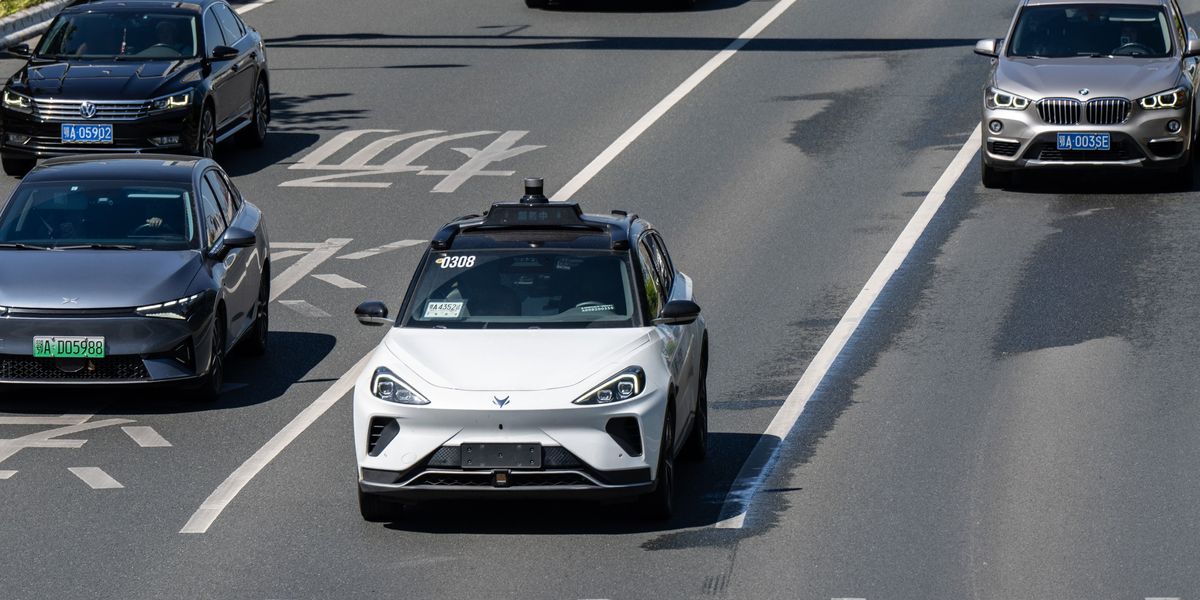
Baidu’s largest operations hub is Wuhan, a megacity in central China with more than 13 million people, strategically chosen for its supportive regulatory environment and its status as China’s automotive heartland. Baidu’s sixth-generation robotaxi is a sleek vehicle with covered steering wheels and rear sliding doors. Still, 1,000 cars are modest compared to China’s vast traditional taxi market and enormous ride-hailing fleets.
Hot on Baidu’s heels are Pony.ai and WeRide, which were founded by former Baidu executives in 2016 and 2017, respectively. Both began in Silicon Valley and moved back to Guangzhou. Both went public on NASDAQ nearly simultaneously in 2024.
With backing from Toyota, Pony.ai is aiming to produce 1,000 of its robotaxis this year.Pony.ai
Pony.ai, backed by Toyota and co-founded by ex-Baidu executive James Peng and coding prodigy Tiancheng Lou, operates 270 robotaxis. By year end, they aim to scale production to 1,000 of their seventh-generation robotaxis, co-developed with Toyota and two local Chinese automakers. Pony.ai has not disclosed its robotaxi order numbers but claims an impressive 1-to-20 ratio of remote safety operators to vehicles and says its operational footprint is roughly 20 times the size of Waymo’s service area in San Francisco.
Since its NASDAQ debut, Pony.ai has attracted significant attention, including a partnership with Uber and rumored discussions involving Uber’s controversial founder, Travis Kalanick, who was supposedly interested in acquiring the company’s U.S. operations.
WeRide, another company founded by Baidu’s veterans, overcame early turmoil when its co-founder, former Baidu executive Wang Jing, stepped down amid a lawsuit alleging trade-secret misappropriation. CTO Tony Han stepped in, steering WeRide to success with a 500-robotaxi fleet and diversified offerings including robo-buses and autonomous street sweepers. WeRide also collaborates with Bosch, the German technology giant and WeRide’s major investor, on ADAS development, though major commercial clients remain elusive.
WeRide launched the Middle East’s first robotaxi service in Abu Dhabi this year. WeRide
Now these firms are turning outward, eyeing overseas expansion in Southeast Asia, Europe, and the Middle East—racing to claim global robotaxi territory ahead of American competitors. Early this year, Baidu expanded into Dubai and Abu Dhabi after securing road‑test permits and reportedly plans to enter Singapore, Malaysia, and Switzerland. Pony.ai signed an agreement with Dubai’s transit authority, aiming for fully driverless operations by 2026 and maintains test operations in South Korea and Luxembourg. WeRide partnered with Uber for pilot operations in Abu Dhabi, becoming the Middle East’s first fully driverless robotaxi service and plans expansion into 15 more cities globally over the next five years.
Cost Advantages and Complex Roads
Technologically, Chinese robotaxi firms have largely used Waymo’s playbook in hardware—combining lidar, radar, cameras, precision GPS, and high-definition maps. Their advantage is cost. Thanks to China’s manufacturing prowess, these companies could quickly scale fleets when ready. For example, Baidu brought robotaxi production costs down to just US $28,000 per vehicle—a fraction of Waymo’s hundreds-of-thousands-per-vehicle expense, on par with Tesla’s forthcoming CyberCab. Pony.ai, meanwhile, boasted a 68 percent drop in lidar costs and an 80 percent reduction in computing costs with the launch of its seventh-generation robotaxi.
Tesla launched its robotaxi service in Austin, Texas, with a handful of vehicles in limited areas of the city. Tim Goessman/Bloomberg/Getty Images
Their software is a combination of AI models and rule-based code, designed to interpret traffic patterns, predict behaviors, and execute driving decisions. All three Chinese robotaxi firms now boast “end-to-end” systems—a term popularized by Tesla that refers to AI models capable of processing raw sensor data and directly outputting driving actions.
Unlike Waymo’s early suburban testing in Phoenix, Chinese robotaxis are trained in the dense, chaotic streets of Beijing and Guangzhou, where roads are often packed with motorbikes, bicycles, and street vendors. The ability to operate in such conditions could arguably make their systems more adaptable.
Regulatory Hurdles and Chip Reliance
Yet challenges persist, mostly regulatory hurdles. Neither China nor the United States has enacted nationwide laws governing robotaxis, leaving the regulation to states and cities. As a result, the industry operates under a fragmented patchwork of local-level policies, with each jurisdiction setting its own rules and requirements.
Unlike some U.S. states, which are quicker with permits but stringent on ongoing safety monitoring, Chinese cities initially demand rigorous testing before granting permits.
Almost all Chinese cities that allow robotaxis only permit their operation within geofenced zones, often in suburban districts away from dense downtown areas. In contrast, Waymo’s service is allowed to cover large parts of San Francisco, including downtown.
Interestingly, Chinese AV companies have leveraged Waymo’s progress to spur government support at home. When Waymo’s ride volume surged last year, Chinese firms intensified their lobbying efforts, urging regulators for more expansive operating permissions.
Waymo operates more than 1,500 robotaxis in the metropolitan areas of four U.S. cities.Craig F. Walker/The Boston Globe/Getty Images
Social issues also loom large. Apollo Go’s expansion in Wuhan last year sparked protests from local taxi drivers who feared for their livelihoods. In response, the Wuhan Transportation Bureau clarified that Apollo Go operates only 400 robotaxis in the city. Baidu CEO Robin Li acknowledged the concerns, emphasizing that scaling robotaxi operations will be a gradual process that may take many years.
Profitability is another challenge for all robotaxi firms. Despite growing ride volumes and improving hardware economics, none of the players have yet reached break-even. Most services remain heavily subsidized, especially during pilot phases. Pony.ai has set the goal of turning profitable by 2029.
Another strategic dependency is chips. Most Chinese robotaxi fleets are currently powered by Nvidia chips, particularly the widely used Orin system-on-chip. These chips handle the bulk of sensor fusion, perception, and path-planning workloads. The reliance on a U.S. supplier poses geopolitical and supply chain risks. Recent export restrictions and rising tensions between the United States and China have prompted some Chinese firms to explore domestic alternatives, but so far, no local chipmaker has matched Nvidia’s AV computing capabilities.
Tesla’s Uphill Climb
Where does this leave Tesla? Elon Musk’s vision-only approach to robotaxis is impressive, but the leap to true Level 4 or 5 autonomy—vehicles that drive entirely on their own in any conditions—remains dauntingly high. Tesla’s modest Austin pilot reveals that the company will need the same careful geographic expansion and safety monitoring that Waymo and Baidu employed years earlier. While Tesla’s production scale could eventually dwarf Waymo and Chinese players, the ultimate winners will ultimately be determined by safety, operational excellence, passenger trust, and regulatory navigation.
Tesla must brace for fierce global competition from Chinese robotaxi firms already establishing footholds worldwide. Just as Tesla once found itself surrounded by Chinese electric vehicle rivals, robotaxis could be next.
From Your Site Articles
Related Articles Around the Web
