


This article was originally published by Canary Media.
Geothermal energy was spared in U.S. president Donald Trump’s sweeping tax and spending law, which made deep cuts to incentives for other forms of clean energy. But developers of the resurgent energy source may still face difficulties due to complex stipulations folded into the new law, among other Trump administration policies.
The “big, beautiful” Republican legislation largely preserves investment and production tax credits for geothermal power plants—as well as battery storage, nuclear, and hydropower projects—established by the Inflation Reduction Act (IRA). Incentives for wind and solar, however, are sharply curtailed, and subsidies for residential clean-energy projects will abruptly end after this year.
Geothermal advocates celebrated the outcome for their industry, which they say will be vital to scaling the resource in the United States to meet the nation’s soaring power demand. The sector has attracted a lot of attention in recent years because it can provide carbon-free power around the clock—something solar and wind can’t do—and technological advances are making it possible to deploy geothermal in places that conventional plants can’t go.
This “policy milestone highlights the geothermal industry’s role in fortifying grid resilience and national security,” Vanessa Robertson, director of policy and education for Geothermal Rising, an industry association, said in a statement. “With certainty in place, we look forward to seeing projects advance and innovative partnerships flourish.”
Still, the industry isn’t immune to the broader market challenges created by Trump’s policies, despite its more favorable treatment from Congress.
New tariffs on things like steel and aluminum have increased the cost of drilling equipment, heat exchangers, and other key components. A provision in the budget bill aimed at restricting Chinese companies and individuals from accessing tax credits will make it harder for developers to prove compliance, increasing the risk for investors who finance clean-energy projects.
“We’re making an ugly layered cake of barriers to quick and clean project development,” said Advait Arun, a senior associate for energy finance at the Center for Public Enterprise, a nonprofit think tank.
Scaling Enhanced Geothermal Systems
Geothermal plants, which harness Earth’s heat to generate power, have for decades represented less than 1 percent of the U.S. electricity mix. That’s because conventional plants tend to be viable only when located near natural formations like hot springs, where the heat is easier to reach, but which only occur in a handful of places in the United States.
New tools and techniques are emerging that make it possible to put geothermal plants in more parts of the country.
The startup Fervo Energy completed the United States’ first “enhanced geothermal system” in late 2023—a 3.5-megawatt pilot plant in Nevada backed by Google. Now, the Houston-based company is building the world’s first large-scale enhanced geothermal plant in Utah’s high desert. Fervo has raised hundreds of millions of dollars in capital to drill dozens of wells for the 500-MW Cape Station, with the first 100 MW slated to start delivering power to the grid in 2026.
Fervo Energy rig operators connect drills that will plunge underground to access reservoirs of heat in Milford, Utah, in 2023.Ellen Schmidt/AP
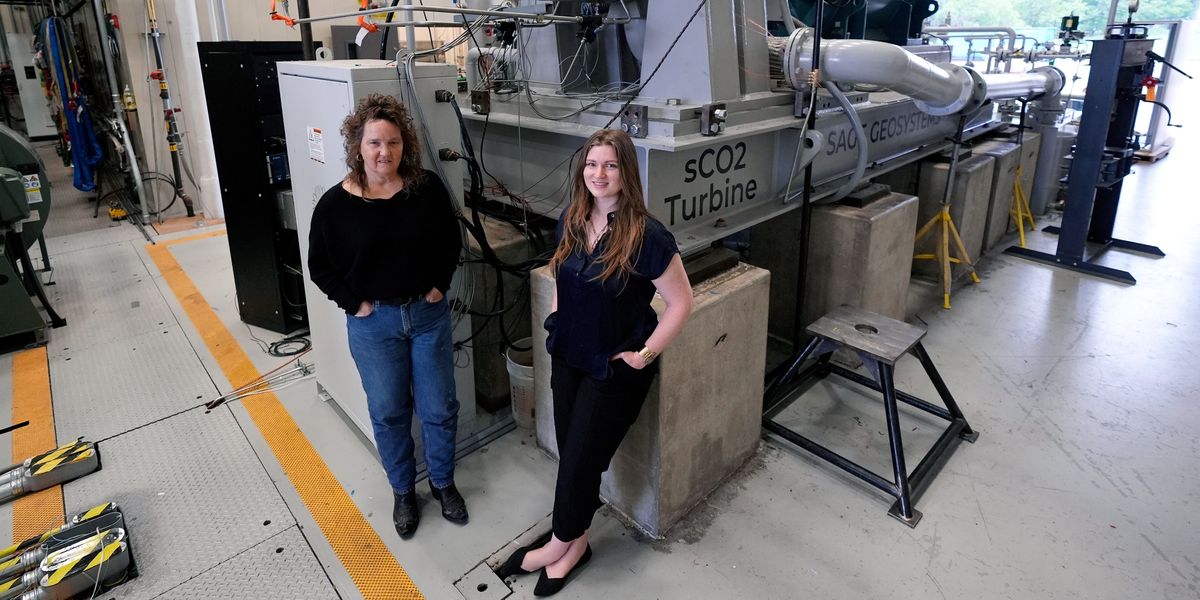
In June, the startup XGS Energy announced plans to build a 150-MW next-generation geothermal project in New Mexico by 2030 to support Meta’s data center operations. Meta, which owns Facebook and WhatsApp, signed a similar agreement last year with Sage Geosystems to build 150 MW of geothermal power at an unspecified site east of the Rocky Mountains. The first phase of that project is set to come online in 2027.
Geothermal has long drawn bipartisan support and has so far dodged Trump’s broader attacks on renewable energy. It helps that the new geothermal wave has considerable overlap with the oil and gas industry, sharing the same drilling equipment, workforce, and investors. U.S. Energy Secretary Chris Wright, previously the CEO of a fracking company that invested in Fervo, played an active role during budget negotiations to shield geothermal from sweeping cuts to IRA incentives.
Under the new law, geothermal and other baseload clean power sources can qualify for the full 48E investment tax credit or the 45Y production tax credit if they begin construction by 2033, after which the credits will gradually decrease to zero in 2036. The concrete phaseout schedule differs from the IRA, which allowed more flexibility and could’ve kept the incentives in place for several more years, according to Geothermal Rising.
Wind and solar facilities, meanwhile, must either start operating before the end of 2027 or begin construction by next summer to obtain credits. Geothermal heat pumps, which heat and cool buildings, will lose access to residential tax credits after 2025.
For next-generation geothermal firms, the tax incentives are crucial to getting the first slate of projects up and running. Developers use the promise of future tax credits as collateral to raise the many millions in financing they need to explore suitable project sites and deploy novel drilling technologies. The credits also help to attract major customers, including tech giants that are looking for a variety of baseload power sources to run their sprawling data centers.
“They help the market to develop,” said Mehdi Yusifov, the director of data centers and AI at Project InnerSpace, a geothermal advocacy group. “Tax credits of this kind can…help get infrastructure built on a mega scale.”
The nuclear reactor at Three Mile Island in Middletown, Penn., can generate over 800 megawatts—a target range for geothermal power producers.George Sheldon/Alamy
Yusifov and Nico Enriquez, a principal at Future Ventures, studied the potential cost of serving a “hyperscale” data center with power from a 1-gigawatt enhanced geothermal project in a place like the western United States. In a new analysis, they found this novel project could achieve a levelized cost of energy of US $119 per megawatt-hour without the investment tax credit—significantly better than estimated costs for nuclear power. With the tax credit, the hypothetical geothermal system could achieve $88 per megawatt-hour, which is competitive with the upper range for a fossil-gas power plant.
“It seems like there’s a dam that would break if it could be proven that [geothermal] can produce power anywhere in the range below Three Mile Island,” said Enriquez, referring to the shuttered nuclear plant in Pennsylvania that is expected to restart to serve Microsoft’s growing energy appetite.
“That’s another reason why this investment tax credit is so important, because it makes it possible to have the dam break,” he added. “And suddenly you can flood the market with these projects that are giving us critical infrastructure.”
It’s unclear whether the budget bill will undermine some next-generation projects due to the anti-China provisions attached to these key incentives. The rules, known as “foreign entity of concern” restrictions, will require companies to scrutinize their supply chains to an unprecedented degree, with potentially onerous and costly legal implications that make it harder for projects to claim incentives.
“It remains to be seen how developers of these really innovative technologies can navigate this, because it’s not going to be the easiest process from here on out,” said Arun of the Center for Public Enterprise.
Even as the headwinds swirl, geothermal developers continue to make significant strides to improve their technologies. Both Fervo and the federal Utah Forge initiative have said they’ve dramatically increased drilling speeds and efficiencies in just a handful of years, with Fervo reducing its per-well costs by millions of dollars. For startups, access to tax incentives allows them to get to work to make such advances in the field, Enriquez said.
“There’s an amount we save long-term if we invest upfront in these tax credits, because of the learning curve,” he said. “If we can maintain [the momentum] for the next five years, I think this industry will be one of the key power sources for the U.S.”
From Your Site Articles
Related Articles Around the Web
