


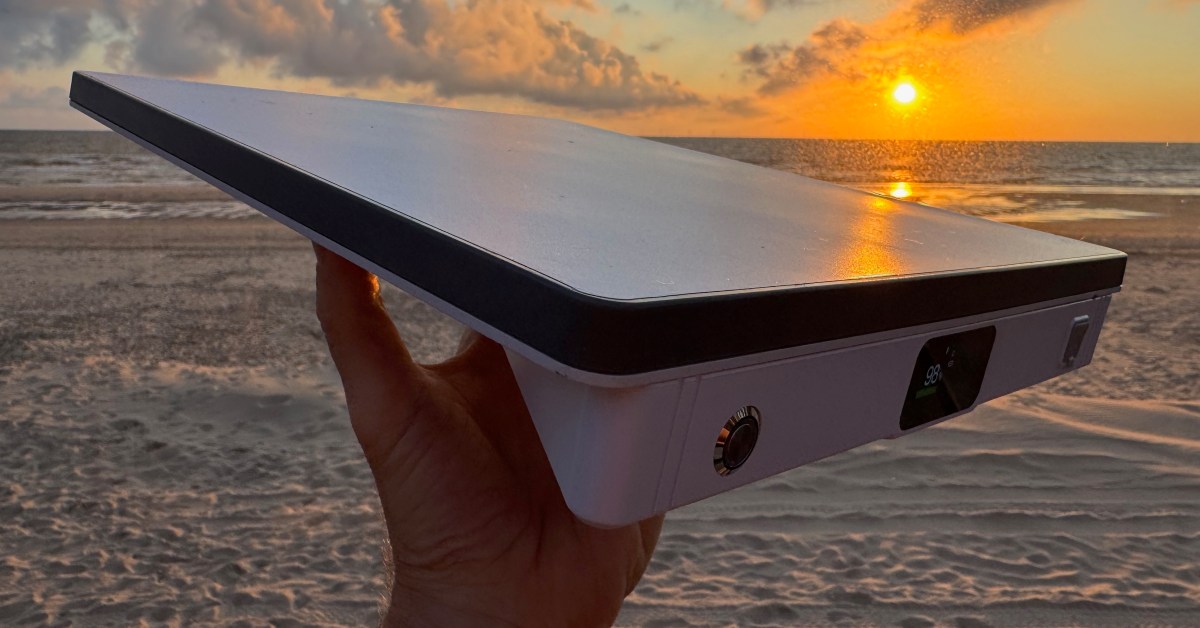
The Starlink Mini satellite dish is now even better thanks to the $119 LinkPower 1 power bank from PeakDo. The battery locks securely to the back of SpaceX’s smallest terminal and provides over 4.5 hours of uninterrupted Internet connectivity. The LinkPower’s battery can also charge simultaneously over USB-C from your car, solar generator, or solar panel for indefinite Internet use. Then the tidy little package can be slipped into a backpack or tote for your next adventure.
Starlink is a life-changing Internet service that connects people and villages too remote for towers and cables to reach. My own Starlink Mini has been critical in helping me pursue life as a digital nomad from almost anywhere in Europe. And right now, Starlink’s the only game in town for relatively cheap and fast consumer internet that can be quickly deployed into data dead spots.
My overriding thought after using the PeakDo LinkPower for the last few weeks is this: why doesn’t SpaceX make one of these?
$119
The Good
- Delivers over 4.5 hours of untethered Internet
- No specialized gear to manage and lose
- Powers Starlink while simultaneously recharging for indefinite use
- Makes placement easier without running cables
The Bad
- Weak resistance to dust and water
- Janky web app
The LinkPower power bank bungs 99Wh right into the slot on the back of the Starlink Mini just like one of SpaceX’s official mounts. It powers the little dish via a short DC-to-DC barrel connector. It makes the Starlink Mini a self-contained unit that can be placed anywhere within Wi-Fi range. That includes on top of your vehicle or shack, or in a distant clearing where it has a clear line-of-sight to satellites overhead — no super long power cable required.
The PeakDo unit has a bi-directional USB-C PD port to charge devices like your phone at up to 65W, or to share 100W of input to simultaneously power the Starlink and charge the LinkPower’s battery. An integrated display lets you monitor the power on both ports.
The 99Wh LinkPower slots right into back just like a standard SpaceX kickstand mount. Photo by Thomas Ricker / The Verge
The web app is janky and requires a special browser on iPhones but it’s also very useful for remote management and control. Photo by Thomas Ricker / The Verge
Untethering the Starlink Mini makes placement super easy without running long power cables. Photo by Thomas Ricker / The Verge
This 50W solar panel could keep the LinkPower charged indefinitely over a USB-C connection. Photo by Thomas Ricker / The Verge
The single button on the LinkPower acts like an on/off switch for the Starlink Mini. Press it once to turn on the integrated display or hold it down to turn on the DC output that powers the Starlink Mini. The USB-C port is always on standby to deliver power, but I didn’t notice any vampire drain as a result. For example, I put it away with a 98 percent charge, and five days later it still said 98 percent.
Remote monitoring and control are possible over Bluetooth with a web app. This works on Android, Mac (with Chrome), and PC desktops, but iPhones require a special browser that supports Web Bluetooth APIs. It was a little janky regardless of platform, but also useful when the dish was sitting on the roof of my van, for example. It’s the only way to access advanced features such as creating on/off schedules for the Starlink Mini.
I averaged a whopping 4 hours and 35 minutes of battery life over repeated tests, with seven devices active on the Starlink Mini. When I reviewed the Mini back in October, I was only getting about 3 hours from my own 99Wh power bank – a good indication that the continuous stream of firmware updates delivered to my Starlink Mini terminal have improved power efficiency. That runtime can be extended by plugging a USB-C cable between the LinkPower and your car, power station, portable solar panel, or even a standard power bank you might use for your phone.
Not having to worry about carrying special equipment just for the Starlink Mini has been incredibly liberating.
Normally, the Starlink Mini requires an AC wall jack or battery with 100W (20V/5A) USB-C PD port to operate, along with specialized cables fitted with weather-resistant 5221 barrel jacks. But with the PeakDo LinkPower plugged in, you can easily keep it charged with the same gear that charges your laptops, phones, and other USB-C gadgets. My Sprinter van’s USB-C jacks only provide about 19W of power, but a USB-C adapter plugged into its 12V socket produces over 30W of the 120W available, easily covering the 22W average power draw of the Starlink Mini. Not having to worry about carrying special equipment – those SpaceX cables are long! – just for the Starlink Mini has been incredibly liberating.
It took 2 hours and 30 minutes to fully recharge the PeakDo LinkPower over USB-C from a 100W source, while simultaneously keeping the StarLink Mini running. The LinkPower’s display was showing 55W – 60W coming in over USB-C to charge the battery, and another 18W – 26W over DC to power the Starlink Mini. I found the USB-C charging rate maxed out at about 60W, whether the Starlink was being powered or not. And pulling the USB-C charger never interfered with the operation of the Starlink Mini when starting or stopping the van.
One knock against the PeakDo LinkPower’s battery is its resistance to dust and water. It has an IPX4 rating, significantly worse than the Starlink Mini’s IP67 rating. That means the LinkPower is not certified against dust — though PeakDo calls it “dustproof” — and it’s only tested to resist splashing water. So, it’s probably not a good idea to mount it on the roof when driving in rain or on dusty roads. Regardless, the Starlink Mini works well from inside moving vehicles when mounted against a glass sunroof or sitting on the dashboard of a van.
PeakDo claims an operating range of 60 degrees Celsius (140 degrees Fahrenheit) to -20 C (-4F). That means the battery should be fine on top of your vehicle’s extra hot roof during sunny summer days, but could struggle in very cold winters. The Starlink Mini’s operating temperature range is 50C (122F) to -30C (-22F).
Using the LinkPower means you can’t use the kickstand or other SpaceX mount with the Starlink Mini. The power bank does have three ¼-inch holes for a tripod or other aftermarket mounts if you’re really bent on locking in a perfect orientation to the sky. I don’t bother with this: it’s never made much difference in my months of regular use.
1/9Connected to an external 99Wh battery for about 9 hours of total runtime.
I don’t have any real gripes with PeakDo’s LinkPower power bank. The battery adds an additional 645g (1.42lb) to the 1.1kg (2.43lb) Starlink Mini, making it feel solid, not heavy. It was previously at risk of blowing away in strong winds. At $119, it costs about twice as much as other 99Wh power banks with 100W USB-C PD outputs, but it’s worth it.
By untethering the Starlink Mini, the PeakDo LinkPower 1 power bank opens up a world of new placement possibilities. Everything you need is in a self-contained kit that can be fired up with the press of a button for over four hours of operation — or longer with a simple USB-C power source. I already gave the ultra-portable Starlink Mini a 9/10 when I reviewed it last year. Making it ultra-convenient with some help from PeakDo edges it even closer to perfection for people with a desire to get up and go.
Photography by Thomas Ricker / The Verge
Follow topics and authors from this story to see more like this in your personalized homepage feed and to receive email updates.
- Accessory ReviewsClose
Accessory Reviews
Posts from this topic will be added to your daily email digest and your homepage feed.
PlusFollow
See All Accessory Reviews
- ReviewsClose
Reviews
Posts from this topic will be added to your daily email digest and your homepage feed.
PlusFollow
See All Reviews
- TechClose
Tech
Posts from this topic will be added to your daily email digest and your homepage feed.
PlusFollow
See All Tech
- Work anywhere
