


In June, a fuel delivery to a Johns Hopkins Hospital campus went terribly awry, spilling 2,000 gallons of diesel into Baltimore’s harbor. As the Maryland capital raced to contain the mess, responders discovered a problem: They didn’t have access to reliable power at the waterfront site.
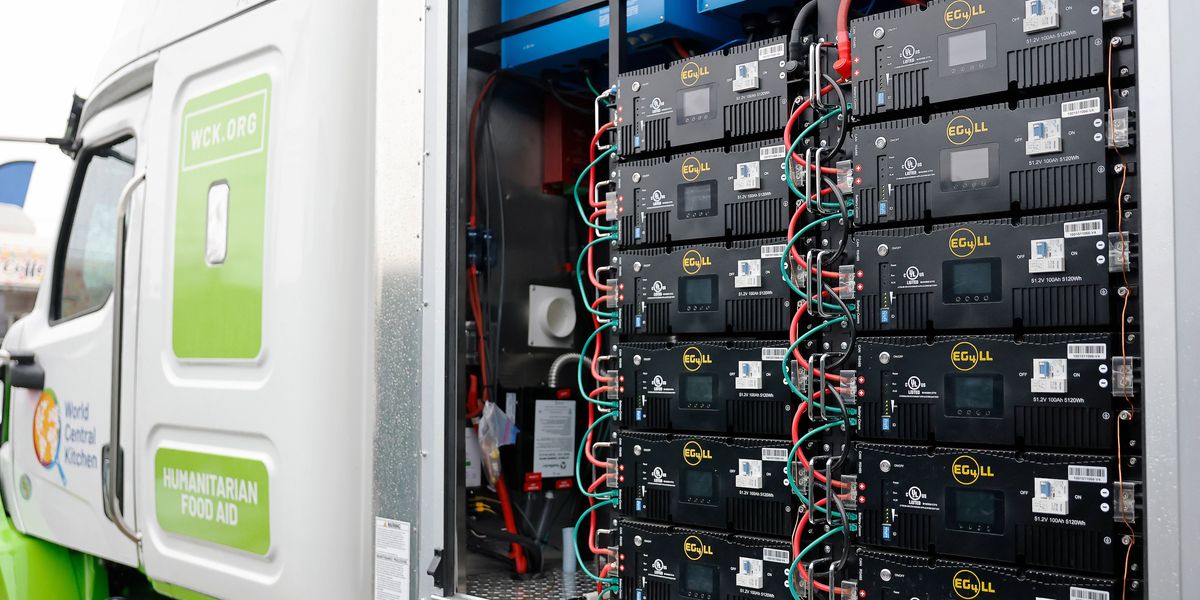
Usually in these kinds of situations, responders bring in fossil-fuel generators. But city officials wanted to do better than burning more fuel while cleaning up diesel. So they tracked down Scott Calhoun, COO of Power Up Connect. The Baltimore-based company has begun to build mobile battery units that can store enough energy to back up an entire hospital or, in this case, energize a harbor cleanup crew.
The company is one of several groups developing mobile battery systems to serve large electricity needs. Volvo builds such systems to charge its all-electric excavators, loaders, and other heavy construction equipment. Tesla has trucked in batteries to beef up the performance of its EV Supercharging stations during times of peak demand.
The batteries are a mobile version of a battery energy storage system, or BESS. In the past, BESS has been used in stationary locations to store grid-scale electricity to help balance supply and demand, such as storing solar energy so that it can be used at night, or storing backup power in case of outages. The improvements to both the chemistry and engineering of lithium-ion batteries has made it possible to move megawatt-level power on the back of a semi truck.
The development opens the possibility to commercialize clean, large-scale electricity on-the-go for applications that previously relied solely on fossil-fuel generators.
Why are Automakers Developing Mobile BESS?
Power Up Connect got its start, in 2008, providing small power stations that allowed people at concerts or sporting events to recharge their phones. Later, customers began to ask for enough power to support applications like recharging power wheelchairs. Now, the company has scaled up to a trailer that can daisy chain up to ten lithium-ion batteries, each with a capacity of 90 kilowatt-hours—slightly bigger than the one that comes in an entry-level Lucid Air electric sedan.
Volvo last year began offering all-electric heavy construction equipment such as loaders and excavators that can move earth with the same force as their fossil-fuel-powered competitors. This equipment needs to be charged, of course, and many clients will want to do that on the job site. So Volvo is building mobile BESS solutions to bring charging to the excavators.
The know-how for Volvo’s mobile BESS stemmed from the building of its growing line of all-electric semi trucks, which use advanced battery chemistries to pack a remarkable amount of energy into a mobile battery pack, says Darren Tasker, a vice president at Volvo Penta, a division of the automaker that uses the company’s technologies for industrial applications.
The improvements to the lithium-ion batteries are due in part to using a nickel cobalt aluminum oxide (NCA) version with aluminum as the cathode. This allowed them to build 90-kWh transportable batteries. According to Tasker, Volvo could easily fit two six-packs of these units onto the back of a semi truck, providing more than a megawatt of power wherever it might be needed. Those batteries can be driven away to a charging depot overnight where they can be recharged, and then brought back to the job site in the morning. After all, Tasker says, “The definition of a construction site is that it is under construction.”
Volvo is looking into lithium iron phosphate (LFP) and lithium-sulfer (Li-S) batteries for future use, Tasker says.
The Volvo PU500 BESS offers a capacity of 540 kWh, and can charge up to 3 heavy-duty trucks or 20 cars daily.AB Volvo
Can Mobile BESS Power Remote Industrial Work?
This moveable feast of electricity could be useful in a wide range of industries. Forestry operations, for example, move from place to place, often in remote locations lacking power. Mining, too, could benefit enormously from electrification. Running fossil fuel-powered trucks and equipment underground creates dangerous emissions that must be vented out of a mine. “The need to electrify underground mining machines is pretty strong,” says Tasker. “To have zero emissions underground is a great driver of new technology,” he says. But the power would need to be mobile.
Mobile BESS is also an appealing solution for places that struggle to find the hundreds of thousands of dollars needed upfront to install an electric charging station. Testing out electrification with trucked-in batteries is less risky than spending six figures to build permanent electrical infrastructure. Volvo has clients that are using mobile charging stations to support electric garbage trucks, forklifts and loaders at ports.
As batteries get better and cheaper, consumer EV charging stations can go off grid. This month Tesla plunked down a battery and solar installation to power an off-grid Tesla Supercharger station, located off Interstate 5 in California. The station provides enough electricity for 80-plus EVs at a time.
The challenge to mobile BESS makers is cost. Batteries aren’t cheap; Tasker says that in some cases, clients might be paying $1,000 per kilowatt-hour for mobile BESS power. That temporary solution is still cheaper than building a charging station, but the cost must come down for moveable batteries to make sense for more uses.
After the diesel spill in Baltimore’s harbor, the city ultimately turned to trusty-but-dirty generators in an effort to get the spill under control quickly. But next time could be different. Baltimore is now in talks with Power Up Connect to use mobile batteries for future emergency response situations, Calhoun says.
From Your Site Articles
Related Articles Around the Web
