


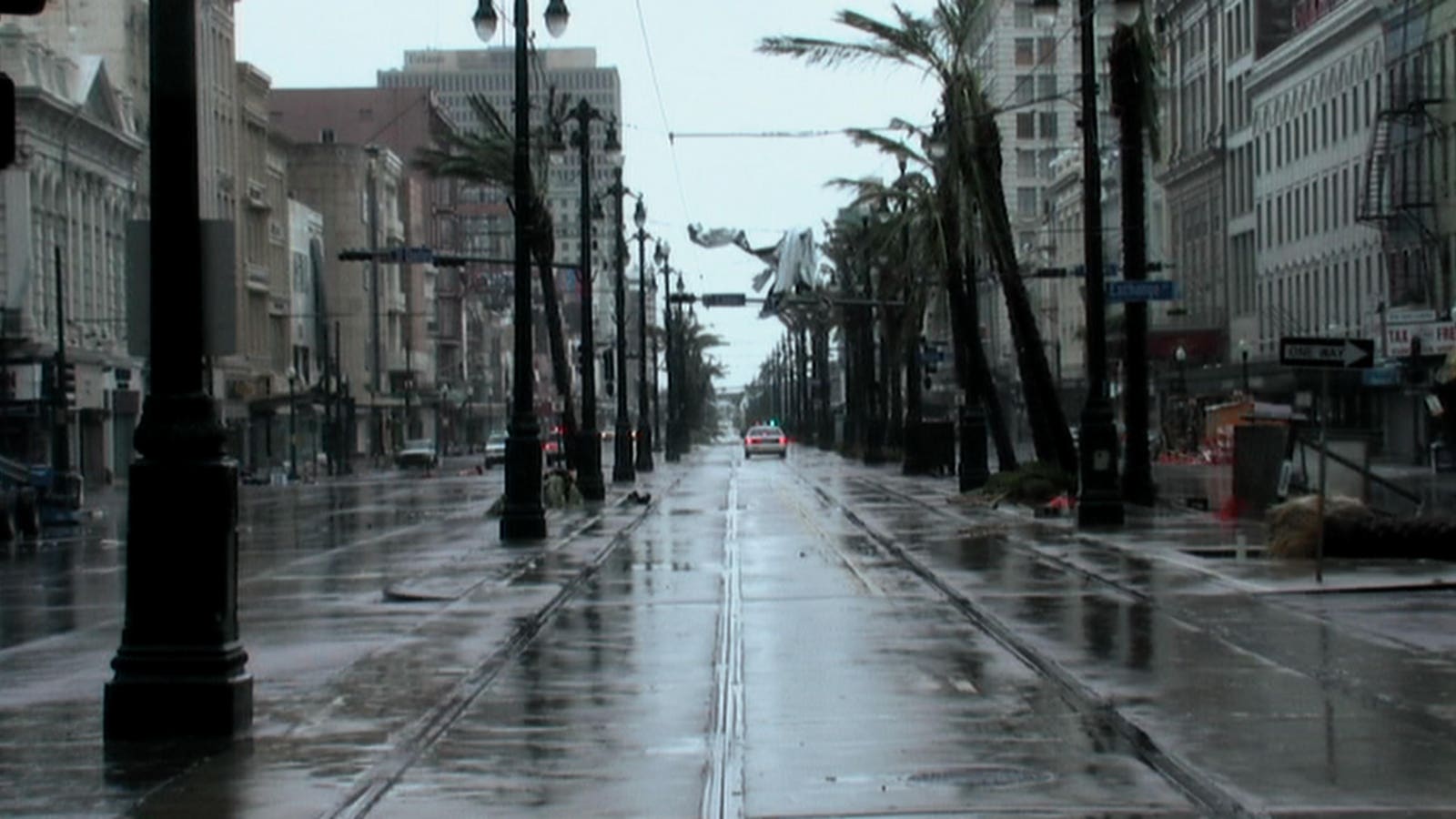
A police car drives through the empty streets of New Orleans after Hurricane Katrina. (Neil … More
Neil Alexander
On August 29, 2005, Hurricane Katrina struck New Orleans. The storm itself was devastating—but what followed was far worse. The real disaster, many experts argue, wasn’t the wind or water, but the collapse of infrastructure, communication and trust in government.
Now, two decades later, National Geographic’s Hurricane Katrina: Race Against Time revisits the catastrophe with the benefit of hindsight and the tools of modern technology. Directed by Traci A. Curry and produced by Proximity Media and Lightbox, the 5-part series is a digitally reconstructed case study in systemic failure—an attempt to rebuild not just the timeline, but the public memory of what actually happened.
Technology as a Truth-Telling Tool
I had an opportunity to connect with Ivor van Heerden, the former deputy director of Louisiana State University’s Hurricane Center. Ivor is the “Cassandra” of the Katrina tragedy—he predicted Hurricane Katrina and the catastrophic impact in 2004, only to be ignored.
“This is definitely not a story about a storm,” said van Heerden. “The trigger, if you will, was a storm—but it was man’s folly that led to the catastrophe.”
LSU Hurricane Center Co-founder Ivor Van Heerden discusses events surrounding Hurricane Katrina and … More
National Geographic
At the time of Katrina, social media was in its infancy. Most people didn’t have smartphones. Surveillance footage was grainy or missing altogether. And the digital infrastructure needed to coordinate a large-scale emergency response simply didn’t exist.
Fast-forward to 2025, and the tools for documentation and storytelling have changed dramatically. The production team behind Race Against Time used AI-enhanced video restoration, satellite overlays, GIS modeling and high-resolution archival footage to create a real-time, moment-by-moment reconstruction of the disaster’s timeline.
“They were banging on my door fairly often,” van Heerden recalled, “for computer model simulations, data, photographs, my own video imagery.” Those simulations—many developed two decades ago—have taken on new life in the series, contextualizing the levee breaches and helping viewers visualize the scale of the flood.
This technical precision is what transforms the docuseries from reflection to re-examination. Overlaying personal stories with geospatial data and timestamped visuals, the series makes a compelling case: the devastation wasn’t random—it was predictable, and preventable.
The Failure Wasn’t Just Physical. It Was Digital.
The documentary also highlights how poor coordination and digital blind spots worsened the crisis. Government systems failed to track where people were sheltered. Communications systems collapsed. Rescue missions turned around because of misinformation—such as unconfirmed reports of violence or looting.
“People were told to go to the Superdome and wait for help,” van Heerden said. “Then the damn roof blew off. And the cavalry didn’t come. And the cavalry didn’t come. And the cavalry didn’t come.”
In one scene, the series deconstructs how the sound of gunfire—interpreted as aggression—was actually a signal for help. “The SOS signal for a hunter is three shots fired. Boom, boom, boom,” van Heerden explained. “You want to make a noise so you can be heard. But instead, those shots were misunderstood, and buses turned around.”
It’s a stark reminder that signal, context and interpretation are everything—especially in crisis response. It’s not enough to have data; you need to understand it, respond to it and trust the systems delivering it.
A Warning for the Future
As we face a new era of climate-driven “storms on steroids,” van Heerden cautions that Katrina should not be viewed as an isolated failure, but as a warning.
“We need to better understand how hurricanes are going to change given these warm oceans and the warm air,” he said. “And then the last thing is, it’s pretty hard to predict sometimes these storms… we need a lot more research into that.”
That research depends on technology. From atmospheric sensors to predictive modeling, modern science is built on data. And yet, as van Heerden pointed out, the very agencies responsible for this work—like NOAA—are facing cuts. “You ignore the science at your folly,” he warned. “Science is a quest for the truth. If you ignore the science, then you won’t know the truth—and the folly is yours.”
Beyond Commemoration
Race Against Time is a digital act of reckoning. By combining technology, testimony and survivor narratives, the series offers a framework for how we can revisit past crises—and build more resilient systems for the future.
What Katrina exposed was not just vulnerability to weather, but vulnerability to misinformation, miscommunication and outdated infrastructure. If there’s a tech lesson in this story, it’s that no amount of forecasting matters if you can’t translate data into action—and no tool can replace accountability.
Hurricane Katrina: Race Against Time premiers on National Geographic on July 27. All episodes will be available to stream July 28 on Disney+ and Hulu.
