


When it comes to learning digital system design, hobbyists and students have a lot of options, whether it’s tinkering with field-programmable gate arrays or working up chip submission for a Tiny Tapeout run. But similar tools for analog design have been harder to come by. Certainly you can create analog circuits in a simulator like LTspice and test them against theory. But nothing beats building real analog circuits and measuring their actual, not theoretical, behavior. Measurement is complicated for analog designs because the test equipment can affect the very measurement being made.
To address this educational gap, a team led by me at Columbia University’s department of electrical engineering created MOSbius, a breadboard-friendly chip that you can think of as a field-programmable transistor array for analog designs.
As its name suggests, MOSbius is built around metal-oxide-semiconductor transistors, divided between n-type and p-type transistors. As these are the building blocks of most analog integrated circuits today, designing with the MOSbius provides experience that’s directly relevant to creating real chips.
The MOSbius has 68 pins, of which 63 connect to either individual transistors or common analog subcircuits such as current mirrors and op-amp stages. Two other pins are used for positive and negative supply voltages.
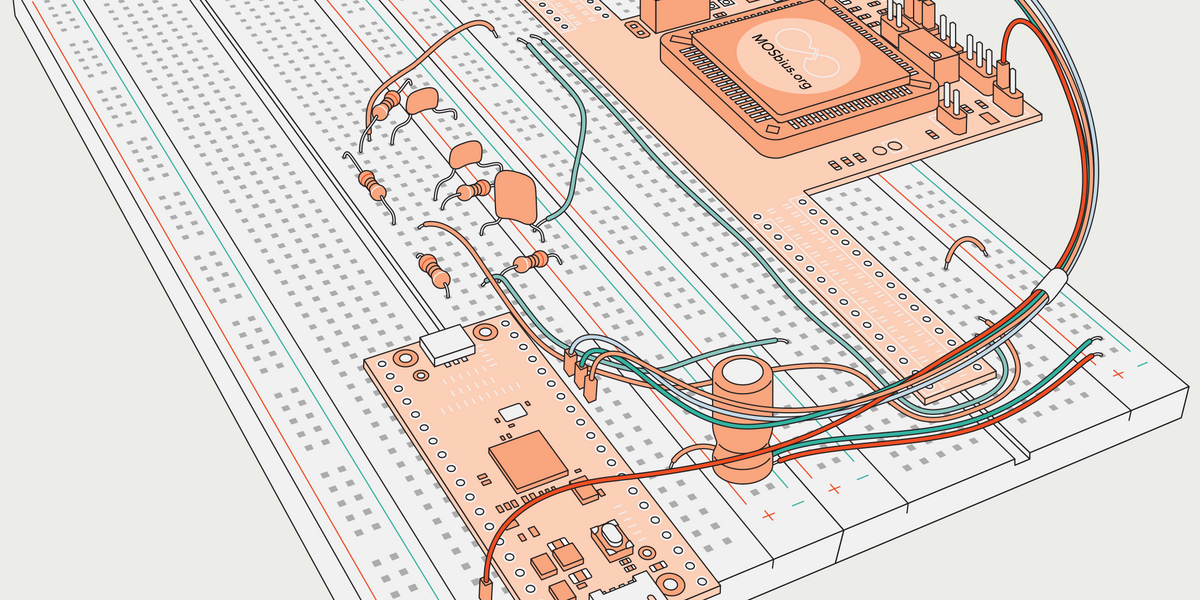
The MOSbius chip [top left] contains all the transistors required for many analog systems. Mounted on a breadboard via a printed circuit board [middle], discrete resistors and capacitors [bottom] are wired up to provide other needed components. A Raspberry Pi Pico [bottom right] is used to program the MOSbius.James Provost
The remaining three pins are used for programming a built-in switch matrix. You can create circuits with the MOSbius by connecting the pins with external wires. But it’s easier to use the switch matrix. This can connect any of the 65 transistor, subcircuit, and voltage pins to one or more of 10 internal buses. The matrix is programmed by clocking in a simple stream of 650 bits—one bit for each possible connection between a bus and a pin.
We program the MOSbius’s matrix using a Raspberry Pi Pico running a Python script that turns a simple JSON text file into the desired bitstream. If you want, though, you can use pretty much any 3.3-volt microcontroller that supports Python.
The MOSbius runs at 2.5 V. The printed circuit board used to connect the pins to a solderless 830-contact breadboard shifts the Pico’s 3.3 V down when programming the matrix. The PCB also includes bias and over-voltage-protection circuits.
How are integrated circuit components different from discrete components?
As the MOSbius contains only transistors, circuit elements like resistors and capacitors are wired up externally as through-hole components inserted into the breadboard. You might think that using these external components would create an imprecise approximation of the behavior of a real analog IC, which has on-chip resistors and capacitors built out of silicon rather than, say, a metal film or ceramic material.
But at signal speeds below about a megahertz, the actual issue is that these external components are overly precise. (Above 1 MHz, things like the stray capacitance of the breadboard begin to become an issue.) Even a cheap through-hole resistor will have an actual resistance that’s within 5 to 10 percent of the value it claims to be, and through-hole resistors with 1 percent accuracy are common. By contrast, integrated components can easily vary by 30 percent from their nominal value.
Consequently, real analog circuits have to be built with a considerable amount of internal margin. Developing the skill to do this relies on understanding what’s going on at different points within the circuit, as input signals and component values vary. And that requires making real-world measurements.
The “aha” moment of seeing your circuit come to life will stay long after the equations are forgotten.
In a simulated circuit, you can click on any node and read out any parameter without affecting the circuit’s behavior in any way. With the MOSbius, you can similarly access nearly every node in a circuit, but now you face the reality that wiring up test probes to make a measurement can change the circuit’s behavior. Figuring out the most elegant way to make measurements is key for anyone hoping to see their ideas committed to silicon. The “aha” moment of seeing your circuit come to life will stay long after the equations and analysis are forgotten
MOSbius’s ability to let folks poke around inside the guts of an integrated circuit design takes inspiration from the Three Fives Discrete Timer Kit, which uses discrete components to re-create the workings of one of the most popular integrated circuits of all time, the 555. You can of course use the MOSbius to re-create a 555, as well as many other demonstration circuits, starting with the “Hello world!” of hardware, a blinking LED.
Metal-oxide transistors and commonly used subcircuits are connected to most of the pins of the MOSbius chip. They can also be wired together internally using a set of buses programmed using a 650-bit stream from a microcontroller. James Provost
The origin of the MOSbius was serendipitous: While preparing a set of students’ IC projects to be fabricated, we realized we had room to squeeze one more chip into the batch if we could meet the shipping deadline. Six weeks later, the MOSbius was off to production!
From this limited run—150 chips in total—we are making MOSbius kits available at a nominal price of US $150 (subject to change and just to recover our costs) to other educators interested in bringing it to their labs. We are also working on a revised version. The MOSbius can be used to make circuits that range in complexity from those suitable for undergraduates to graduate-level projects. The Web site has a complete set of tutorials and a lab experiments manual ready to go. If you’re interested in obtaining a kit, you can contact me through the site.
I realize we have only a small number of kits available—we are after all a university department, not a semiconductor manufacturer—but we want to make the MOSbius more broadly available to both educators and enthusiasts in the future. The best way to make that happen is to contact me, because strong demand is something we can present to a commercial partner!
From Your Site Articles
Related Articles Around the Web
