


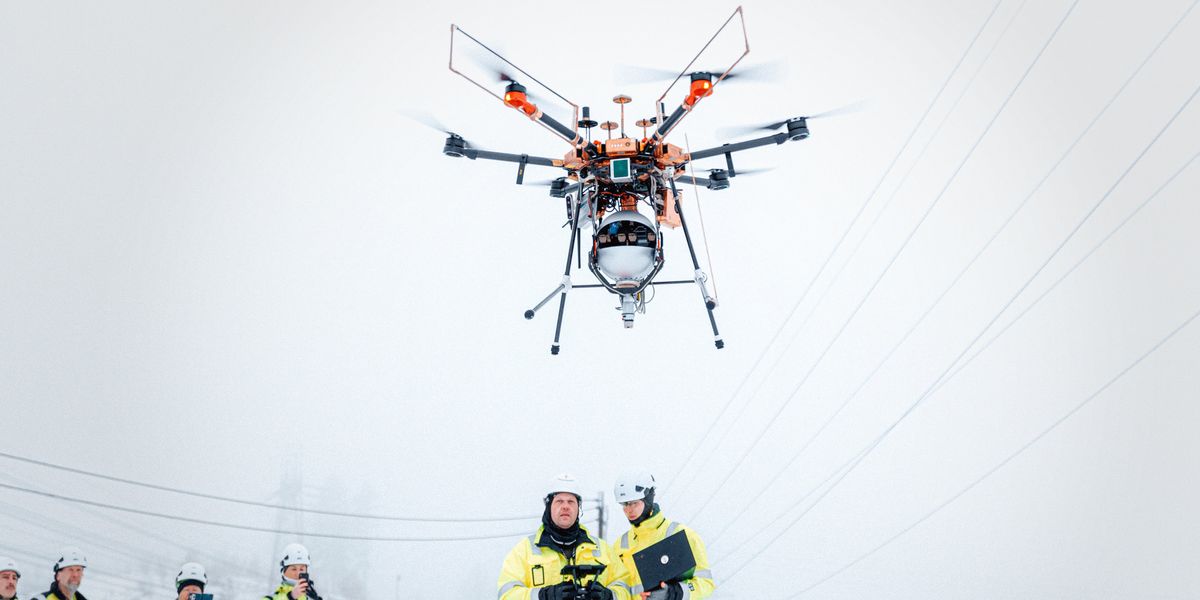
On a cloudy day in mid-July, a crew of technicians carries a shiny metal orb, about the size and weight of a kid’s bowling ball, under a 110-kilovolt transmission line running near Hamburg. Their task: to attach the orb to the line where it will track real-time environmental conditions affecting the capacity of the wire.
To hoist the orb onto the overhead line, a crew member attaches it to a quadcopter drone and pilots it up with a remote control. As it nears the wire, one side of the orb slides open, like a real-life Pac-Man about to chomp a power pellet, and then clamps down. The process takes about 10 seconds and requires no electrical downtime.
Oslo-based Heimdall Power, the manufacturer of the orb, has installed over 200 of them on the transmission lines of SH-Netz, the grid operator in the northernmost part of Germany. Together, the devices form a system that calculates how much current these high-voltage lines can safely carry based on real-time weather conditions. The hotter it is, the lower their capacity.
Historically, grid operators have estimated the capacity of lines based on average seasonal temperatures—a fixed value called static line rating. For safety, the estimates must be highly conservative and assume that the weather is always very warm for the respective season. So for all but the hottest days, transmission lines could carry significantly more electricity, if grid operators only knew the actual temperature of the wires.
Tools like Heimdall’s orb, dubbed the Neuron, can fill in that blank. By tracking information such as the sag of the line and ambient temperature, the system can more accurately determine the temperature—and therefore the real-time capacity—of the line. This allows grid operators to take advantage of the unused headroom by maximizing the current in that line. The system uses weather forecasts to predict the temperature and capacity of the lines for the next day, which is especially useful for day-ahead planning.
Dynamic Line Rating Offers Grid-Congestion Solution
The strategy, called dynamic line rating, or DLR, is being rapidly adopted in North America and Europe as an antidote—at least in the short term—to grid congestion woes. New transmission lines are needed to accommodate the explosion of AI data centers, electrification, and renewable energy generation, but building them is a notoriously lengthy task often requiring a decade or more. In the interim, grid operators must do more with existing infrastructure.
Dynamic line rating and other grid-enhancing technologies, or GETs, offer a quick and inexpensive fix—a bridge until new transmission can be built. Heimdall is one of many companies, including Linevision in Boston and Gridraven in Tallinn, Estonia, providing the technology.
“Transmission operators aren’t maximizing the potential of our power lines, leading to unnecessarily high energy costs for consumers,” said Caitlin Marquis, managing director at Advanced Energy United, an industry advocacy group, in a statement. “Dynamic line ratings are one of the most cost-effective tools we have for getting more out of our existing power-grid infrastructure.”
Heimdall Power’s orb tracks line sag, ambient temperature, sunlight intensity, and other metrics on a transmission line in southwestern Norway.Heimdall Power
Heimdall’s Grid-Enhancing Technologies
In Heimdall’s approach, one of the key metrics its sensors track is line sag; as metal wires get hotter, they expand and make the line droop. Measuring sag helps determine how much capacity drops. The sensors also track other information such as ambient temperature and sunlight intensity. Heimdall combines the information with local weather-forecast data—particularly wind speed, which has a cooling effect on power lines and can thus increase their capacity.
Heimdall’s machine learning uses the data to help grid operators plan how they’ll route electricity for the next day. In urgent situations, they can use real-time data from its sensors to adapt on the fly.
After working mostly with utilities in Europe, last year the company opened a headquarters in Charlotte, N.C., to better access the U.S. market. Its first major U.S. project, in Minnesota, is helping the utility Great River Energy increase its capacity by 25 percent nearly 70 percent of the time, according to the utility. Heimdall has deals with six additional U.S. utilities bringing its technology to 13 states.
“We’ve spent the last 80-plus years building the North American power grid, and we’re basically still running it the way we did in the beginning,” says Heimdall U.S. President Brita Formato. “DLR lets us bring the existing grid into the digital age—essentially overnight, and with relatively low cost and effort.”
Linevision’s Lidar Sensors Enhance Power-Line Monitoring
Linevision, another dynamic line rating provider, uses lidar sensors to monitor line sag, and combines the data with weather forecasting and computer analysis of how wind is affected by objects near power lines. Instead of putting its sensors directly on the power lines, the company mounts them on the towers. This makes installation and operation easier, according to Linevision.
The company originally used electromagnetic sensors to indirectly measure loading on each line but pivoted to lidar as it became cheaper and more widely deployed in self-driving cars. “When we made that switch, we were riding the wave of autonomous vehicles,” says Jon Marmillo, Linevision’s cofounder and chief business officer.
Linevision’s LUX sensor uses lidar to monitor line sag and is installed on transmission line towers.Linevision
For the wind prediction, Linevision starts with a detailed, publicly available spatial map that includes buildings and trees, then uses machine learning to interpret how obstructions change wind near power lines. Marmillo says it takes about 90 days of learning for the system to create accurate predictions of line capacities after it’s installed. Utilities then integrate that into their grid-management software.
After completing an earlier project with Linevision, National Grid, the grid operator for England and Wales, in June announced a new, bigger project with the company, on 263 kilometers of 400-kV lines. The first project increased capacity by 31 percent on average, freeing lines to carry an additional gigawatt of power and saving customers £14 million annually (US $19 million). The new project is expected to save customers £20 million annually ($27 million).
Gridraven’s Wind Forecasting Boosts Dynamic Line Rating
In Estonia, DLR provider Gridraven takes a different tack: It doesn’t use hardware at all. Instead, it relies on machine learning to make accurate, hyperlocal wind predictions. The predictions are based on weather forecasts and a detailed terrain map made from satellite and lidar scans.
Georg Rute, the CEO and cofounder, was working for Estonia’s national grid operator in 2018 when he noticed that forecasts of wind around power lines were “really bad,” he says. Rute came back to study the question in 2023 with Gridraven’s other two cofounders, finding that two-thirds of the error in wind prediction was caused by the landscape—mainly buildings and trees.
Gridraven’s CEO, Georg Rute, founded the company after realizing that hyperlocal wind forecasting wasn’t accurate enough for dynamic line rating.Gridraven
Gridraven began its first large rollout last month, covering 700 km of Finland’s 400-kV lines, and plans to expand to the country’s entire 5,500-km network of high-voltage transmission lines. “With DLR, it is particularly possible to support the integration of wind power into the grid,” said Arto Pahkin, a manager at Fingrid, Finland’s transmission system operator. “This makes DLR a strategically important part of the integration of renewable energy.” Gridraven’s system can increase capacity of power lines by 30 percent on average, according to the company.
DLR companies are quick to point out that the technology is not a cure for all that ails our grids; over the long term, we will simply need more transmission. Congestion is already raising electricity prices and increasing outages. Since 2021, grid congestion has cost American consumers $12–$21 billion per year, depending on electricity prices and weather.
Other grid-enhancing technologies can help in the meantime. For example, reconductoring existing lines with advanced materials can double their capacity. But that approach also takes the lines out of use while the new materials are installed, and it’s more expensive than DLR.
“The potential of DLR is to unlock up to one-third more capacity in the existing grid globally,” said Rute. “This would boost economic growth and increase affordability right away while more grid is being built.”
From Your Site Articles
Related Articles Around the Web
