


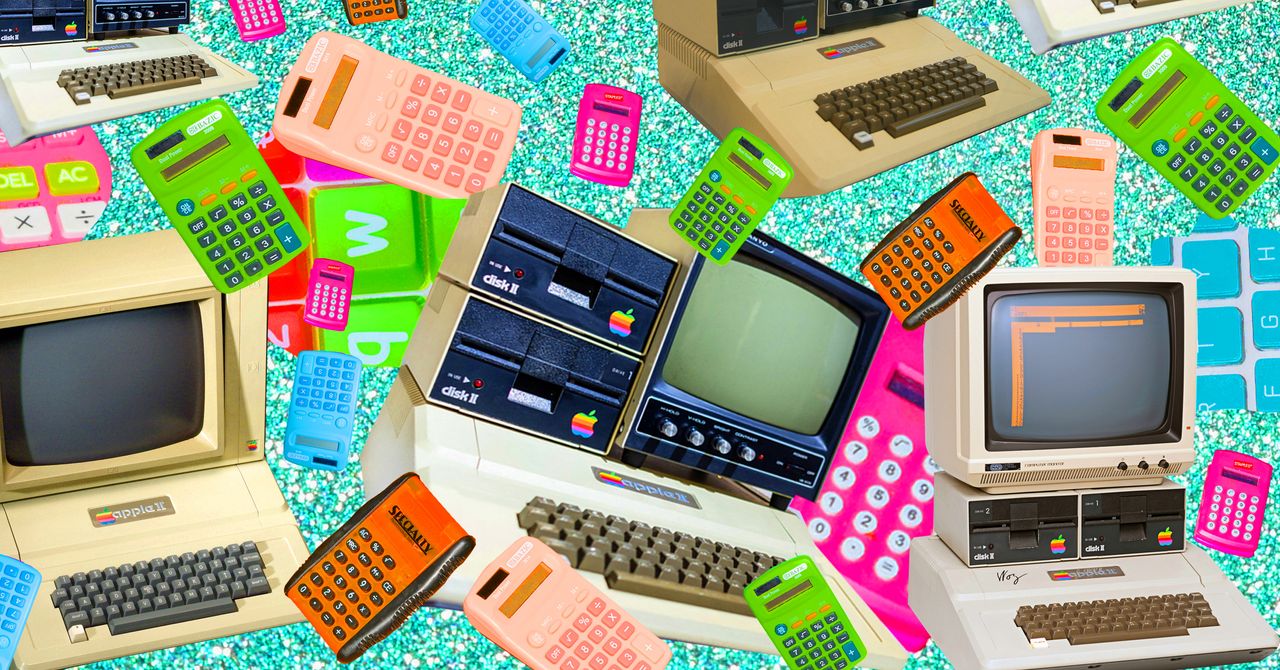
Adoption by schools: Apple played a crucial role in getting computers into classrooms, in part by promoting legislation to offer tax breaks to computer manufacturers that donated computers to schools, museums, and libraries. In the early 1980s, Apple donated close to 10,000 of its Apple IIe computers to California schools as part of the company’s Kids Can’t Wait program.
In 1984, there was a 1:92 computer-to-student ratio in US public schools. Twenty-four years later, in 2008, the ratio was 1:4. By 2021, 90 percent of school district leaders surveyed by Education Week said they were providing one “school-issued digital learning device” per middle and high school student. Eighty-four percent said they were doing the same for their elementary school students.
Public Panic:
“A. Daniel Peck, an education professor at San Francisco State University, is typical of an increasingly vocal body of skeptics. ‘We’re in a computer religion explosion to the detriment of basic-skills education,’ Peck says. ‘We ought to be looking at the extent to which the computer splurge is diluting education; it most certainly is not helping.’ Peck has organized an ad hoc committee of educators and business people, called the Committee on Basic Skills Education, to combat the march of computers into the schools. A position paper by the group calls for help to ‘stop the bandwagon’ before ‘the educational system goes overboard on its reliance on microcomputers.’”
“Computers: Too Much Too Soon,” The Washington Post, 1983
The Interactive Whiteboard
Introduced to the public: 1991
Cost: In 2009, they cost from $700 to $4,500 (from about $1,069 to $6,874 when adjusted for inflation).
Adoption by schools: Close to one-third of K-12 classrooms in the US had an interactive white board (or “wall screen”) by 2009. From 2004 to 2009, global sales rose from 170,000 to 700,000—mostly to schools.
Public Panic:
“There are real concerns about the high cost of whiteboards. Many educators would prefer to see investment go into other technologies, like laptops or tablet devices. Educators are also concerned that whiteboards emphasize teacher-centered lessons over student-centered lessons.”
“Interactive Whiteboards Allow More Sharing,” The New York Times, 2012
The Internet
Introduced to the public: The World Wide Web was launched in 1991, but mainstream use of the internet kicked off when Mosaic, the first graphical web browser, was released in 1993.
Cost: In 1996, unlimited access to the internet through AOL cost $19.99 a month (about $42 when adjusted for inflation).
Adoption by schools: In 1994, 3 percent of US public schools had internet access. By 2001, that had risen to 87 percent. The Federal Communications Commission’s E-Rate program, established in 1996 as part of the Telecommunications Act, helped subsidize the internet for schools and libraries. By 2001, the E-Rate program committed $5.8 billion to applicants throughout the nation.
Public Panic:
“Yes, the Internet is a fantastic, vibrant, and evolving medium that is changing the world. However, this is not a technology destined to improve our schools. [President Bill] Clinton’s Internet infatuation offers a pathetic but telling symbol of just how much the history and role of technology in education is misunderstood. This infatuation is about politics and pandering, not promise and potential.”
