


Law school can be notoriously competitive, with post-graduation job opportunities heavily dependent on grade point average. GPAs are determined primarily by final exams, which are graded on a strict curve.
To give students a fair chance, professors often provide detailed syllabi, comprehensive course outlines, and practice exams with sample questions—usually based on hypothetical legal scenarios—along with essay responses students can use to prepare.
To make those materials even more valuable, a startup called Cubby has developed an AI-powered study tool, Cubby Law, that can generate an essentially unlimited number of practice exam questions. It can also evaluate student responses according to what the system believes a particular professor is likely to expect.
“We try to help the student understand exactly how the professor is going to be writing these different fact patterns based on the content that they’ve specifically learned, and what he’s looking for, and how he’s grading them,” says Cubby founder and CEO Truman Sacks.
[Image: Courtesy of Cubby]
Cubby piloted an early version of the software with about 100 paying law students in the spring semester. According to Sacks, it boosted their average GPA between 0.25 and 0.55 points. The AI was trained on thousands of law school practice exams—many freely available on university websites—and further refined its performance based on the class-specific materials students uploaded.
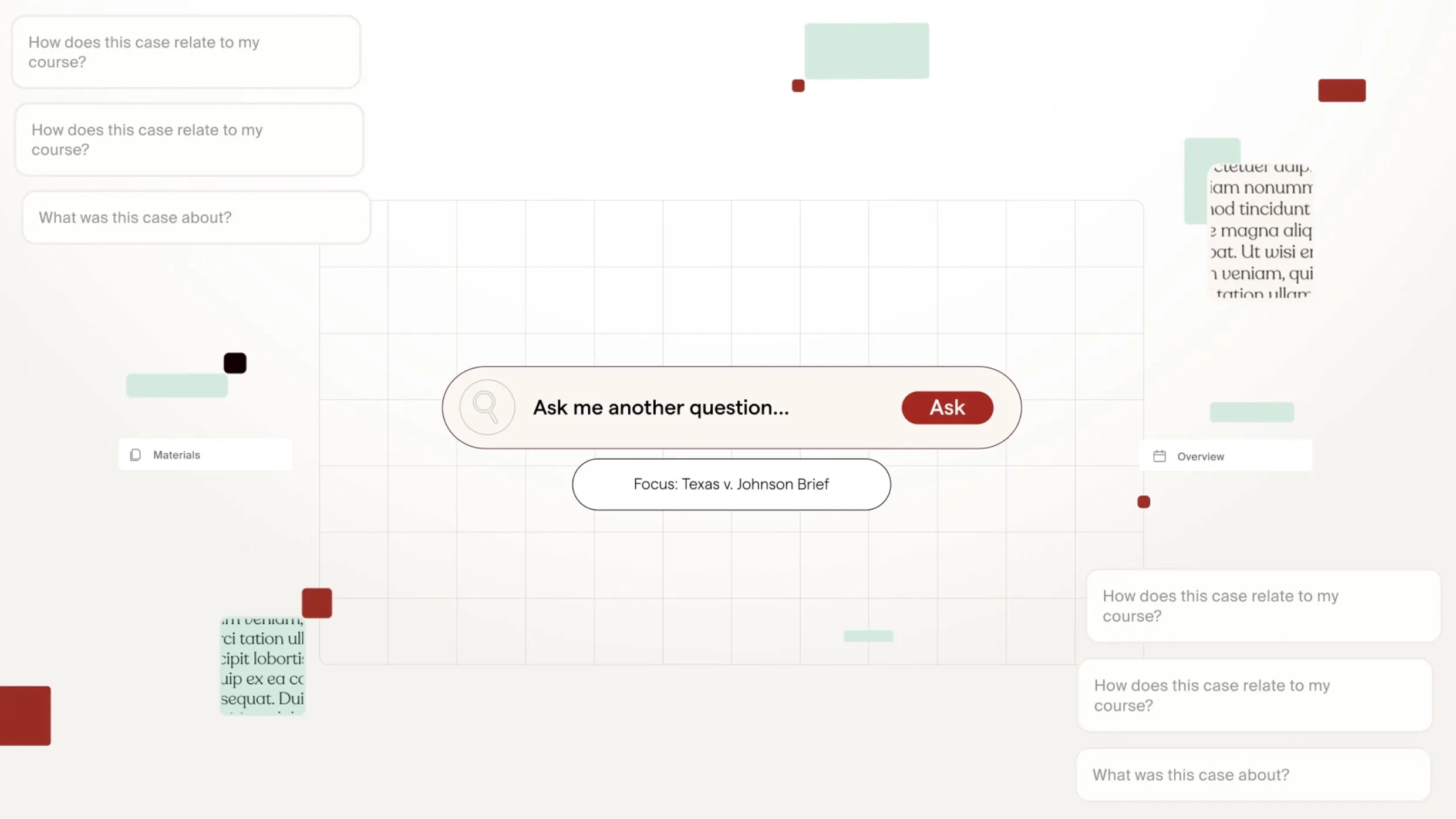
A new version, launching August 25, introduces additional features. These include a calendar automatically populated from students’ syllabi, showing them exactly what to read for each course on specific days. Cubby Law can also create relevant quizzes throughout the semester—a feature Sacks likens to Khan Academy and Duolingo—so students can study consistently, not just before finals.
“You can see if you’re able to effectively apply and understand the knowledge as you’re going through the semester, instead of just waiting toward the very end, trying to learn everything at once and cramming,” Sacks says.
[Animation: Cubby]
The software now also includes a library of briefs on thousands of legal cases commonly taught in law school. The AI can tailor these case briefs to a particular class, ensuring students focus on the precedents most relevant to their studies.
Priced at $30 per month, Cubby Law’s law school-specific training gives it an advantage over general-purpose AI programs like ChatGPT, Sacks argues. Liam Willis, a rising second-year law student at Southern Methodist University in Dallas who participated in Cubby’s pilot, agrees.
Before discovering Cubby, Willis had tried using ChatGPT as a “study buddy,” uploading materials and asking it to generate questions. But ChatGPT often fell short—producing weaker questions and offering overly enthusiastic praise rather than critical feedback. Cubby’s AI, by contrast, delivered detailed critiques.
The tool, he says, not only helped him learn the law but also taught him how to answer exam questions effectively—including which points to emphasize. That guidance boosted his GPA by more than half a point.
“It helped me figure out how to answer the exam question, as opposed to just knowing the answer to the exam question,” he says.
Even before the new features, students were seeing benefits beyond exam prep. Mia Bartschi, entering her second year at the University of California’s law school in San Francisco, says the AI helped her pinpoint where she needed more practice.
“It has the ability to check your answer against your outline, and it was able to flag areas that I needed to practice more,” she says. The result: her GPA rose by 0.2 points.
Cubby Law grew out of an earlier product, also called Cubby, which was designed as a general-purpose research tool for analyzing and summarizing documents and videos. The idea was to act like a digital cubby hole where users could drop all sorts of materials. But when the team noticed law students were using it primarily as a study aid, they decided to focus on that market.
As part of its launch, Cubby plans to host in-person pop-up events with food and live demos at law schools in New York City, where Sacks is based. The company—which has a team of about seven and has raised $2.75 million in funding—may expand into additional areas of study in the future, including bar exam preparation. That could allow aspiring lawyers to continue using the technology even after graduation.
The early-rate deadline for Fast Company’s Most Innovative Companies Awards is Friday, September 5, at 11:59 p.m. PT. Apply today.
