


The package containing the ArduCopter 2.8 board finally arrived from China, bearing the weight of our anticipation. I remember picking it up, the cardboard box weathered slightly from its journey. As I tore through the layers of tape, it felt like unwrapping a long-awaited gift. But as I lifted the ArduCopter 2.8 board out of the box, my heart sank. The board, which was to be the cornerstone of our project, looked worn out and old, with visible scuffs and bent pins. This was just one of a cascade of setbacks my team would face.
It all started when I was assigned a project in machine design at Obafemi Awolowo University (OAU), located in the heart of Ilé-Ifẹ̀, an ancient Yoruba city in Osun State, in southwest Nigeria, where I am a mechanical engineering student entering my final year of a five-year program. OAU is one of Nigeria’s oldest and most prestigious universities, known for its beautiful campus and architecture. Some people I know refer to it as the “Stanford of Nigeria” because of the significant number of brilliant startups it has spun off. Despite its reputation, though, OAU—like every other federally owned institution in Nigeria—is underfunded and plagued by faculty strikes, leading to interruptions in academics. The lack of funding means students must pay for their undergraduate projects themselves, making the success of any project heavily dependent on the students’ financial capabilities.
Dr. Oluwaseun K. Ajayi, an expert in computer-aided design (CAD), machine design, and mechanisms, gave us the freedom to choose our final project. I proposed a research project based on a paper titled “Advance Simulation Method for Wheel-Terrain Interactions of Space Rovers: A Case Study on the UAE Rashid Rover” by Ahmad Abubakar and coauthors. But due to the computational resources required, it was rejected. Dr. Ajayi instead proposed that my fellow students and I build a surveillance drone, as it aligned with his own research. Dr. Ajayi, a passionate and driven researcher, was motivated by the potential real-world applications of our project. His constant push for progress, while sometimes overwhelming, was rooted in his desire to see us produce meaningful work.
As my team finished scoping out the preliminary concepts of the drone in CAD designs, we were ready to contribute money toward implementing our idea. We conducted a cost analysis and decided to use a third-party vendor to help us order our components from China. We went this route due to shipping and customs issues we’d previously experienced. Taking the third-party route was supposed to solve the problem. Little did we suspect what was coming.
By the time we finalized our cost analysis and started to gather funds, the price of the components we needed had skyrocketed due to a sudden economic crisis and depreciation of the Nigerian naira by 35 percent against the U.S. dollar at the end of January 2024. This was the genesis of our problem.
Initially, we were a group of 12, but due to the high cost per person, Dr. Ajayi asked another group, led by Tonbra Suoware, to merge with mine. Tonbra’s team had been planning a robotic arm project until Dr. Ajayi merged our teams and instructed us to work on the drone, with the aim of exhibiting it at the National Space Research and Development Agency, in Abuja, Nigeria. The merger increased our group to 25 members, which helped with the individual financial burden but also meant that not everyone would actively participate in the project. Many just contributed their share of the money.
Tonbra and I drove the project forward.
With Dr. Ajayi’s consent, my teammates and I scrapped the “surveillance” part of the drone project and raised the money for developing just the drone, totaling approximately 350,000 naira (approximately US $249). We had to cut down costs, which meant straying away from the original specifications of some of the components, like the flight controller, battery, and power-distribution board. Otherwise, the cost would have been way more unbearable.
We were set to order the components from China on 5 February 2024. Unfortunately, it was a long holiday in China, we were told, so we wouldn’t get the components until March. This led to tense discussions with Dr. Ajayi, despite having briefed him about the situation. Why the pressure? Our school semester ends in March, and having components arrive in March would mean that the project would be long overdue by the time we finished it. At the same time, we students had a compulsory academic-industrial training at the end of the semester.
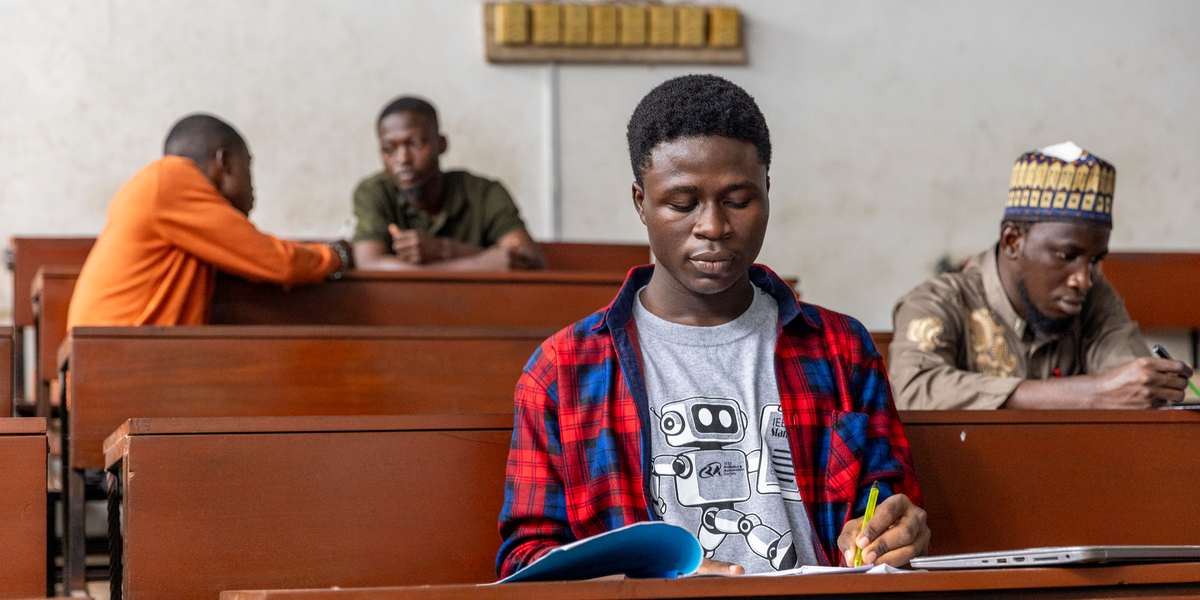
Oluwatosin Kolade, a mechanical engineering student at Nigeria’s Obafemi Awolowo University, says the drone project taught him the value of failure.Andrew Esiebo
But what choice did we have? We couldn’t back down from the project—that would have cost us our grade.
We got most of our components by mid-March, and immediately started working on the drone. We had the frame 3D-printed at a cost of 50 naira (approximately US $0.03) per gram for a 570-gram frame, for a total cost of 28,500 naira (roughly US $18).
Next, we turned to building the power-distribution system for the electrical components. Initially, we’d planned to use a power-distribution board to evenly distribute power from the battery to the speed controllers and the rotors. However, the board we originally ordered was no longer available. Forced to improvise, we used a Veroboard instead. We connected the battery in a configuration parallel to the speed controllers to ensure that each rotor received equal power. This improvisation did mean additional costs, as we had to rent soldering irons, hand drills, hot glue, cables, a digital multimeter, and other tools from an electronics hub in downtown Ilé-Ifẹ̀.
Everything was going smoothly until it was time to configure the flight controller—the ArduCopter 2.8 board—with the assistance of a software program called Mission Planner. We toiled daily, combing through YouTube videos, online forums, Stack Exchange, and other resources for guidance, all to no avail. We even downgraded the Mission Planner software a couple of times, only to discover that the board we’d waited for so patiently was obsolete. It was truly heartbreaking, but we couldn’t order another one because we didn’t have time to wait for it to arrive. Plus, getting another flight controller would’ve cost an additional sum—240,000 naira (about US $150) for a Pixhawk 2.4.8 flight controller—which we didn’t have.
We knew our drone would be half-baked without the flight controller. Still, given our semester-ending time constraint, we decided to proceed with the configuration of the transmitter and receiver. We made the final connections and tested the components without the flight controller. To ensure that the transmitter could control all four rotors simultaneously, we tested each rotor individually with each transmitter channel. The goal was to assign a single channel on the transmitter that would activate and synchronize all four rotors, allowing them to spin in unison during flight. This was crucial, because without proper synchronization, the drone would not be able to maintain a stable flight.
“This experience taught me invaluable lessons about resilience, teamwork, and the harsh realities of engineering projects done by students in Nigeria.”
After the final configuration and components testing, we set out to test our drone in its final form. But a few minutes into the testing, our battery failed. This failure meant the project had failed, and we were incredibly disappointed.
When we finally submitted our project to Dr. Ajayi, the deadline had passed. He told us to charge the battery so he could see the drone come alive, even though it couldn’t fly. But circumstances didn’t allow us to order a battery charger, and we were at a loss as to where to get help with the flight controller and battery. There are no tech hubs available for such things in Ilé-Ifẹ̀. We told Dr. Ajayi we couldn’t do as he’d asked and explained the situation to him. He finally allowed us to submit our work, and all team members received course credit.
Resourcefulness is not a substitute for funding
This experience taught me invaluable lessons about resilience, teamwork, and the harsh realities of engineering projects done by students in Nigeria. It showed me that while technical knowledge is crucial, the ability to adapt and improvise when faced with unforeseen challenges is just as important. I also learned that failure, though disheartening, is not an ending but a stepping stone toward growth and improvement.
In my school, the demands on mechanical engineering students are exceptionally high. For instance, in a single semester, I was sometimes assigned up to four different major projects, each from a different professor. Alongside the drone project, I worked on two other substantial projects for other courses. The reality is that a student’s ability to score well in these projects is often heavily dependent on financial resources. We are constantly burdened with the costs of running numerous projects. The country’s ongoing economic challenges, including currency devaluation and inflation, only exacerbate this burden.
In essence, when the world, including graduate-school-admission committees and industry recruiters, evaluates transcripts from Nigerian engineering graduates, it’s crucial to recognize that a grade may not fully reflect a student’s capabilities in a given course. They can also reflect financial constraints, difficulties in sourcing equipment and materials, and the broader economic environment. This understanding must inform how transcripts are interpreted, as they tell a story not just of academic performance but also of perseverance in the face of significant challenges.
As I advance in my education, I plan to apply these lessons to future projects, knowing that perseverance and resourcefulness will be key to overcoming obstacles. The failed drone project has also given me a realistic glimpse into the working world, where unexpected setbacks and budget constraints are common. It has prepared me to approach my career with both a practical mindset and an understanding that success often comes from how well you manage difficulties, not just how well you execute plans.
From Your Site Articles
Related Articles Around the Web
