


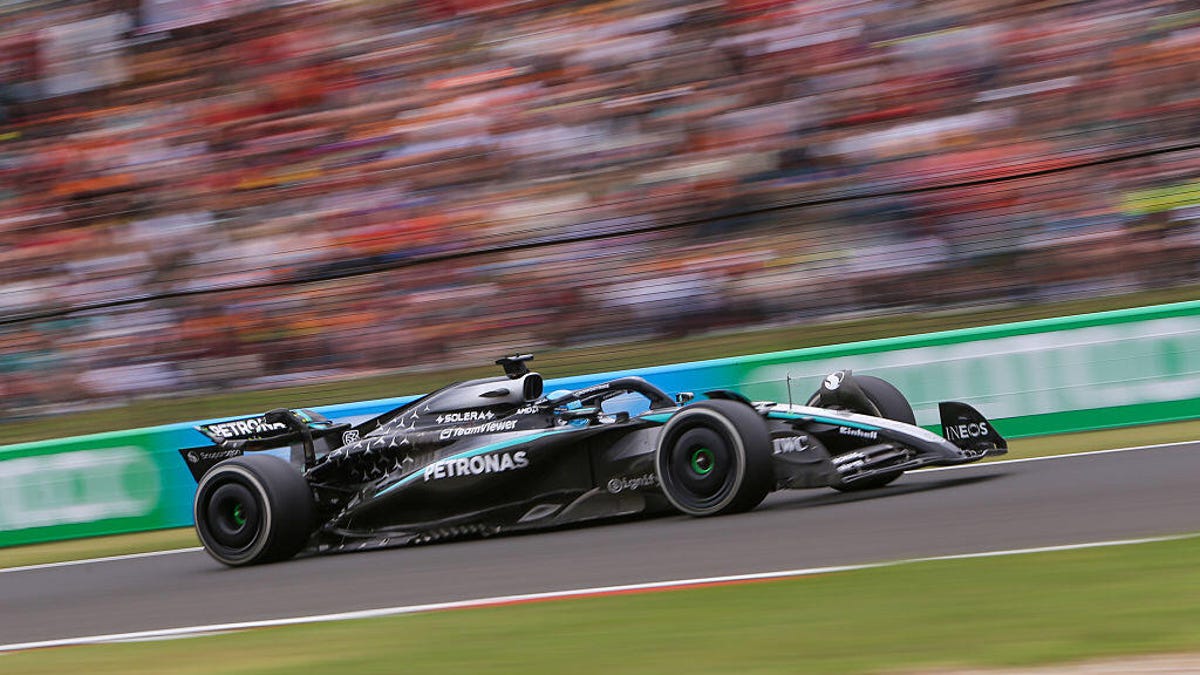
NurPhoto/Contributor/NurPhoto via Getty Images
Get more in-depth ZDNET tech coverage: Add us as a preferred Google source on Chrome and Chromium browsers.
Steve Riley, head of IT operations and service management at Mercedes-AMG PETRONAS F1 Team, gave ZDNET a tour of his racing team’s state-of-the-art technology campus in Brackley, UK, and reflected on the impact digital and data have on the sport.
“Technology is more crucial in Formula One than ever,” he said. “Any sort of manufacturing function in an F1 team many years ago wouldn’t necessarily be quite as reliant on IT services as they are today.”
Also: How the Premier League uses AI to boost fan experiences and score new business goals
Having worked for the racing team for almost a decade, Riley has a clear vantage point from which to assess the importance of technology. He told ZDNET that the IT organization has a crucial role to play as the team seeks on-track and off-track performance improvements.
“We’re central to that effort because we’re one of the few departments that work across all areas of the business,” he said.
Here are five ways Mercedes F1 uses technology to ensure the highest levels of performance.
Riley: “Technology is more crucial in Formula One than ever.”
Mercedes-AMG PETRONAS F1 Team
1. Getting the basic rights
Riley explained how his IT function supports the team in the buildup to race weekend. The process begins at the track on the Monday before the race, when a setup crew starts positioning racks, connecting cables, and tweaking systems.
“We take a mobile data center around the globe with us,” he said. “So, they’ve been setting that up, making sure networks are up and running, making sure our storage, our compute, our Wi-Fi network, are all present and correct.”
Also: Everything you need to know about how technology is changing business
Riley recognized that shifting IT systems around the globe and ensuring everything is ready for racing involves hard work. The key to success is preparation.
“It’s a big challenge logistically. To make that effort happen is daunting, but fortunately, we’ve got a lot of reliable processes to ensure our IT infrastructure is all in the right place at the right time,” he said.
“We’ve got a checklist-type approach, which means we’re able to set up our infrastructure and support it through the events and then pack it up at the end of each race and bring it back to Brackley or send it straight to the next event.”
2. Doing more than break-fix
Riley recognized that a lot of his team’s operational work focuses on efficiency. However, while F1 teams must be able to rely on their IT systems and services, there’s also room for technological innovation.
“I’d rather people be working on the value-add type projects that we support around the organization than just keeping the lights on,” he said.
“What works for us is managing the whole IT workflow as efficiently as possible. Then we can spend less time doing break-fix and more time delivering results.”
Also: How AI-enabled autonomous business will change the way you work forever
Riley said his department has spent the past 12 months honing the team’s storage platforms and networks to increase reliability. Strong foundations create more room for maneuver.
“Now we are far more involved in that future-facing conversation because we can get a lot of the basics right. That success gives you a seat at the table,” he said.
“As an IT person, finding out that you need to contribute to a project where the end goal is long-decided and investments are already made isn’t really where you can add value. We want to be in the conversation and add our expertise and know-how to the context in which we operate to deliver performance.”
3. Finding the crown jewels
Riley’s operational function can use these IT foundations to help people across the team find performance-changing insights — and that’s a far from straightforward task.
“We have so much data that being able to find the stuff that’s of value to us quickly is a real skill,” he said.
The key to finding the crown jewels, said Riley, is ensuring you know your data.
“We have engineers reviewing specific elements of data, but we also, from an IT standpoint, have access to quite a bit of telemetry from our infrastructure,” he said.
“Finding the most valuable data points comes back to having proper alerting, monitoring, and observability platforms in place, which are focused on exactly the types of things that are of interest to us.”
Riley works closely with various technology partners and is always looking for new ways to improve IT operations.
Also: 5 ways to successfully integrate AI agents into your workplace
For example, he believes TeamViewer’s Digital Employee Experience platform could help the IT function find and resolve issues proactively.
“That’s one element of our IT infrastructure that we don’t necessarily have that level of instrumentation around,” he said.
“There’s a huge amount of data that’s captured on every endpoint we have, and it’d be interesting to use that technology to see exactly what’s happening out there.”
4. Embracing digital twins
Riley said one area of performance-motoring where data and emerging technology already pay dividends is racing simulation.
Mercedes F1’s driver-in-loop simulator replicates the behavior of a real car in a controlled digital environment at Brackley.
“We’ve been running a simulator for many years. This is the sixth iteration of the simulator, and we’ve been running it for a couple of years now,” he said.
Riley explained how the team’s drivers, George Russell and Kimi Antonelli, use the simulator to practice driving around race circuits, and the team can explore potential car configurations.
Also: AI’s biggest impact on your workforce is still to come – 3 ways to avoid getting left behind
Drivers and the simulator team work closely with engineers to test solutions for real-time issues.
“The correlation between the simulator and the track is key,” he said. “The mathematical model is as close as we can get to the car, so we can tune a setup change and test new parts in the simulator before using them on the track.”
The global nature of F1 means the race team is frequently overseas. TeamViewer’s remote connectivity platform, Tensor, ensures personnel can log in, monitor results, and make changes to the simulator devices in Brackley from any location.
“A lot of the design of the car takes place in mathematical modeling and physics, and that connectivity means we can create a digital twin of the car in a way that is accurate in terms of representing what we have at the track,” said Riley.
5. Exploring AI carefully
Riley said the challenge his team faces with the rollout of AI-enabled services will be familiar to other business leaders.
“Which direction do you go in? We’re all using AI, whether it’s ChatGPT or Microsoft Copilot, or any of the other models, in our personal lives. So, what do we do as an organization? How do we secure that technology from an enterprise standpoint, and bring it in safely?”
The mantra for a high-profile F1 team exploring AI is better safe than sorry. While generative and agentic AI services can provide a competitive advantage, the sensitive nature of racing data means explorations into AI must be pursued carefully.
“AI is an interesting challenge for us. How do we centralize our approach, and how do we leverage the collective benefits of shared know-how around the topic?” he said.
Also: 5 ways to be a great AI agent manager, according to business leaders
The competitive nature of F1 makes Riley reticent to share details about AI-powered, performance-enhancing activities. However, he could see areas where copilot-like technologies can play a role in the organization.
“We’ve got some data scientists working on ML and AI-type capabilities, and it’s impressive what they’re doing,” he said.
“But I think the benefits of AI, as we can see them, will be for a much wider set of people across our organization, not just those folks who are specifically looking at data.”
