


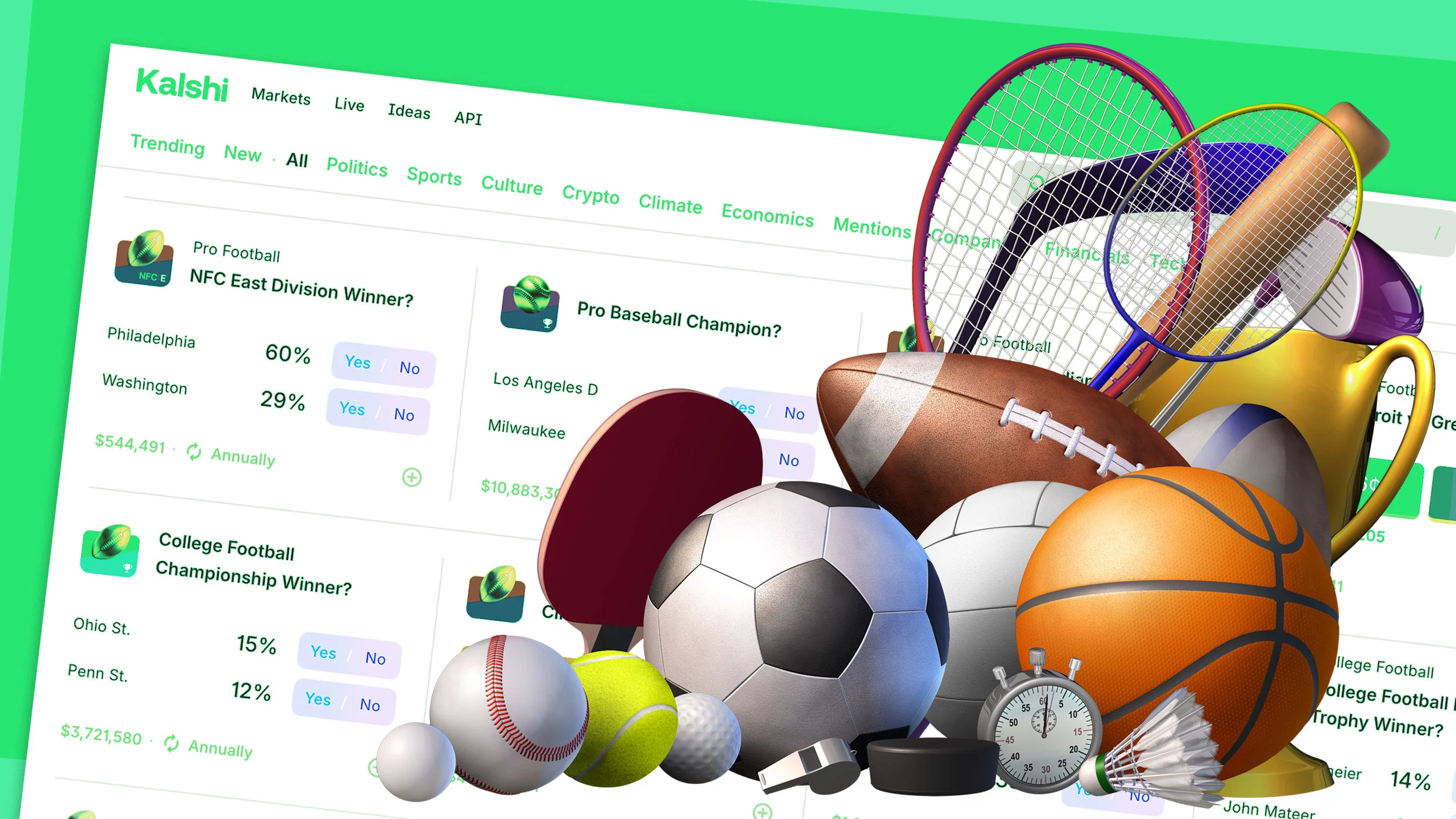
Last month, the online prediction market Kalshi filed some very dry but potentially very lucrative paperwork with the federal Commodity Futures Trading Commission (CFTC). The company, which allows users to predict real-world event outcomes that range from election winners to the annual number of U.S. cases of whooping cough, announced its intent to offer markets for football point spreads, totals, and individual touchdown scorers, too.
In other words, Kalshi users would no longer be limited to predicting game results, awards winners, win totals, and end-of-season champions. Instead, they would be able to make these sportsbook-style wagers on the platform, without going through a state-licensed sportsbook to do it.
Technically, Kalshi doesn’t take bets or set odds itself, and the company carefully avoids referring to its business as “gambling.” Instead, it enables customers to trade “event contracts” priced between 1 and 99 cents, where the prices roughly correspond to the percentage chance that the market believes a given outcome will occur. Kalshi, which allows trading both on its own site and also through its partnership with Robinhood, makes its money on transaction fees. When the market “resolves,” those who hold the winning position are paid out at $1 per share.
For example, if Kalshi offers a contract for whether Justin Jefferson catches a touchdown on Monday Night Football, and Jefferson promptly reels in a 77-yard bomb and then hits the Griddy, those who bought shares in the “yes” position would get to cash in. Those who banked on Vikings quarterback J.J. McCarthy struggling to throw downfield in his regular-season debut would get nothing. (As of this writing, Robinhood allows users to bet on some sports outcomes via its Kalshi partnership, but doesn’t yet offer Kalshi’s prop bets.)
Given how ubiquitous sports gambling has become since the Supreme Court struck down a near-total federal ban in 2018, the distinction between buying an event contract on Kalshi and placing a conventional bet on the DraftKings app might seem irrelevant. But there are differences that matter. Because Kalshi is regulated by the federal government, its contracts effectively enable people to skirt local regulations and place bets in states where sports betting is still illegal—among others, California, Georgia, and Texas.
Unlike state-licensed sportsbooks, federally regulated exchanges like Kalshi are also not subject to state-mandated procedures for reporting suspicious sports betting patterns. Last year, Toronto Raptors forward Jontay Porter received a lifetime ban from the NBA for tipping off bettors that he intended to fake an injury to ensure that his under bets would hit. The NBA opened an investigation after sportsbooks found that prop bets on Porter, a fringe player on a bad team, were among the biggest winners of the night. If a player were to try the same stunt on a platform like Kalshi, it might be more challenging to find out that the game is literally rigged.
In most states, users must be 21 to use DraftKings or FanDuel. Kalshi users, however, need only to be 18. Studies show that problem gamblers are disproportionately young men, who now have the ability to gamble away paychecks, inheritances, and student loan money via smartphone app. In my view, the nationwide availability of a lightly regulated platform that functionally lowers the gambling age from 21 to 18 is troubling, to say the least.
Like all exchanges, Kalshi is subject to CFTC-required integrity and surveillance requirements. It also works with a third-party service to monitor for suspicious sports betting-related activity, and recently debuted “responsible risk management” tools, like those in use at sportsbooks, that allow users to cap their deposits, take breaks, and opt out of market access.
That said, when asked about consumer protection concerns earlier this year, a lawyer for Kalshi said, “People are adults, and they’re allowed to spend their money however they want it, and if they lose their shirt, that’s on them”—a response that does not suggest that the company is terribly concerned with some of the bigger-picture issues here.
To date, a few state regulators have sent the company cease-and-desist letters, but with limited success. Federal district courts in Nevada and New Jersey have found that the CFTC’s jurisdiction over exchanges like Kalshi is likely exclusive, which means states would not have the legal authority to regulate them—or, critically, to tax them. Robinhood quickly filed lawsuits of its own in both states, arguing that Kalshi’s victories clear the way for Robinhood to offer sports contracts on its platform, too.
Those leery of using “events contracts” as a backdoor form of sports betting have what might, on paper, sound like a pretty good argument: CFTC regulations bar exchanges like Kalshi from listing contracts related to “gaming,” which, at least in the colloquial sense of the word, would seem to cover point spreads and player props. And as ESPN’s David Purdum and Shwetha Surendran reported earlier this year, in early 2024, Kalshi’s own lawyers argued that this “gaming” language bars the sports-related contracts that the company is now rolling out.
Why? At the time, the company wanted to list contracts for election outcomes, and asserted that regulators intended “gaming” to refer to sports, and thus not to politics. A federal court eventually greenlit Kalshi’s offerings in time for the 2024 elections, and the company says it posted around $1 billion in trading volume on the results.
With the election behind it, though, Kalshi has spent 2025 pushing further into sports, notwithstanding its lawyers’ earlier arguments. And under President Donald Trump, Kalshi has good reasons to be optimistic about its chances of clearing whatever regulatory hurdles might stand in its way.
In January, the company announced that Trump’s son, Donald, Jr., would serve as a “strategic advisor,” touting his ability to help “push prediction markets into the mainstream.”
Trump’s nominee to serve as the new CFTC chair, Brian Quintenz, is a Kalshi shareholder who sits on Kalshi’s board of directors. Quintenz plans to resign and sell his stock if confirmed; even so, if a recently departed board member takes over as the head of its primary regulator, Kalshi is probably going to feel pretty good about that relationship going forward.
Already, Kalshi has scored a major legal victory since Trump took office: Shortly after that federal court allowed the company to list contracts related to the 2024 elections, the Biden administration appealed. But under new leadership, the CFTC voluntarily dropped its appeal in May, leaving users free to take long positions on whether JD Vance, Gavin Newsom, or someone else wins the White House in 2028.
Kalshi has promised a “slow rollout” of its contracts on NFL props, and told InGame, a publication that covers the sports betting industry, that it has no “immediate plans” to offer college football props. But the success of its initial filings seems to have further emboldened the company: This week, Kalshi submitted additional paperwork to the CFTC to allow users to more or less construct parlays—popular sportsbook bets that require multiple events, or “legs,” to occur in order to pay out.
One contract—a market for predicting whether the Dallas Cowboys would beat the Philadelphia Eagles on Thursday, and the teams would combine to score at least 48 points, and Cowboys receiver CeeDee Lamb would score a touchdown—went live shortly before kickoff. (It did not hit.)
To date, traditional sportsbooks have been publicly critical of exchanges like Kalshi—a position that makes sense, given that they have 70 billion reasons and counting to maintain their oligopoly on the market.
But under an administration that has adopted a lax, industry-friendly stance to prediction markets regulation, sportsbooks are increasingly looking to get in on the action themselves: If they can persuade at least some customers to make basically the same wagers, but on a platform that isn’t subject to state regulation or state taxes, they are going to get over their initial skepticism in a hurry.
Sure enough, Underdog recently partnered with Crypto.com, which rolled out a sports event contract business in December. FanDuel has announced that it will offer event contracts with the CME Group, a derivatives marketplace; DraftKings says it is “evaluating” its prediction market-adjacent options, too.
The growth of prediction market-based sports betting doesn’t mean that traditional sports betting will disappear. But it does mean that the problems created by legal sports gambling—the addiction epidemic, the embarrassing scandals, an increasingly captured sports media ecosystem that is seemingly incapable of covering games without incorporating an officially sponsored betting angle—are going to get worse.
The companies that take bets (by any name) care about making money. This is just one more way for them to do it.
The early-rate deadline for Fast Company’s Most Innovative Companies Awards is Friday, September 5, at 11:59 p.m. PT. Apply today.
