


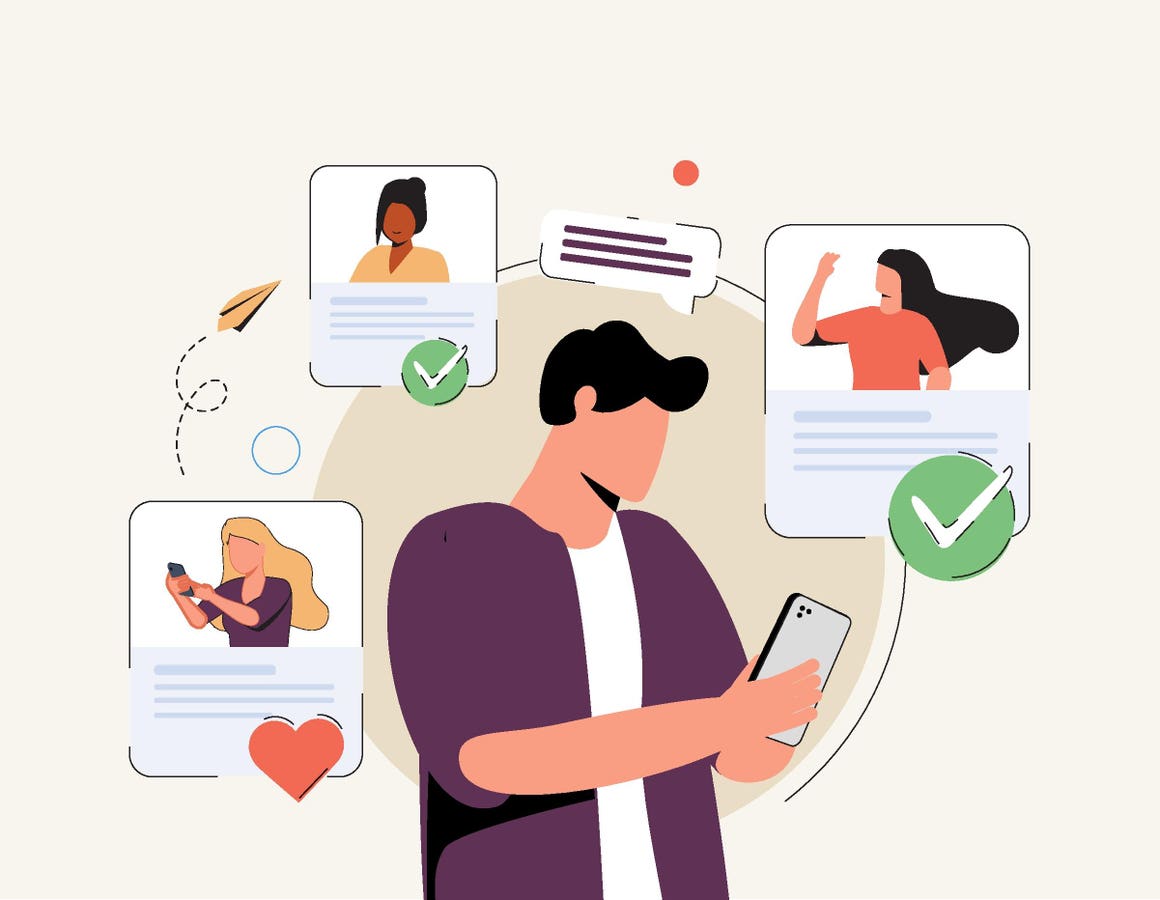
Is the dating game is rigged against men? Here’s what new research reveals about what men should do for better matches on dating apps.
getty
Based on eharmony’s dating statistics, an estimated 80 million Americans are currently utilizing dating apps or websites — that’s roughly 30% of adults. Men are represented more than women, although by only about 34% of men versus 27% of women. But this doesn’t necessarily equate to balanced opportunities for connection.
The Pew Research Center indicates that 63% of men younger than 30 claim to be single, while only 34% of women of the same age group do so. With more men than women using apps and with women being more discerning, the odds seem to be against men, particularly men who are clinging to unrealistic expectations.
In a July 2025 study published in PLOS One, researchers Renata Topinkova of the Ludwig Maximilian University of Munich, Germany, and Tomas Diviak of the University of Manchester, U.K. looked over data from almost 3,000 heterosexual users on a Czech dating app. They found that men often swiped right on women who were considered more desirable than themselves, while women chose more strategically despite having options.
Online Dating Creates A Harsh Hierarchy
Topinkova and Diviak found that desirability on the dating app was immensely skewed. A small number of users, mostly women, got a large number of swipes, while many users got none or very few. Only a small percentage of highly desirable users stood out from the crowd.
They also found that even the most desirable men got fewer swipes than women considered “below average” in desirability by the users. This was partly due to gender imbalance, that is having more men on the app than women, but cultural expectations also play a major role, where men are often expected to make the first move.
This produces a demand-supply disparity in which a large number of men are vying for a small number of women. On Tinder alone, men dominate the active user base, which gives women more choice and negotiating power.
If men only go for their “ideal” matches, they are subject to intense competition and rejection. A total of 53% of singles claim dating burnout, with men specifically indicating insecurity over not getting replies, according to Match’s 2025 “Singles in America” survey.
A 2020 study published in BMC Psychology discovered that users of swipe-based dating apps are more likely to report depression, anxiety and psychological distress than non-users. This indicates rejection does take a toll. Unrealistically high expectations only make it worse, since fewer matches mean more frustration and less confidence.
Men Chase Upward While Women Choose Strategically
Contrary to the popular belief that most women go for the top selected few men, the study found that women’s swiping behavior was less likely to be “aspirational” and even slightly downward or lateral. That means women on average tend to contact men who are perceived to be slightly less or roughly the same as them in terms of desirability and attractiveness, which signals a cautious approach.
The advantage in numbers also provides women a chance to be more strategic. This gives them a chance to look beyond desirability and explore other dimensions such as values, mutual engagement, compatibility and shared interests. It also helps them in finding more successful and meaningful matches.
However, in no way does this mean that attractiveness doesn’t play an important role for both men and women in online dating. Another 2025 study published in Computers in Human Behavior Reports analyzed data from over 5,300 swipe choices across six traits: looks, height, job, biography text, intelligence and similarity between the selector and target.
Researchers found that physical appearance alone overwhelmingly drives early online dating decisions, much more so than other commonly cited traits like intelligence or occupation, and this pattern is similar across genders.
Real Matches Reflect Reciprocity, Not Aspirations
It turns out that the matches people actually end up with aren’t just about chasing after the most “desirable” person out there. Instead, successful matches tend to happen when both people are pretty much on the same level of desirability.
“The successful matching outcomes tend to align more closely with women’s preferences than with men’s. This likely reflects women’s stronger position in the online dating market, as men outnumber women and are often expected to make the first move,” Topinkova and Diviak mentioned in a recent press release.
So while men often swipe right on women they see as way “out of their league,” it’s not those swipe-ups that turn into dates. Instead, the real connections happen between people who are more evenly matched. This means the whole process is more about reciprocity and mutual interest than just one person chasing someone they believe is way “above” them.
Here’s how men can realistically navigate expectations on dating apps:
- Accept the landscape. As research indicates, men tend to have a more difficult time on dating apps because of imbalanced gender ratios and competition. Knowing this can assist you with managing expectations — it’s not a matter of your value, but a structural fact of most dating platforms.
- Focus on being genuine and patient. Instead of attempting to pander to all women, focus on writing a genuine profile that reflects your real values and interests. Quality is more desirable than quantity. Be patient; deep connections take time to form.
- Make thoughtful first moves. When making the first move, invest in personalized and respectful messages rather than generic icebreakers. Be interested in more than physical beauty.
- Don’t internalize rejection. Rejection is rampant and frequently driven by factors unrelated to you as an individual. Utilize it as a learning opportunity, not a reflection on your worth. When feasible, maintain a sense of humor and perspective.
- Enhance your profile tactically. Employ great-looking photos, crisp and compelling bios and bring out authentic features of your personality. Minor adjustments can drastically grow your appeal and exposure.
Topinkova and Diviak’s study highlights how rejection and competition naturally balance out initial ambitions, leading to more realistic partnerships.
While these findings shed light on online dating dynamics, researchers mention there’s more to explore across different apps, cultures and dating styles in future research.
Think your swiping habits are out of control? Take this science-backed test to find out: Problematic Tinder Use Scale
