


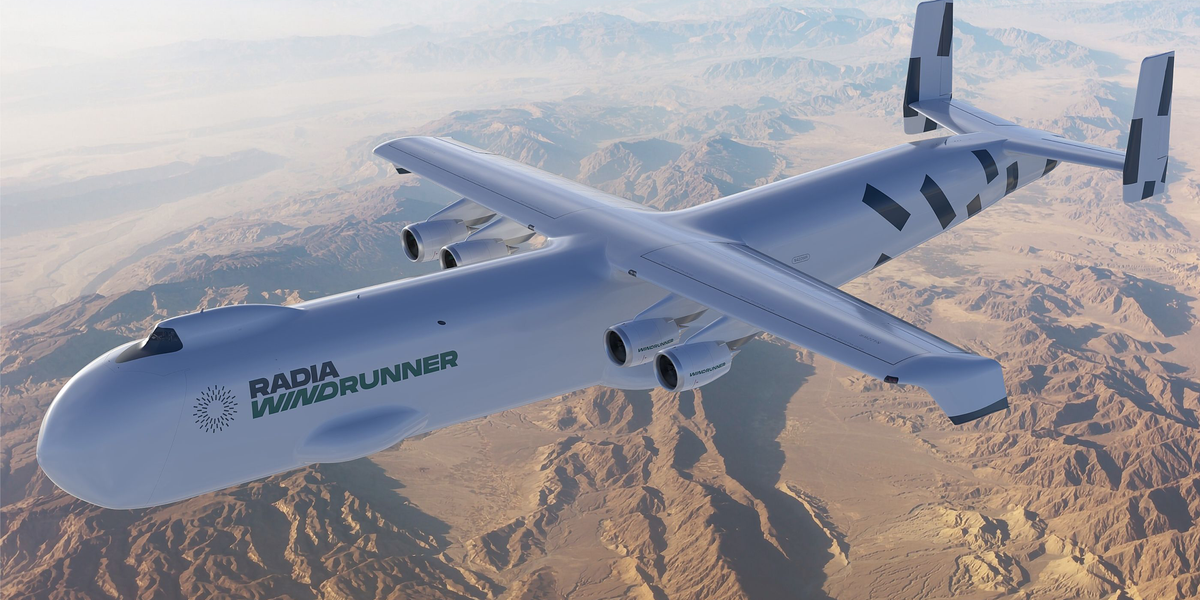
The world’s largest airplane, when it’s built, will stretch more than a football field from tip to tail. Sixty percent longer than the biggest existing aircraft, with 12 times as much cargo space as a 747, the behemoth will look like an oil tanker that’s sprouted wings—aeronautical engineering at a preposterous scale.
Called WindRunner, and expected by 2030, it’ll haul just one thing: massive wind-turbine blades. In most parts of the world, onshore wind-turbine blades can be built to a length of 70 meters, max. This size constraint comes not from the limits of blade engineering or physics; it’s transportation. Any larger and the blades couldn’t be moved over land, since they wouldn’t fit through tunnels or overpasses, or be able to accommodate some of the sharper curves of roads and rails.
So the WindRunner’s developer, Radia of Boulder, Colo., has staked its business model on the idea that the only way to get extralarge blades to wind farms is to fly them there. “The companies in the industry…know how to make turbines that are the size of the Eiffel Tower with blades that are longer than a football field,” says Mark Lundstrom, Radia’s founder and CEO. “But they’re just frustrated that they can’t deploy those machines [on land].”
Radia’s plane will be able to hold two 95-meter blades or one 105-meter blade, and land on makeshift dirt runways adjacent to wind farms. This may sound audacious—an act of hubris undertaken for its own sake. But Radia’s supporters argue that WindRunner is simply the right tool for the job—the only way to make onshore wind turbines bigger.
Bigger turbines, after all, can generate more energy at a lower cost per megawatt. But the question is: Will supersizing airplanes be worth the trouble?
Wind Turbine Blade Transportation Challenges
Lundstrom, an aerospace engineer, founded Radia nine years ago after coming across a plea for help from wind-turbine manufacturers. In their plea, posted as a press release, the manufacturers said they could build bigger onshore blades if there were simply a way to move them, Lundstrom recalls.
In the United States, for example, the height of interstate highway overpasses—typically 4.9 meters (16 feet)—won’t allow for bigger turbine blades to pass. The overpass limitation is true for Europe too. There’s more flexibility in the developing world, where there are fewer tunnels and overpasses generally, Lundstrom says. But many of the roads aren’t paved or hardened, which makes it much tougher to move 50-tonne objects around.
Some regions in China don’t have the same road constraints, allowing extralarge onshore wind turbines to be built there. Last year, Chinese multinational Sany Renewable Energy announced that it had installed a 15-megawatt model in Tongyu, Jilin province, in northeast China, with blades that are 131 meters long. The blades were manufactured in an industrial park in Inner Mongolia, an 1,800-kilometer trek from where they were ultimately installed.
The WindRunner
WindRunner required unique design specifications to accommodate the ultra-long length of the wind turbine blades it will carry.
Carl De Torres
Offshore wind farm developers suffer from the logistical and practical challenges of operating in open ocean, but finding vessels big enough to transport the blades isn’t one of those. The biggest offshore blades measure more than 250 meters, and they’re usually transported via cargo ship. Manufacturers typically locate their facilities on the coast.
Onshore, the movement of blades has met the hard limits of infrastructure. Shipping them in multiple pieces and reassembling them on-site won’t work because the joints would create weak spots. Junctions would also add too much weight compared with that of blades made from single pieces of polymer, says Doug Arent, executive director at the National Renewable Energy Laboratory Foundation and emeritus NREL researcher.
“It comes down to the stress engineering of the components,” Arent says. Blades could one day be 3D-printed on-site, which could negate the need for an airplane, but that research is still in early stages, he says. (Lundstrom says 3D-printed blades will never happen, since it would require a large, sophisticated manufacturing facility to be built at every wind farm.)
If moving blades in pieces is folly, then the way forward is to fly. But even the largest existing cargo planes—the C-5 and C-17 flown by the U.S. Air Force and the Russo-Ukrainian Antonov AN-124 Ruslan—can’t accommodate large turbine blades. “There really is no big cargo aircraft in production, or planned, except for ours,” Lundstrom says.
How to Make the World’s Largest Aircraft Fly
What you can experience of Radia’s WindRunner today fits inside a conference room in the company’s Boulder headquarters. Here, a kind of gazebo made of two-by-fours houses a flight simulator, where I’m trying to virtually fly, and land, the behemoth.
There’s a couple of pilot chairs, a joystick, a throttle, a video screen with a head-up display, and a few buttons to operate the simulated landing gear and wing flaps. The grid of flight instruments that will occupy the cockpit space above the pilot’s head are not finished yet. Instead, laminated pictures of the eventual controls are Velcroed in place.
It takes surprisingly few levers and controls to fly the WindRunner. “Physics is physics,” says my copilot Etan Karni, principal engineer and head of Radia’s advanced systems groups. As Karni controls the WindRunner’s airspeed, I pull up on the joystick and guide it off the runway of a virtual Denver International Airport. A few minutes later I make a planned U-turn around a nearby lake. The maneuver is wobbly; I remind myself to move the joystick gently even though this is such a big bird.
The WindRunner
When it’s built, WindRunner will stretch longer than a football field.
Carl De Torres
With Karni’s aid in controlling the landing gear and flaps, we set down back in Denver. I not only keep the WindRunner in one enormous piece but also bring it to a stop at the very front of the runway, just before the visible streaks of burned rubber from other airliners.
In the real world, this remarkable feat of deceleration will enable the WindRunner to stop within 10 lengths of the aircraft—about 1,080 meters. And the aircraft won’t need the perfected runways of contemporary airports. It’s designed, by necessity, to land on and take off from rugged dirt tracks—like access roads on the perimeter of a wind farm, but wider.
These capabilities are enabled by the plane’s relatively light weight, its wing and body shape, and its big tires. Optimized for cargo volume rather than mass—because turbine blades are huge but not dense—WindRunner is, effectively, one giant cargo hold with the bare minimum of amenities required to make it fly. “Landing on dirt basically comes down to how many pounds per wheel you have,” Lundstrom told me.
WindRunner’s four jet engines will aid with short takeoffs. “When the aircraft is empty,” Lundstrom says, “the engines are so powerful that the vehicle has a thrust-to-weight ratio similar to early fighter jets.” (Radia chose an engine already in use by modern airlines, but hasn’t disclosed which one.)
To allow the plane to quickly turn skyward without scraping its underside, its back end will sweep away from the ground at a sharp angle. A single tail tall enough to stabilize the WindRunner would exceed airports’ height limit of 24 meters, so Radia designed it with two risers in the shape of the letter H.
For landings, the aircraft’s broad and stubby wings use their nearly 1,000-square-meter surface to catch air and decelerate quickly. Twenty big tires borrowed from the classic design of the U.S. Air Force’s C-130 Hercules will help WindRunner slow down after it touches the ground.
The plane’s mouth flips up to reveal its cavernous interior, a feature borrowed from the Antonov An-124. The cockpit, itself about as big as an entire Gulfstream private jet, looks like a pimple bulging from the WindRunner’s staggering frame. It sticks out from the fuselage to avoid interfering with cargo space and is the only part of the plane designed for human habitation. During flight, the hold is only pressurized to about the level of the peak of Mt. Everest, to save energy.
Why Wind Turbines Got Bigger
During my visit to Radia, a virtual-reality headset lets me behold the colossus from underneath its wing and inside its cargo bay. It feels like standing next to a warehouse that can fly. Seeing the virtual superplane towering above, and grasping the plane’s monumental scale makes me wonder if this adventure in engineering is necessary, that surely there’s another way.
The largest helicopters built in the Western Hemisphere can carry up to 15 tonnes, but megablades can weigh four to five times that, Lundstrom notes. Blimps and airships can carry the weight, but they bring a laundry list of complications. They’re too slow, need an expensive hangar to shield them from bad weather, require helium—which is currently scarce—and struggle to land when it’s windy. “And by the way, wind farms tend to be windy,” he says.
And, since the world’s biggest cargo planes can’t be stretched to meet the length of a 100-meter blade, nor can they land on short, rugged runways, a new design is needed. Still, the fundamental question remains: Is increasing the size of onshore wind turbines by 50 percent worth the trouble?
Michael Howland, a wind-optimization expert at MIT, says there’s a huge value proposition in it. A turbine’s power-generation capacity increases by the cube of the wind speed blowing through it and the square of the diameter of the circle created by the spinning blades, he says. In other words, bigger turbines, while more expensive per individual unit, more than make up for it in generating capacity. That’s why the size of turbines has grown steadily larger over the years.
“You’re able to have half as many,” Lundstrom adds. “So even though the cost of each turbine has gone up, the cost per gigawatt goes way down.” He estimates that GigaWind turbines would decrease the cost of energy by 20 to 35 percent while increasing output by 10 to 20 percent, potentially doubling wind’s profitability even with the cost of all those flights included.
Having fewer total turbines means a wind farm could space them farther apart, avoiding airflow interference. The turbines would be nearly twice as tall, so they’ll reach a higher, gustier part of the atmosphere. And big turbines don’t need to spin as quickly, so they would make economic sense in places with average wind speeds around 5 meters per second compared with the roughly 7 m/s needed to sustain smaller units. “The result…is more than a doubling of the acres in the world where wind is viable,” Lundstrom says.
Upon the WindRunner’s landing at a wind farm, rail equipment will roll turbine blades off the plane. Radia
To kick-start this market, and to support the first WindRunners, Radia is developing a business arm that partners with wind-turbine manufacturers to develop new wind farms both domestically and internationally. WindRunners would deliver blades to those farms and those developed by other companies.
The scope of Radia’s plan, and the ambition behind it, has impressed many observers, including Howland. “I was both surprised but also very impressed by the innovative spirit of the idea,” he says. “It’s great to be ambitious in terms of solving the grand challenges.” But onshore “gigawind” is full of unknowns, he notes. Less is understood about the flow physics and engineering of record-breaking turbine sizes. Plus, huge blades could create wakes so large that the turbines behind them would be noticeably affected by variations in air temperature and even the Coriolis effect caused by Earth’s rotation, and might require innovation in fundamental science, he says.
Then there’s the question of the big plane’s carbon footprint. To move enough blades for a whole wind-farm operation, a WindRunner might fly back and forth from factory to farm every day for months, carrying one or two blades at a time. This may create more carbon emissions compared with trucking them. But Radia argues that the increased amount of clean energy created by advanced wind farms would be far more than enough to offset the CO2 from the jet engines. Besides, the biggest component of a wind farm’s carbon footprint is the concrete and steel. With longer blades allowing for fewer turbines to create the same amount of energy, carbon contributions should decrease, Lundstrom argues.
As Radia continues its quest, a dark cloud hangs over the endeavor. U.S. President Donald Trump and his administration have made multiple attempts to grind the American wind-energy industry to a halt by pausing approvals, permits, and government loans. But Lundstrom pushes back against the notion that the prevailing winds out of Washington will clip Radia’s wings. There’s simply too much money to be made, he says.
“My belief is that [it’ll] sort itself out….We’ll be delivering [planes] at the end of this administration,” Lundstrom says. Increasing the scale at which societies can produce wind power is crucial for a future without fossil fuels. And that scale, he says, can’t be reached without a new airplane to make it possible.
From Your Site Articles
Related Articles Around the Web
