


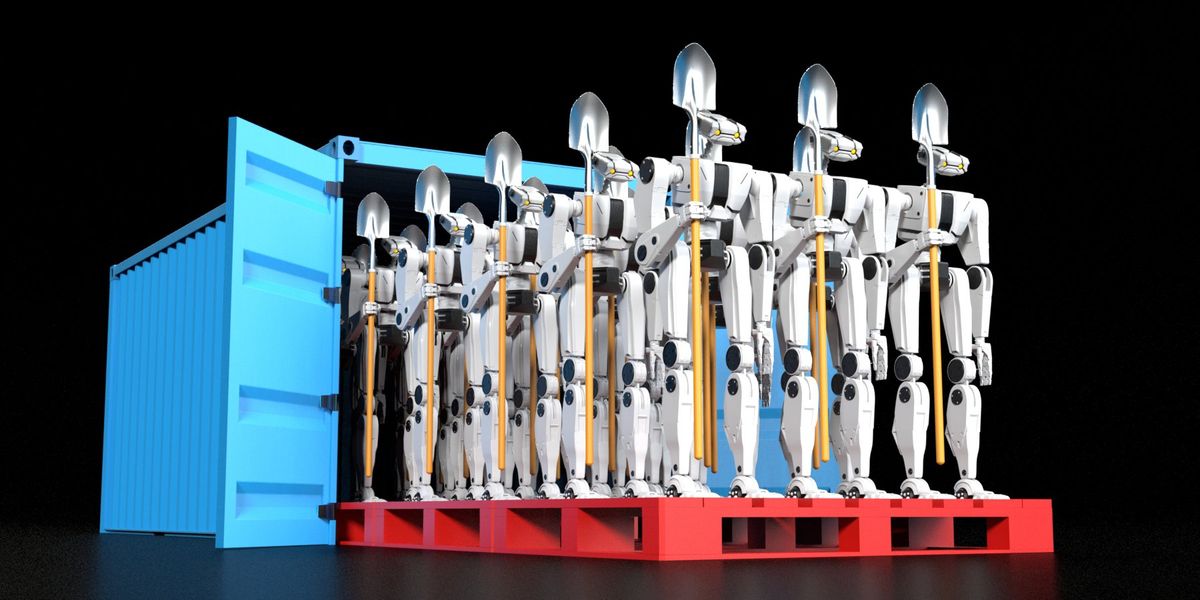
Over the next several years, humanoid robots will change the nature of work. Or at least, that’s what humanoid robotics companies have been consistently promising, enabling them to raise hundreds of millions of dollars at valuations that run into the billions.
Delivering on these promises will require a lot of robots. Agility Robotics expects to ship “hundreds” of its Digit robots in 2025 and has a factory in Oregon capable of building over 10,000 robots per year. Tesla is planning to produce 5,000 of its Optimus robots in 2025, and at least 50,000 in 2026. Figure believes “there is a path to 100,000 robots” by 2029. And these are just three of the largest companies in an increasingly crowded space.
Amplifying this message are many financial analysts: Bank of America Global Research, for example, predicts that global humanoid robot shipments will reach 18,000 units in 2025. And Morgan Stanley Research estimates that by 2050 there could be over 1 billion humanoid robots, part of a US $5 trillion market.
But as of now, the market for humanoid robots is almost entirely hypothetical. Even the most successful companies in this space have deployed only a small handful of robots in carefully controlled pilot projects. And future projections seem to be based on an extraordinarily broad interpretation of jobs that a capable, efficient, and safe humanoid robot—which does not currently exist—might conceivably be able to do. Can the current reality connect with the promised scale?
What Will It Take to Scale Humanoid Robots?
Physically building tens of thousands, or even hundreds of thousands, of humanoid robots, is certainly possible in the near term. In 2023, on the order of 500,000 industrial robots were installed worldwide. Under the basic assumption that a humanoid robot is approximately equivalent to four industrial arms in terms of components, existing supply chains should be able to support even the most optimistic near-term projections for humanoid manufacturing.
But simply building the robots is arguably the easiest part of scaling humanoids, says Melonee Wise, who served as chief product officer at Agility Robotics until this month. “The bigger problem is demand—I don’t think anyone has found an application for humanoids that would require several thousand robots per facility.” Large deployments, Wise explains, are the most realistic way for a robotics company to scale its business, since onboarding any new client can take weeks or months. An alternative approach to deploying several thousand robots to do a single job is to deploy several hundred robots that can each do 10 jobs, which seems to be what most of the humanoid industry is betting on in the medium to long term.
While there’s a belief across much of the humanoid robotics industry that rapid progress in AI must somehow translate into rapid progress toward multipurpose robots, it’s not clear how, when, or if that will happen. “I think what a lot of people are hoping for is they’re going to AI their way out of this,” says Wise. “But the reality of the situation is that currently AI is not robust enough to meet the requirements of the market.”
Bringing Humanoid Robots to Market
Market requirements for humanoid robots include a slew of extremely dull, extremely critical things like battery life, reliability, and safety. Of these, battery life is the most straightforward—for a robot to usefully do a job, it can’t spend most of its time charging. The next version of Agility’s Digit robot, which can handle payloads of up to 16 kilograms, includes a bulky “backpack” containing a battery with a charging ratio of 10 to 1: The robot can run for 90 minutes, and fully recharge in 9 minutes. Slimmer humanoid robots from other companies must necessarily be making compromises to maintain their svelte form factors.
In operation, Digit will probably spend a few minutes charging after running for 30 minutes. That’s because 60 minutes of Digit’s runtime is essentially a reserve in case something happens in its workspace that requires it to temporarily pause, a not-infrequent occurrence in the logistics and manufacturing environments that Agility is targeting. Without a 60-minute reserve, the robot would be much more likely to run out of power mid-task and need to be manually recharged. Consider what that might look like with even a modest deployment of several hundred robots weighing over a hundred kilograms each. “No one wants to deal with that,” comments Wise.
Potential customers for humanoid robots are very concerned with downtime. Over the course of a month, a factory operating at 99 percent reliability will see approximately 5 hours of downtime. Wise says that any downtime that stops something like a production line can cost tens of thousands of dollars per minute, which is why many industrial customers expect a couple more 9s of reliability: 99.99 percent. Wise says that Agility has demonstrated this level of reliability in some specific applications, but not in the context of multipurpose or general-purpose functionality.
A humanoid robot in an industrial environment must meet general safety requirements for industrial machines. In the past, robotic systems like autonomous vehicles and drones have benefited from immature regulatory environments to scale quickly. But Wise says that approach can’t work for humanoids, because the industry is already heavily regulated—the robot is simply considered another piece of machinery.
There are also more specific safety standards currently under development for humanoid robots, explains Matt Powers, associate director of autonomy R&D at Boston Dynamics. He notes that his company is helping develop an International Organization for Standardization (ISO) safety standard for dynamically balancing legged robots. “We’re very happy that the top players in the field, like Agility and Figure, are joining us in developing a way to explain why we believe that the systems that we’re deploying are safe,” Powers says.
These standards are necessary because the traditional safety approach of cutting power may not be a good option for a dynamically balancing system. Doing so will cause a humanoid robot to fall over, potentially making the situation even worse. There is no simple solution to this problem, and the initial approach that Boston Dynamics expects to take with its Atlas robot is to keep the robot out of situations where simply powering it off might not be the best option. “We’re going to start with relatively low-risk deployments, and then expand as we build confidence in our safety systems,” Powers says. “I think a methodical approach is really going to be the winner here.”
In practice, low risk means keeping humanoid robots away from people. But humanoids that are restricted by what jobs they can safely do and where they can safely move are going to have more trouble finding tasks that provide value.
Are Humanoids the Answer?
The issues of demand, battery life, reliability, and safety all need to be solved before humanoid robots can scale. But a more fundamental question to ask is whether a bipedal robot is actually worth the trouble.
Dynamic balancing with legs would theoretically enable these robots to navigate complex environments like a human. Yet demo videos show these humanoid robots as either mostly stationary or repetitively moving short distances over flat floors. The promise is that what we’re seeing now is just the first step toward humanlike mobility. But in the short to medium term, there are much more reliable, efficient, and cost-effective platforms that can take over in these situations: robots with arms, but with wheels instead of legs.
Safe and reliable humanoid robots have the potential to revolutionize the labor market at some point in the future. But potential is just that, and despite the humanoid enthusiasm, we have to be realistic about what it will take to turn potential into reality.
This article appears in the October 2025 print issue as “Why Humanoid Robots Aren’t Scaling.”
From Your Site Articles
Related Articles Around the Web
