


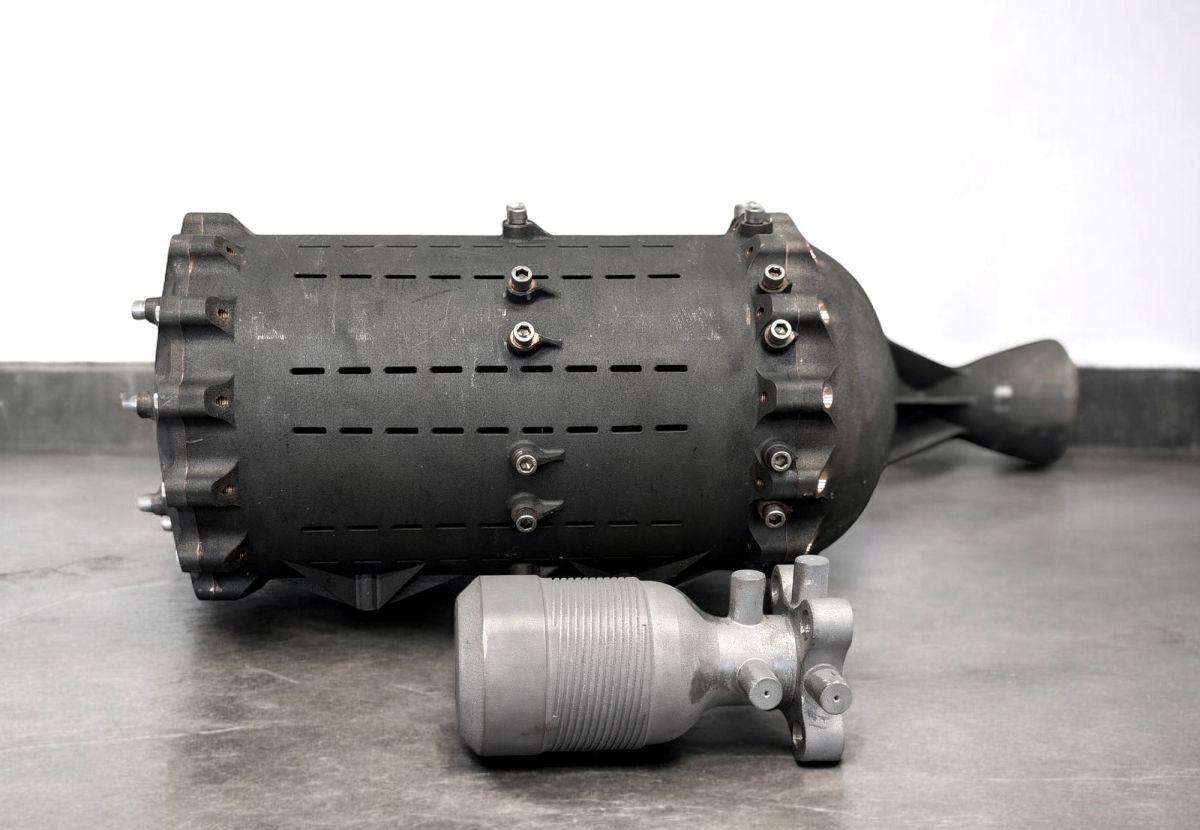
Jeff Thornburg helped turn a government research project into SpaceX’s most powerful rocket engine. Now, he’s trying to do the same thing at his startup Portal Space Systems, which is taking an idea set aside by NASA and turning it into high-powered propulsion for the next generation of spacecraft.
Portal, founded in 2021, announced a $50 million Series A funding round Thursday that values the company at $250 million. The round was led by Geodesic Capital and Mach33, alongside Booz Allen Ventures, ARK Invest, AlleyCorp, and FUSE.
The company is developing a technology called solar thermal propulsion. Today’s standard satellite engines either burn chemical fuel or convert the sun’s energy to electricity, using that to power efficient but low-powered thrusters. Portal’s engines would instead concentrate the heat of the sun, using that to heat propellant and move the spacecraft along at high speed.
The technology has been the subject of investigation in government research labs since the 1960s, most recently as a concept for sending a probe into interstellar space, but has yet to make it into orbit. Thornburg, along with co-founders Ian Vorbach and Prashaanth Ravindran, plans to change that in the next two years.
Thornburg began his career in the U.S. Air Force, where he worked on a program to develop an efficient, powerful next-generation kind of rocket engine that engineers call full-flow staged combustion. A decade later, he was wooed to SpaceX by Elon Musk to turn those concepts into the Raptor engine that now powers the company’s massive Starship.
After stints working at Stratolaunch and Amazon’s Project Kuiper, he turned to propulsion once again.
A new kind of rocket engine
Solar thermal power is, in Thornburg’s view, the next logical step in rocket tech. NASA had studied the technology extensively in the late nineties and concluded it provides better performance in many cases. It wasn’t developed further because there wasn’t enough demand for in-space mobility, according to a 2003 report commissioned by NASA.
Techcrunch event
San Francisco, CA
|
October 13-15, 2026
With satellites and space probes flying much more rarely back then, it was simpler just to use a more powerful rocket than invest in in-space propulsion. Now, with thousands of new satellites flying every year and the U.S. military demanding spacecraft that can fly quickly between orbits to surveil or threaten rivals, that calculus has been turned on its head.
“It’s no longer acceptable to move slowly on orbit,” Thornburg told TechCrunch. “You know, China’s running circles around our spacecraft. We need equivalent capability.”
Portal has already received $45 million in strategic funding from the U.S. military, on top of $67.5 million in private capital, thanks to the potential for using its technology for orbital warfare, according to Booz Allen Ventures’ managing director Travis Bales.
And in a future where we may see millions of satellites in orbit around the Earth providing communications and computing services, satellite operators will need cheaper means of maneuvering spacecraft out of each other’s way, notes Aaron Burnett, the CEO of the aerospace-focused venture fund Mach33. Burnett sees Portal becoming a “space mobility prime,” providing propulsion to a variety of users.
The path to orbit
To get there, the company will need to get its technology working in orbit. Its flight electronics were launched on a shakedown cruise around the planet last week, and another prototype spacecraft is expected to launch in October. The company will demonstrate a working prototype of its engine with the launch of its first SuperNova spacecraft — a “fighter jet for orbit,” per Thornburg — expected in 2027.
Portal benefits from recent advancements in additive manufacturing and materials science, which have led to the development of the company’s combined solar concentrator and nozzle, the Hex thruster.
Rocket nerds think that nuclear-powered rockets are the next step to unlock transportation throughout the solar system, but the regulatory and legal challenges of building such a system make it beyond a startup’s pay grade.
But Portal’s engine also gives the company a head start on one version of an atomic rocket, a nuclear thermal propulsion system — essentially replacing the heat of the sun with that of a reactor. When the U.S. government is ready to build it, Thornburg’s team will have already proved out many of the moving parts in orbit.
“I’ll be able to help mature this technology much faster on orbit than we ever will by trying to build a $2 billion ground test facility that’s nuclear safe,” Thornburg said.
