


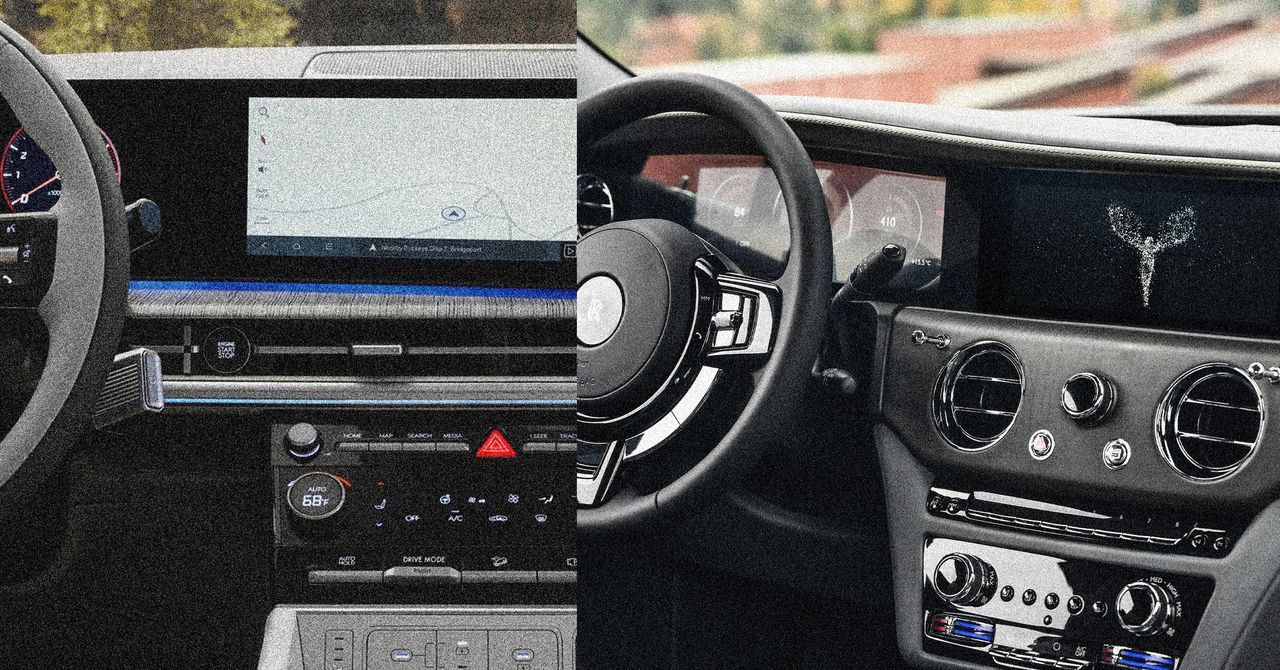
Automakers that nest key controls deep in touchscreen menus—forcing motorists to drive eyes-down rather than concentrate on the road ahead—may have their non-US safety ratings clipped next year.
From January, Europe’s crash-testing organization EuroNCAP, or New Car Assessment Program, will incentivize automakers to fit physical, easy-to-use, and tactile controls to achieve the highest safety ratings. “Manufacturers are on notice,” EuroNCAP’s director of strategic development Matthew Avery tells WIRED, “they’ve got to bring back buttons.”
Motorists, urges EuroNCAP’s new guidance, should not have to swipe, jab, or toggle while in motion. Instead, basic controls—such as wipers, indicators, and hazard lights—ought to be activated through analog means rather than digital.
Driving is one of the most cerebrally challenging things humans manage regularly—yet in recent years manufacturers seem almost addicted to switch-free, touchscreen-laden cockpits that, while pleasing to those keen on minimalistic design, are devoid of physical feedback and thus demand visual interaction, sometimes at the precise moment when eyes should be fixed on the road.
A smattering of automakers are slowly admitting that some smart screens are dumb. Last month, Volkswagen design chief Andreas Mindt said that next-gen models from the German automaker would get physical buttons for volume, seat heating, fan controls, and hazard lights. This shift will apply “in every car that we make from now on,” Mindt told British car magazine Autocar.
Acknowledging the touchscreen snafus by his predecessors—in 2019, VW described the “digitalized” Golf Mk8 as “intuitive to operate” and “progressive” when it was neither—Mindt said, “we will never, ever make this mistake anymore … It’s not a phone, it’s a car.”
Still, “the lack of physical switchgear is a shame” is now a common refrain in automotive reviews, including on WIRED. However, a limited but growing number of other automakers are dialing back the digital to greater or lesser degrees. The latest version of Mazda’s CX-60 crossover SUV features a 12.3-inch infotainment screen, but there’s still physical switchgear for operating the heater, air-con, and heated/cooled seats. While it’s still touch-sensitive, Mazda’s screen limits what you can prod depending on the app you’re using and whether you’re in motion. There’s also a real click wheel.
But many other automakers keep their touchscreen/slider/haptic/LLM doohickeys. Ninety-seven percent of new cars released after 2023 contain at least one screen, reckons S&P Global Mobility. Yet research last year by Britain’s What Car? magazine found that the vast majority of motorists prefer dials and switches to touchscreens. A survey of 1,428 drivers found that 89 percent preferred physical buttons.
Motorists, it seems, would much prefer to place their driving gloves in a glove compartment that opens with a satisfying IRL prod on a gloriously yielding and clicking clasp, rather than diving into a digital submenu. Indeed, there are several YouTube tutorials on how to open a Tesla’s glove box. “First thing,” starts one, “is you’re going to click on that car icon to access the menu settings, and from there on, you’re going to go to controls, and right here is the option to open your glove box.” As Ronald Reagan wrote, “If you’re explaining, you’re losing.”
Voice Control Reversion
The mass psychosis to fit digital cockpits is partly explained by economics—updatable touchscreens are cheaper to fit than buttons and their switchgear—but “there’s also a natural tendency [among designers] to make things more complex than they need to be,” argues Steven Kyffin, a former dean of design and pro vice-chancellor at Northumbria University in the UK (the alma mater of button-obsessed Sir Jonny Ive).
“Creating and then controlling complexity is a sign of human power,” Kyffin says. “Some people are absolutely desperate to have the flashiest, most minimalist, most post-modern-looking car, even if it is unsafe to drive because of all the distractions.”
