

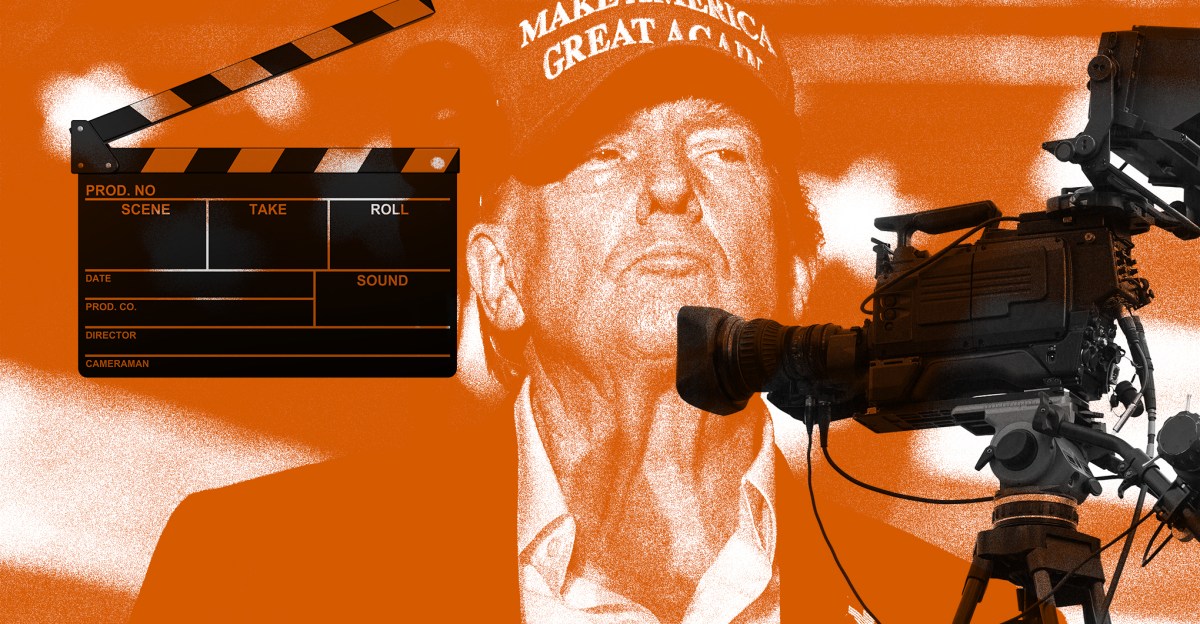
After slamming everything from clothing to avocados with tariffs, now President Donald Trump has taken aim at films. “The Movie Industry in America is DYING a very fast death,” Trump proclaimed on Truth Social last week, while floating a 100 percent tariff on movies “produced in Foreign Lands.”
The news stirred up confusion across Hollywood, as it would seemingly apply to a broad range of films, maybe even US films with scenes shot abroad. Though Trump has already begun to reel his original statement back in, as he told CNBC that he’s “not looking to hurt the industry,” it doesn’t seem like he’s given up on the idea completely. But like many of Trump’s plans, he’s relying on presidential powers that are stretched to a breaking point.
“A car has a value when it arrives at a US port that they can slap a tariff on,” says Mark Jones, a professor of political science at Rice University. “But because of the way the film industry works, it’d be much tougher to determine what proportion of the film you would actually apply a tariff to.”
Trump’s tariff plan appears to have spun out of a meeting with actor Jon Voight, a fervent Trump supporter who has been appointed a “special ambassador” to “make Hollywood great again.” The plan, which has since been published in full by Deadline, mentions offering more tax incentives for producers, but also proposes tariffs. Voight’s plan says that if a film “could have been produced in the U.S. but the producer elects to produce in a foreign country and receives a production tax incentive,” then the government should impose a tariff “equal to 120% of the value of the foreign incentive received.”
Typically, Congress is in charge of imposing tariffs, but Trump has become an expert at pulling emergency levers to unilaterally stick fees on imported goods. His past few months of sweeping tariffs leverage the International Emergency Economic Powers Act (IEEPA) of 1977, a law that grants the president the power to implement tariffs in response to an “unusual and extraordinary threat” to national security or the economy.
As pointed out by the Brennan Center for Justice — and the many states suing Trump — the current global trade situation doesn’t call for a national emergency. “By no stretch of the imagination can long-standing trade relationships be considered an unforeseen emergency,” a writeup from the Brennan Center for Justice says. “If Trump believes that global tariffs could benefit the United States, he needs to make his case to Congress.”
Trump hasn’t said what law he’d use to tax movies. If it’s the IEEPA, then even by his usual standards, that’s a stretch. The rule includes a specific carveout to protect the exchange of “informational materials,” such as publications, films, posters, photographs, CDs, and artwork. That language suggests even under his emergency powers, Trump shouldn’t have the authority to impose tariffs on movies.
We saw the “informational material” rules come into play during Trump’s first term, when a federal judge blocked his initial ban on TikTok in 2020. The judge ruled the president doesn’t have the “authority to regulate or prohibit” the import of informational materials and “personal communications, which do not involve a transfer of anything of value.”
But there’s a different rule Trump could use to impose tariffs on films: Section 232 of the Trade Expansion Act of 1962. This law allows the president to impose or adjust tariffs if the US Secretary of Commerce finds that a particular import can “threaten or impair the national security.” In his post proposing a tariff on films, Trump called the film incentives offered by foreign countries a “concerted effort” to take away films from the US, making it a “National Security Threat.”
Even if that dubious logic holds, collecting the money would raise more problems. Films can cross our borders in many different ways that would allow them to avoid going through customs and facing tariffs — whether they’re uploaded to a cloud storage service, beamed through a streaming service like Netflix, or even transferred to movie theaters using hard drives.
“If it was going to happen, it wouldn’t look at all like a tariff.“
“The laws that the President can rely upon to hit imported goods aren’t laws that provide him authority to do that in respect of audio-visual content that doesn’t clear customs or is already here,” John Magnus, president of Tradewins LLC, a DC-based trade consultancy, told The Verge. “So most likely, if it was going to happen, it wouldn’t look at all like a tariff.”
It might be possible to collect something like an excise tax, which is placed on goods purchased in the country, like cigarettes, alcohol, soda, and gas. But this would likely be out of Trump’s control, as, again, only Congress typically has the authority to impose taxes — and unlike tariffs, there’s no emergency power for excise taxes..
If Congress took up the cause of an excise tax, it would likely be applied to the distributor of a foreign film, which would then be passed onto consumers, likely raising the price of everything from movie tickets to streaming services.
“Prices are already much higher than they used to be,” Christopher Meissner, a professor of economics at the University of California Davis, tells The Verge. “It’ll limit the range of movies we can watch.”
Like many of the things Trump espouses, the specifics surrounding film tariffs are nonexistent, and the plan may never come to fruition. “We spend a lot of time and energy discussing things and analyzing things that, at the end of the day, are going to lead to nothing, because he [Trump] has no real intention,” Jones says. “It may be that he has an intention now, but moving forward, they’re never going to amount to anything.”
That said, a lot of people never thought Trump could blow up US-China trade either — and we’re all seeing how that turned out.
