

Stocktrek Images/Getty Images
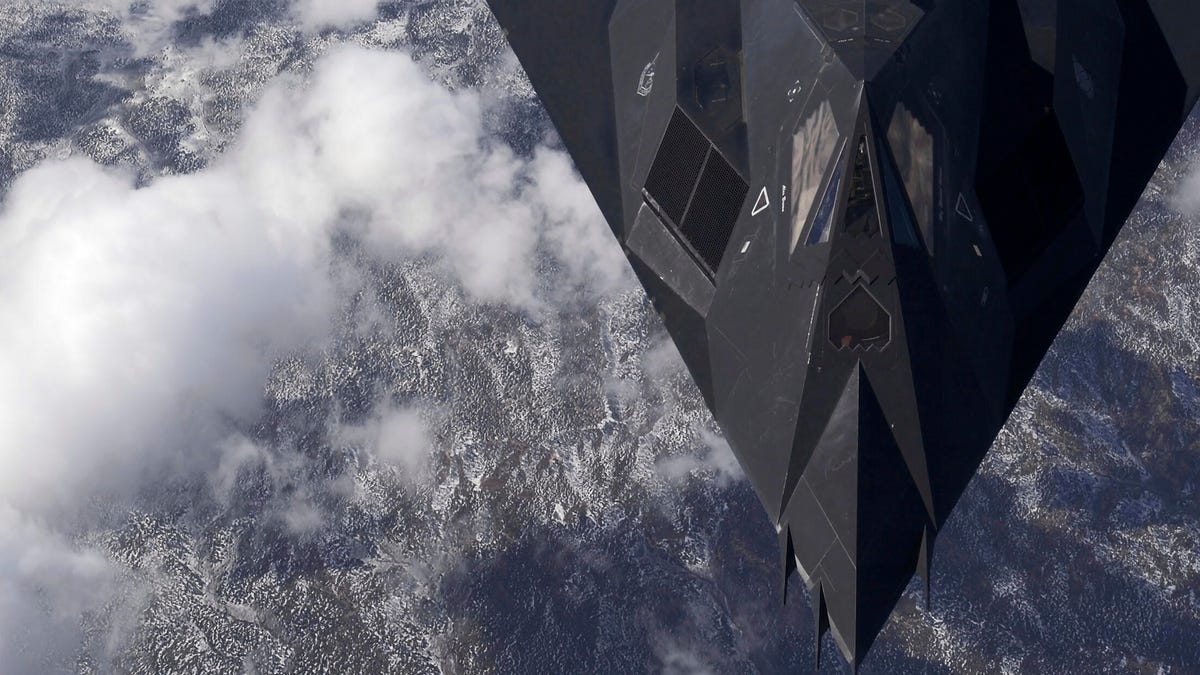
The Lockheed F-117 Nighthawk, the first stealth aircraft, had a striking design driven by radar invisibility rather than intimidation. Its flat, triangular surfaces minimized radar detection but caused instability in yaw, pitch, and roll — the three dimensions of flight control.
Most aircraft are designed to be stable, allowing pilots to easily control their movement and return to a steady course after disturbances. Stability is crucial for safety and ease of flight, exemplified by the Cessna 172 Skyhawk, a highly stable trainer aircraft forgiving of pilot error. However, some aircraft prioritize performance, like fighter jets that require high maneuverability, which inherently reduces stability. Traditionally, aircraft design involved a trade-off between stability and performance.
Also: 5 ways you can plug the widening AI skills gap at your business
The F-117 overcame its inherent instability through fly-by-wire technology, where computer systems assist pilots by controlling the aircraft’s surfaces electronically, unlike traditional mechanical systems. This innovation decoupled the stability requirement from the pursuit of specific performance goals like stealth.
Fly-by-wire is now common, and its evolution has led to Intelligent Flight Control Systems (IFCS) powered by artificial intelligence (AI). These systems go beyond stabilization, actively working to achieve the pilot’s objectives, predict failures, and even compensate for damage, optimizing performance in flight. The development of fly-by-wire and IFCS demonstrates a shift in aircraft design. Previously, human limitations necessitated compromises in stability for performance. Now, technology manages stability, allowing for the design of aircraft optimized for specific outcomes like passenger safety, radar evasion, combat effectiveness, or fuel efficiency, removing prior constraints.
This trade-off between stability and performance isn’t unique to aircraft; it applies to various product and system designs, influenced by the desired level of control. Control can be achieved by either stabilizing behavior for easier manipulation (down-control) or amplifying behavior for greater impact (up-control), depending on the user’s expertise. Down-control prioritizes ease of use and forgiveness through stabilization, often sacrificing performance. Up-control prioritizes specific performance characteristics like speed and precision, often at the cost of stability.
Consider a beginner tennis player needing a forgiving racket (down-control) versus an expert wanting a responsive racket for strategic play (up-control). This distinction exists in running shoes (stability versus speed), skis (ease versus performance), kitchen knives (general use versus specialized precision), and photography (automated assistance versus manual control).
Also: Why WFH isn’t dead and how digital-first companies have a big AI advantage
The integration of AI fundamentally alters this compromise by managing stability, allowing users and designers to focus on and achieve maximum performance, leading to entirely new system possibilities. This concept extends to business. While stability is often seen as desirable, especially in turbulent times, an overemphasis on it might hinder high performance. Ultimately, AI allows organizations to move beyond the traditional stability-performance trade-off, designing for maximum performance while maintaining stability, creating new avenues for innovation and competitive advantage by delivering both reliability and high performance simultaneously.
We’ve always needed to find compromises between making something easy for us to use and manage, and making us perform at a high level. The more stable a system is, the easier it is for us to use and manage; the higher performing it is, the more unstable it tends to be. At some performance point, the system becomes so unstable that it’s impossible for a human to use/manage it — and there’s no point in designing a system like that.
Also: Tech leaders are seemingly rushing to deploy agentic AI – here’s why
Far from being inherently unstable, our businesses — which are a type of system — are actually built for stability. Our hierarchical organization structure, our departmental systems and silos, our business processes are all intentionally designed to be stable. We talk about pillars and foundations, and a form of resilience that sounds a lot more like resistance to “tumultuous times” than embracing them or seeing opportunity in them. It’s a truism that humans hate change, and we see that in business all the time.
Powerful and advanced technology like AI means we do not have to make that design compromise or trade-off anymore. We can design for high performance and activate AI to take care of the instability for us. Our companies today are conventionally super-stable because that makes them easy for us to manage and because we think it gives them survivability amid external turbulence, chaos, instability, whatever you want to call it. But that super stability makes it very hard for them to adjust course and even harder to achieve high performance.
Also: How AI can help you finally demolish your business’s mounting technical debt
The unrecognized effects of blockage on corporate success are significant, and growing faster than ever before. Blockages, waste, silos are all part of it. AI offers us the opportunity to redesign them — to make them high-performance without losing the appearance and feeling of stability. It’s not a matter of making them respond to instability; it’s a matter of making them inherently unstable themselves to achieve high performance, but managing that instability with AI.
This is an important inflection point for business leaders. There’s a fork in the road and the choice is between a path that’s very unfamiliar but with nonlinear potential and a path that’s very familiar but destined for obsolescence. That second path is the one designed for and led by humans.
This article was co-authored by Henry King, co-author of Boundless and a new book, Autonomous, Wiley October 2025.
Want more stories about AI? Sign up for Innovation, our weekly newsletter.
