

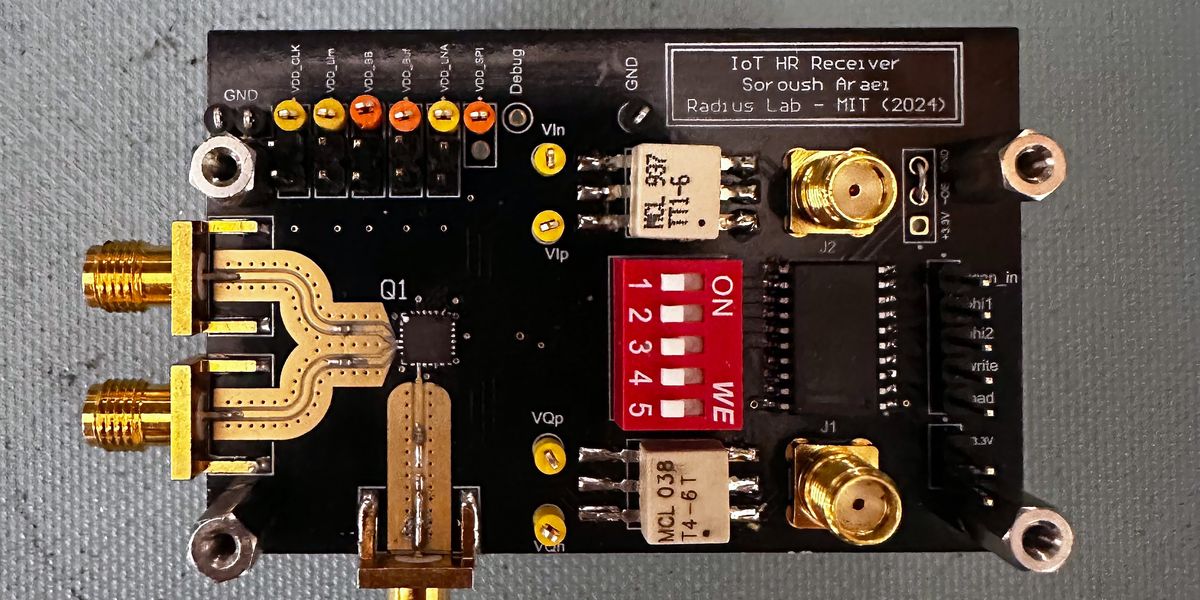
A new chip component designed by MIT researchers promises to expand the reach of the Internet of Things into 5G. The discovery represents a broader push for 5G-based IoT tech—using the telecom standard’s low latency, energy efficiency, and capacity for massive device connectivity. The new research also signals an important step toward applications that include smaller, low-power health monitors, smart cameras, and industrial sensors, for instance.
More broadly, the prospect of moving the IoT onto 5G means more things can connect more quickly with potentially greater data speeds and less battery drain. It also means trickier and more complicated circuits will need to be toiling away behind the data streams.
And doing all this using 5G standards rather than equivalent 4G/LTE or Wi-Fi networks arguably means IoT is expanding its range and scope. It’s moving beyond relatively modest-sized IoT deployments to broader networks boasting the potential for hundreds of nodes or more.
To clarify, however, says Soroush Araei, a PhD candidate at MIT in electrical engineering and computer science, IoT-over-5G doesn’t mean that every node in a network will suddenly be getting its own phone number.
“The main goal here is that you have a single radio receiver that can be reused for different applications,” Araei says. “You have a single piece of hardware which is flexible, and you can tune it across a wide frequency range in software.”
Using 5G standards rather than 5G wireless networks allows IoT devices to frequency hop, to sip their battery power, and to use massive-connectivity tricks that allow for up to one million devices per square kilometer.
How to Make a 5G IoT Chip
On the other hand, the fact that IoT developers have to date been slow to adopt 5G underscores just how difficult the hardware challenge is.
“For IoT, power efficiency is critical,” says Eric Klumperink, associate professor of IC design at the University of Twente in Enschede, Netherlands. “You want a decent radio performance for very low power—[using] a small battery or even energy harvesting.”
But with more and more devices connecting to more and more networks, 5G or otherwise, other concerns rear their heads too.
“In a world increasingly saturated with wireless signals, interference is a major problem,” says Vito Giannini, a technical fellow at Austin, Tex.-based L&T Semiconductor Technologies. (Neither Giannini nor Klumperink were involved with the MIT group’s research.)
Using 5G standards potentially addresses both issues, Araei says. Specifically, he says, the MIT group’s new tech relies on a slimmed-down version of 5G that’s already been developed for IoT and other applications. It’s called 5G reduced capacity (or 5G RedCap).
“5G RedCap IoT receivers can hop across frequencies,” he says. “But they’re not required to be as low-latency as the top-tier 5G applications [including smartphones].”
By contrast, the simplest IoT chip that uses Wi-Fi would rely on a single frequency band—perhaps 2.5 or 5 gigahertz—and could potentially seize up if too many other devices were using the same channel.
Frequency hopping, however, requires robust radio communications hardware that can quickly switch between frequency channels as directed by the network and then ensure the frequency hops align with network instructions and timing.
That’s a lot of hardware and software smarts packed into a tiny chip that might be just one of hundreds of motes affixed to pallets across an entire warehouse.
But features like that are just the appetizers, Araei says.
The centerpiece of any viable 5G RedCap chip is the hardware that can flexibly work across a range of frequencies, while still keeping to a tiny power budget and a modest overall cost for the device. (The MIT group’s tech can only be used for receiving incoming signals; other chip components would be needed to transmit across a similarly wide range of frequencies.)
Here the researchers pulled a few tricks from the world of analog circuits and power electronics. But rather than bulk components layered and stacked like ceramic capacitors, the present work integrates these tricks into an on-chip system to miniaturize RF frequency hopping cheaply and efficiently. The researchers presented their work last month at the IEEE Radio Frequency Integrated Circuits Symposium in San Francisco.
“This is kind of a switched-capacitor network,” Araei says. “You’re turning on and off these capacitors in a periodic manner sequentially, which is called ‘N-path structure.’ That generally gives you a low-pass filter.”
Which means that rather than using a single capacitor in the circuit, the team used a miniaturized bank of capacitors to flick on and off in tune with the needs of the frequency range being received at the circuit.
And because they could put all this frequency-filtering wizardry at the front-end of the circuit, before the amplifier touches the signal, the team reports high efficiency at blocking out interference. Compared to conventional IoT receivers, they report, their circuit can filter out 30 times more interference, while doing so using only single-digit milliwatts of power.
In other words, the group appears to have designed some pretty effective low-power 5G IoT receiver circuitry. So who can design a similarly clever transmitter?
Do both of those, and someone someday will be in business, says Klumperink. “There are arguments to be made for IoT-over-5G (or 6G),” he says. “Because spectrum is allocated and managed better than ad hoc Wi-Fi connections.”
Running the Internet of Things over 5G realistically means operating with very low power requirements. The MIT team’s chip consumes less than a milliwatt while still filtering out extraneous signals.Soroush Araei
Is This the Stuff of 5G IoT Chips to Come?
The MIT group’s circuitry, Klumperink says, could conceivably be manufactured at a mainstream chip fab.
“I don’t see big hurdles as the circuit is implemented in mainstream CMOS technology,” Klumperink says. (The group’s circuits demand only a 22-nanometer fabrication process, so it wouldn’t need to be a bleeding-edge foundry by any stretch.)
Araei says the team aims next to work on eliminating a need for a battery or other dedicated power supply.
“Is it possible to get rid of that power supply and basically harness the power from the existing electromagnetic waves in the environment?” Araei asks.
He says they also hope to extend the frequency range for their receiver tech to cover the whole frequency range of 5G signals. “In this prototype we were able to achieve low frequencies of 250 megahertz up to 3 GHz,” he says. “So is it possible to extend that frequency range let’s say up to 6 GHz, to cover the entire 5G range?”
If these various upcoming hurdles can be cleared, says Giannini, a range of applications probably appear on the near-term horizon. “It offers an advantage for mobility, scalability, and secure wide-area coverage in mid-range and mid-bandwidth scenarios,” he says of the MIT group’s work. He adds that the new circuit’s 5G IoT adaptability could make the tech well suited for, he says, “industrial sensors, some wearables, and smart cameras.”
From Your Site Articles
Related Articles Around the Web
