

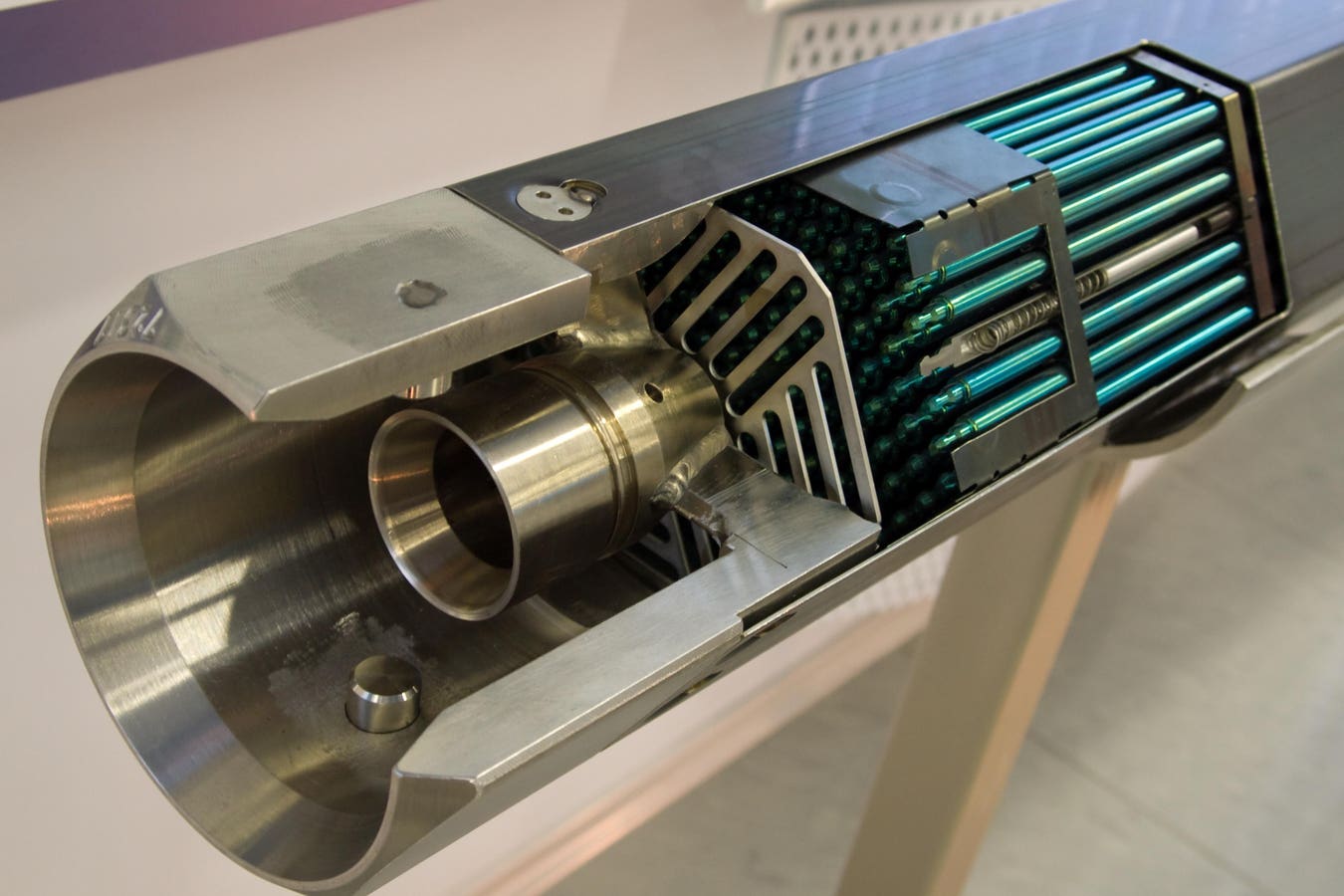
Part of a nuclear reactor fuel rod element.
getty
The U.S. Nuclear Regulatory Commission has completed a study of advanced, better performing accident tolerant fuels being developed by three U.S. companies as it prepares to handle licensing demand for new commercial nuclear power reactors.
Accident tolerant fuels may offer important technological advances to increase the safety of U.S. nuclear power plants. ATFs are being studied to determine their potential to perform better in normal operations and during transportation as well as in nuclear power plant accidents.
The NRC’s Office of Nuclear Regulatory Research recently released the report prepared by the U.S. Department of Energy’s Pacific Northwest National Laboratory.
The Richland, Wash.-based PNNL is providing technical assistance about the proposed nuclear fuel and new fuel cladding designs that may replace current nuclear fuel rods made with zirconium-based alloys.
The 91-page highly technical report is called “Spent Fuel Storage and Transportation of Accident Tolerant Fuel Concepts” and outlines the latest information on fuel material properties and performance associated with storing and transporting spent nuclear fuel.
The federal government is evaluating the performance of nuclear power systems containing ATF. The NRC says the same performance requirements are being sought with irradiated ATF fuel as mandated for conventional zirconium alloy cladded uranium dioxide fuel.
3 Companies Testing New Nuclear Power Plant Fuels
The new report explores the current activities of the following companies in their developments with ATFs and fuel cladding designs:
- Framatome—has tested cladding and enriched uranium fuel. It hopes to commercialize two ATF designs as part of the CEA-Framatome-EDF French nuclear fuel joint program. Framatome on July 17 opened its expanded operations in Lynchburg, Va. with a dedicated nuclear training center to support next-generation small and advanced reactor technologies. The company plans to hire 500 employees there.
- Global Nuclear Fuels—has experimented with alloys, cladding and enriched uranium fuel. A joint venture led by General Electric, the company is working with GE to commercialize two ATF designs for use in boiling water nuclear reactors.
- Westinghouse—has tested cladding and enriched uranium fuel. The company is simultaneously developing both near- and long-term ATF designs.
DOE Also Studying Innovations in Nuclear Reactor Fuels
The DOE is working on its Advanced Fuels Campaign with teams of researchers seeking new nuclear power plant fuels at five of its national laboratories. The federal collaborations are centered at the PNNL, Brookhaven National Laboratory, Idaho National Laboratory, Oak Ridge National Laboratory and Los Alamos National Laboratory.
Advanced Fuels Campaign national laboratories are located in many regions of the U.S.
U.S. Department of Energy
According to DOE, ATFs offer several advantages over conventional nuclear energy fuel. ATFs are being developed to improve nuclear reactor safety “by maintaining structural integrity and reactor cooling for a longer duration during severe accident conditions,” DOE says. ATFs
- Can withstand extreme heat/steam longer.
- Last longer with better efficiently in a reactor core to possibly lengthen refueling from 1.5 years to 2 years while using 30% less fuel.
- Generate less waste and lower fuel costs.
The main objective of the Advanced Fuels Campaign is to develop and use ATFs to significantly increase nuclear power performance and safety.
Further ATF Developments Expected
Researchers lower a test train into the Advanced Test Reactor at Idaho National Laboratory.
Idaho National Laboratory
The NRC report also discussed whether its current regulations would apply to ATF storage and transportation. While it advised companies applying for licenses to provide justification data to support their applications, the NRC noted the federal government’s current regulatory framework for storing and transporting spent nuclear fuel would generally cover apply to ATFs. These findings would appear to pave the way for greater interest by companies in turning to nuclear power to meet their energy demands.
