

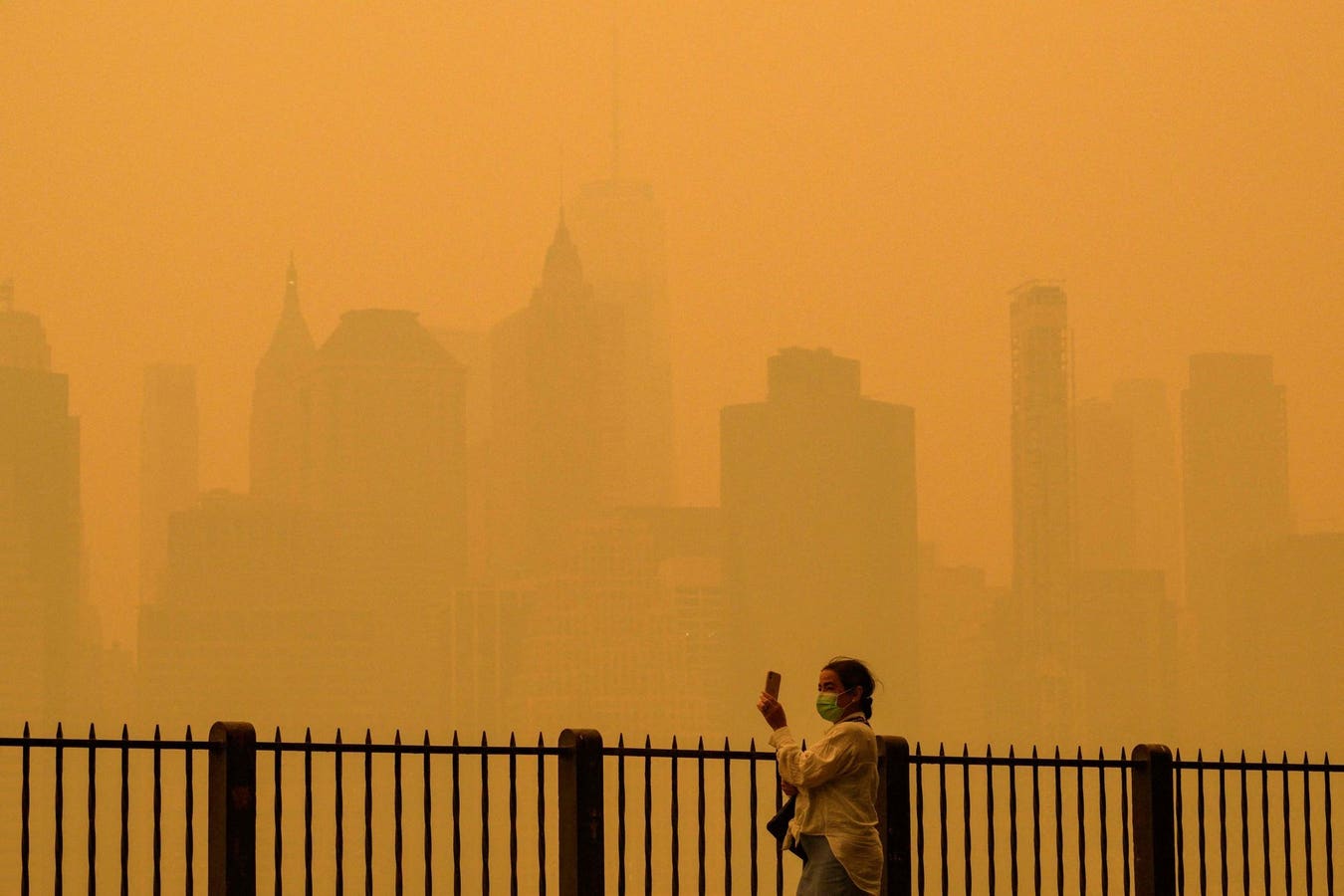
TOPSHOT – A person wearing a face mask takes photos of the skyline as smoke from wildfires in Canada … More
AFP via Getty Images
As climate risks intensify — rising seas, extreme heat, and ever-more-frequent storms—cities are being forced to confront a new reality. For centuries, urban centers have been magnets for people, capital, and innovation. Now, they are on the frontlines of climate adaptation, resilience building and migration, and will be forced to rethink everything from their infrastructure to the fundamentals of urban life.
Against the backdrop of a warming planet, mayors and municipal officials must make decisions that will shape the future of urban life for generations to come. The stakes are high: climate impacts are not distant threats, but immediate challenges that touch every aspect of city living—from housing and transportation to public health and economic opportunity. The complexity of these issues means that there is no one-size-fits-all solution; rather, each city must navigate its own unique vulnerabilities, resources, and political landscapes.
The Jakarta Parable: When a City Must Move
Jakarta, Indonesia’s capital, home to over 10 million people, is sinking. Rising sea levels and extensive groundwater extraction has made Jakarta one of the fastest-sinking megacities in the world. Up to 40% of the city can be underwater during the rainy season, and the problem is worsening.
Faced with this reality, Indonesia has embarked on one of the most ambitious urban projects in modern history: relocating its capital from Jakarta to Nusantara, a new city being built on the island of Borneo.
But moving a city is no simple task. As Robert Blake, former U.S. Ambassador to Indonesia and Senior Managing Director at McLarty Associates has cautioned, “It’s one thing for the political authorities to move the government apparatus to a new capital, but it’s much harder to convince local businesses and citizens to move to a new capital.” Numerous neighboring cities and islands in Indonesia rely heavily on Jakarta for commerce and resource access. As if relocating a city of over 10 million people was challenging enough, ensuring that the local economy does not suffer in turn is a separate challenge in and of itself.
Jakarta is nearly 500 years old and is one of southeast Asia’s longest continuously-inhabited cities. The current effort to relocate it shows that for many major cities, incremental improvements will not suffice. Instead, entire urban systems—how they are planned, built, and operated—must be fundamentally reimagined.
And while Jakarta may be one of the most notable cases at the moment, it is not alone. United Nations’ head Antonio Gutierres, has discussed how major urban areas around the world, from Cairo to Buenos Aires, Bangkok to New York will face a range of existential risks as sea levels and temperatures rise. Building resilience often comes in the form of enormous infrastructure upgrades – new bridges, roads, sea walls, buildings, etc. – but as Gutierres has cautioned, adapting to climate change may entail mass migration. In these cases needs will go far beyond standard mitigation and adaptation measures, requiring protection across the human development spectrum.
Cities will be the testbeds for innovative policy, technology and financing approaches to addressing climate risks. They will be on the frontline for making difficult decisions about how to protect their populations, encompassing economic, environmental and humanitarian considerations that few urban leaders have ever been asked to address. This process is still in its infancy. As Blake warned, “We’re really just at the beginning stages of thinking about adaptation in Jakarta and other major metro areas around the world.”
Building a Sustainable City: A Model from Dubai
Beyond basic upgrades, we will also likely need to build entirely new cities. Dubai’s Sustainable City, built by entrepreneur and developer Faris Saeed and his company Diamond Developers, offers a proactive model for building climate resilience from the ground up. Saeed’s Sustainable City is a living laboratory for urban sustainability in the desert environment of the United Arab Emirates.
“We wanted to create a city that is not just sustainable in terms of energy and environmental targets, but also socially sustainable,” Saeed explained. “The Sustainable City is designed to be net-zero energy, where solar panels, urban farming, water and waste recycling, clean mobility, and inclusive public spaces are seamlessly integrated into everyday life, fostering both environmental responsibility and human well-being,” he added.
But introducing clean and sustainable technology solutions is only a fraction of the city’s larger vision. “Sustainability is not just about technology. It’s about changing mindsets, creating social cohesion, and building economic resilience,” Saeed said. “We have shown that you can build a city that is both profitable and good for the planet.” Its model reflects a mixture of innovative design and technology considerations mixed with a broader community engagement approach and residents are active participants in sustainability efforts, from recycling to urban farming. The city does not allow any vehicles in its borders aside from golf carts that residents drive to get around the neighborhoods, it comes equipped with schools, restaurants, grocery stores, wellness facilities and is also home to the SEE Institute, a hub for sustainability education, research and business incubation.
Replicability and scalability considerations have been critical since day one – as Saeed argues, “This model can be scaled and adapted for cities around the world, especially those facing water scarcity or extreme heat.” In fact Saeed and his team have received inquiries for projects from over 50 countries, and currently have plans in the United States (Dallas, Texas), Europe (Norway, Greece and Cyprus), Southeast Asia (South Korea) as well as other locations in the Middle East and North Africa.
Global Approaches: A Spectrum of Urban Climate Solutions
Jakarta and Dubai are just two cases on a spectrum of global responses to urban climate risk.
For example, Kiribati, the Pacific Island Nation has enacted the “Migration with Dignity” project wherein it has purchased land in Fiji to potentially relocate its population as sea levels rise. In the EU coastal cities like Rotterdam and Venice have used a range of technologies and infrastructure projects to combat flooding, with the MOSE project one of the more notable attempts globally to use a system of mobile flood barriers to safeguard the city of Venice. In parallel, the Netherlands is also experimenting with floating homes – most notably IJburg.
And cities will have to do more than just prepare for more flooding. For instance, Medellin, Colombia has transformed its urban landscape with green corridors and parks to combat the urban heat island effect and improve air quality. And RESO, an underground city in Montreal, Canada, while not originally designed in response to climate change, is composed of an extensive underground network that protects residents from extreme weather conditions.
Lastly, numerous smart city approaches abound, including cases like Songdo, in South Korea, and Tianjin Eco-City in China, which are both large-scale, eco-friendly urban developments that aim to be sustainable and smart cities. Both projects involve reclaimed land and aim to be models for other smart city developments around the world.
These examples underscore a fundamental truth: there is no one-size-fits-all solution to urban climate adaptation. Each city must tailor its approach to its unique geographical, economic, and social context. What works in the Netherlands may not be feasible in Kiribati, and the lessons learned in Medellin might not translate directly to Montreal.
As much as the current climate realities are sobering, these diverse strategies are also a source of inspiration and learning. By studying how cities around the world are confronting climate risks—whether through technological innovation, social adaptation, or radical reimagining of urban space—leaders can gain insights into potential pathways for their own communities.
Decisions and Challenges for Urban Leaders
Urban leaders face a daunting set of choices as they prepare for climate change. The below challenge areas are just a snapshot of what any leaders’ agenda could look like.
- Relocation vs. resilience: Should cities invest in massive resilience projects, or is relocation the only viable option for some?
- Financing the future: How can cities secure the trillions needed for climate-resilient infrastructure—especially in developing countries with limited resources?
- Technological innovation: What role can new technologies (e.g., floating solar, smart grids, advanced water systems) play, and how can cities ensure equitable access?
- Community buy-in: How can leaders ensure that residents, businesses, and civil society are engaged and willing to embrace change?
- Protecting the most vulnerable: How can vulnerable populations be protected, especially in places where capacity and resources are most limited?
Urban leaders must balance the urgent need for rapid action with the importance of long-term planning and community engagement. They are tasked with making choices that address both immediate risks, such as flooding or heatwaves, and systemic issues like inequality and infrastructure resilience. These decisions often require trade-offs between competing priorities: economic growth versus environmental protection, short-term costs versus long-term benefits, and the interests of current residents versus those of future generations.
This shift is about more than deploying solar panels or electric buses; it’s about redesigning the very DNA of urban life. The goal for cities is not simply to be “greener” or more energy-efficient. In many cases, survival and prosperity will depend on the willingness to redesign how cities are created and operated or in extreme instances, the ability to move entire populations to safer ground. Cities that act boldly and creatively today will be the ones that thrive tomorrow. As climate risks mount, the world’s urban centers must become laboratories for resilience, sustainability, and inclusive prosperity. The future of cities—and the people who call them home—depends on it.
