

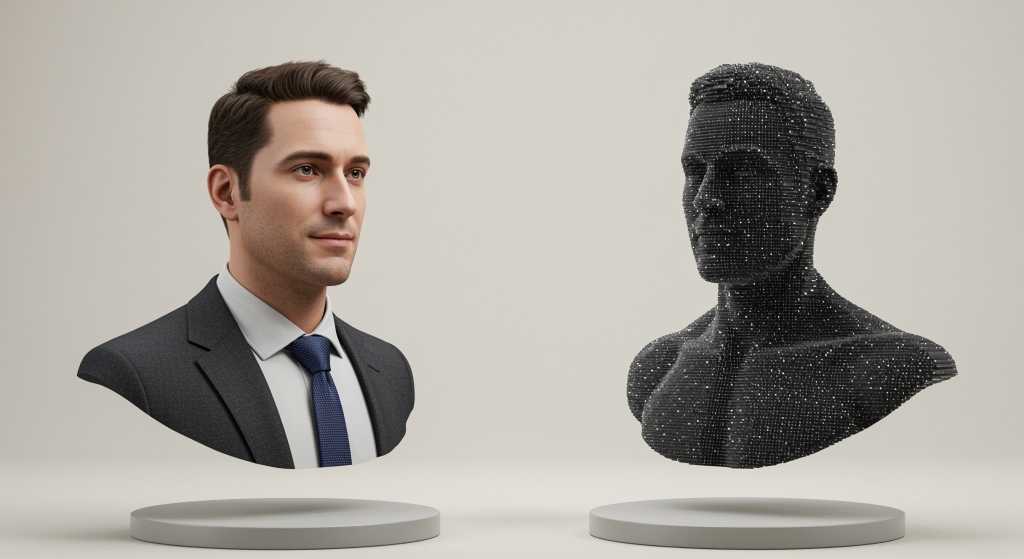
We’re all so busy that it’s tempting to wish for a digital clone to share the workload. And now, thanks to AI, you can.
Many people are embracing generative AI (genAI) tools to make a clone or digital twin of themselves that can speak and even interact on their behalf.
We’re all familiar with the idea of creating fake people using AI. But a digital clone is an AI replica of a real person, with the same appearance, voice, mannerisms, and pertinent knowledge as that person.
Of course, the first thing that comes to mind when we think about digital clones is fraud and porn. Creep factor aside, legitimate and ethical applications for digital clone technologies are emerging.
Some of the genAI tools people are using should be familiar to you: ElevenLabs, OpenAI’s ChatGPT, Google Gemini, Anthropic Claude, and others.
You may be less familiar with Hedra’s Character-3, an AI model that enables the creation of videos featuring talking, singing, or moving digital characters. Led by CEO Michael Lingelbach and CTO Alex Bergman, Hedra released Character-3 in March.
Here’s one way to use it. You can upload a photo of yourself, along with a recording of your voice. Then, you type a prompt about what you want the digital version of you to say and do. The system then bases the video on the photo, the voice on your sample, and the action on your instructions.
The model can create full-body movement, not just faces, and accurately matches lip and facial motion to the audio. It handles up to 90 seconds of video in one go, with output up to 4K at 60 frames per second.
Character-3 is used by content creators, marketers, teachers, and businesses. For example, teachers can create videos with virtual instructors, and brands can utilize digital spokespersons for their advertisements. The tool is part of Hedra Studio, a web platform that brings together Character-3 and other AI tools for video, audio, and images. Hedra Studio enables users to build scenes, add backgrounds, and control the look and feel of each video. Developers can also use Character-3 through an API.
The most-watched creators who are assumed to be using Character-3 today are comedian Jon Lajoie, who runs the Talking Baby Podcast, and virtual singer and musician Milla Sofia.
It’s not just influencers. Businesses of all sizes are using Character-3 to make digital spokespersons and brand mascots for ad campaigns. Brands can create custom characters that match their style and message, and use them in ads, social media, and customer support videos. One benefit is that brands can quickly respond to fast-moving current events or changing circumstances and build the creative for a campaign in minutes, not days.
Businesses can also use Character-3 for internal training, making videos with animated trainers who guide employees through new processes or policies, while developers and AI enthusiasts use the Character-3 API to build new apps and services. (They integrate the model into their own platforms to create custom video tools, chatbots, or virtual assistants.)
Teachers and educational companies can use Character-3 to make lessons with virtual instructors. These digital teachers can explain complex topics, act out scenarios, or speak in different languages, making learning more engaging and accessible. The tool is already used in both schools and online education platforms.
Hedra claims over three million users and more than 10 million videos created with Character-3, showing its broad reach across industries and creative fields.
Clones mean business
Enterprises, mom-and-pop shops and everything in between can use genAI tools to create digital clones or digital twins of their leaders, and for several reasons. These digital versions are virtual copies trained on the leader’s speeches, writings, interviews, and meetings. Companies like Delphi, Tavus, and Personal AI offer services to build these clones by feeding AI large amounts of data from the leader’s communication and behavior.
CEOs like Reid Hoffman, Sam Liang, and Eric Yuan have created AI replicas of themselves to attend meetings, handle investor calls, or answer employee questions when the real person is too busy.
Another reason businesses create digital clones is to preserve and share institutional knowledge. A retiring executive’s AI clone can serve as a mentor to new employees, passing on wisdom and company culture. This helps keep valuable experience accessible even after a leader leaves. Some companies use these clones to onboard new hires by having the digital leader explain company values and strategies. (You can bet Apple would have created a digital clone of Steve Jobs if the technology existed while he was still alive.)
Digital clones also support decision-making and strategy. By embedding a leader’s style and vision into an AI, companies can empower teams with consistent guidance. The clones act as an always-available resource for employees, clients, and partners, offering the kind of advice and insights the real person might. This can expedite decision-making and ensure clarity throughout an organization.
Clones as a repository of knowledge and advice
While the idea of digital clones sounds like dystopian cyberpunk sci-fi (and, in fact, that is where the idea first emerged in the culture), it actually makes a lot of sense for some thought leaders. When people are so sought after that the demand for their wisdom, knowledge, or advice far exceeds their available time, AI can capture all the things they say and offer them up in an automated, interactive way. For such overwhelmed people, a digital clone is better than nothing.
Becky Kennedy, a clinical psychologist from Manhattan, built a business around helping parents handle tough moments with their kids. She started sharing advice on Instagram in 2020, quickly gaining a large following of 3.2 million by 2025. Kennedy’s style is direct and practical. She often records videos between therapy sessions or after dealing with her own children.
Kennedy’s company, Good Inside, launched an AI chatbot called Gigi last year. The chatbot is built on her parenting method and uses OpenAI technology. Parents can use the app to get real-time advice, such as how to manage a child’s tantrum or how to talk about feelings.
The inevitability of superclones
A superclone (my own term) is a digital twin that mimics the appearance, voice, and mannerisms of a real person but possesses far greater capabilities and knowledge than the real person.
The first application of superclones will likely be as personal assistants. When people can craft the ultimate AI helper, they might create it in their own image.
Napster View is a small, high-resolution 2.1-in. 3D holographic display made by Napster — the same brand but different company as the peer-to-peer file sharing service in olden times. (The company launched Napster View in June, just after it rebranded from Infinite Reality and bought Touchcast for $500 million.) Napster View displays Napster Companion, an AI assistant platform.
The system allows users to create and interact with their Napster Companion in real-time. It connects via USB-C and works immediately with no setup required. The device weighs less than 2.3 ounces and is made of anodized aluminum.
Napster View allows users to turn their own face and voice into a digital assistant by recording themselves and submitting the video to Napster’s platform, which then creates a photorealistic 3D avatar that can speak, move, and respond in real-time.
It looks and sounds like you, but has the knowledge of OpenAI and Gemini, which are the models that power the interaction.
Another concept for a superclone would be a CEO or business leader who creates a twin with all their knowledge and ways of speaking, but which is fed real-time information about the company, markets, and other relevant data, effectively creating a digital version of that leader that is more knowledgeable than the flesh-and-blood version.
No matter how you look at it, the age of AI-powered digital clones is here.
