

Join the event trusted by enterprise leaders for nearly two decades. VB Transform brings together the people building real enterprise AI strategy. Learn more
What would it be like to chat with health records the way one could with ChatGPT?
Initially posed by a medical student, this question sparked the development of ChatEHR at Stanford Health Care. Now in production, the tool accelerates chart reviews for emergency room admissions, streamlines patient transfer summaries and synthesizes information from complex medical histories.
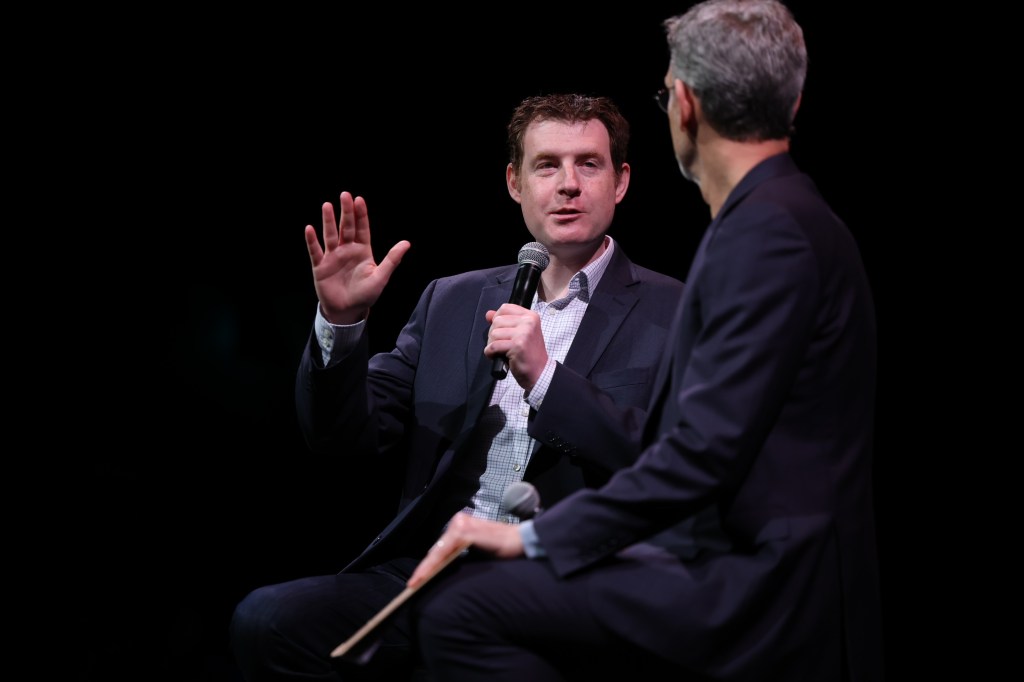
In early pilot results, clinical users have experienced significantly sped-up information retrieval; notably, emergency physicians saw 40% reduced chart review time during critical handoffs, Michael A. Pfeffer, Stanford’s SVP and chief information and digital officer, said today in a fireside chat at VB Transform.
This helps to decrease physician burnout while improving patient care, and builds upon decades of work medical facilities have been doing to collect and automate critical data.
“It’s such an exciting time in healthcare because we’ve been spending the last 20 years digitizing healthcare data and putting it into an electronic health record, but not really transforming it,” Pfeffer said in a chat with VB editor-in-chief Matt Marshall. “With the new large language model technologies, we’re actually starting to do that digital transformation.”
How ChatEHR helps reduce ‘pajama time,’ get back to real face-to-face interactions
Physicians spend up to 60% of their time on administrative tasks rather than direct patient care. They often put in significant “pajama time,” sacrificing personal and family hours to complete administrative tasks outside of regular work hours.
One of Pfeffer’s big goals is to streamline workflows and reduce those extra hours so clinicians and administrative staff can focus on more important work.
For example, a lot of information comes in through online patient portals. AI now has the ability to read messages from patients and draft responses that a human can then review and approve for sending.
“It’s kind of like a starting point,” he explained. “While it doesn’t necessarily save time, which is interesting, it does actually reduce cognitive burnout.” What’s more, he noted, the messages tend to be more patient friendly, because users can instruct the model to use certain language.
Moving on to agents, Pfeffer said they’re a “pretty new” concept in healthcare but offer promising opportunities.
For instance, patients with cancer diagnoses typically have a team of specialists who review their records and determine the next treatment steps. However, preparing is a lot of work; clinicians and staff have to go through a patient’s entire record, not just their EHR but imaging pathology, sometimes genomic data, and information on clinical trials that patients might be a good match for. All of these have to come together for the team to create a timeline and recommendations, Pfeffer explained.
“The most important thing that we can do for our patients is to make sure they have appropriate care, and it takes a multidisciplinary approach,” said Pfeffer.
The goal is to build agents into ChatEHR that can generate a summary and timeline and make recommendations for clinician review. Pfeffer emphasized that it doesn’t replace, it prepares “just incredible summary recommendations in a multimodal way.”
This allows medical teams to do now “actual patient care,” which is critical amidst a physician and nursing shortage.
“These technologies are going to shift the time physicians and nurses spend doing administrative tasks,” he said. And, when combined with ambient AI scribes that take over notetaking duties, medical staff are focusing more time on patients.
“That face-to-face interaction is just priceless,” said Pfeffer. “We’re going to see AI shift more to clinician-patient interaction.”
‘Amazing’ technologies coupled with a multidisciplinary team
Before ChatEHR, Pfeffer’s team rolled out SecureGPT to all of Stanford Medicine; the secure portal features 15 different models that anyone can tinker with. “What is really powerful about this technology is that you can really open it up to so many people to experiment,” said Pfeffer.
Stanford is taking a varied approach to AI development, building its own models and using a mix of secure and private off-the-shelf (such as Microsoft Azure) and open-source models where appropriate. Pfeffer explained that his team is “not completely specific” to one or the other, but rather goes with what will likely work best for a specific use case.
“There’s so many amazing kinds of technologies now that if you can piece them together in the right way, you can get solutions like what we’ve built,” he said.
Another credit to Stanford is its multidisciplinary team; as opposed to a chief AI officer or AI group, Pfeffer gathered a chief data scientist, two informaticists, a chief medical information officer and a chief nursing information officer, and their CTO and CISO.
“We bring together informatics, data science and traditional IT, and wrap that into the architecture; what you get is this magic group that allows you to do these very complex projects,” he said.
Ultimately, Stanford views AI as a tool that everybody should know how to use, Pfeffer emphasized. Different teams need to understand how to use AI so that when they meet with business owners and come up with ways to solve problems, “AI is just part of how they think.”
Daily insights on business use cases with VB Daily
If you want to impress your boss, VB Daily has you covered. We give you the inside scoop on what companies are doing with generative AI, from regulatory shifts to practical deployments, so you can share insights for maximum ROI.
Thanks for subscribing. Check out more VB newsletters here.
An error occured.
