
Close Menu
TechurzTechurz

    Subscribe to Updates

    Get the latest creative news from FooBar about art, design and business.

    What's Hot

    Cursor admits its new coding model was built on top of Moonshot AI’s Kimi

    March 22, 2026

    Delve accused of misleading customers with ‘fake compliance’

    March 21, 2026

    AI startups are eating the venture industry and the returns, so far, are good

    March 20, 2026
    Facebook X (Twitter) Instagram
    Trending
    • Cursor admits its new coding model was built on top of Moonshot AI’s Kimi
    • Delve accused of misleading customers with ‘fake compliance’
    • AI startups are eating the venture industry and the returns, so far, are good
    • Bluesky announces $100M Series B after CEO transition
    • Consumer-focused privacy company Cloaked raises $375M as it expands to enterprise
    • Tools for founders to navigate and move past conflict
    • K2 to launch its first high-powered satellite for space compute
    • Anori, Alphabet’s new X spinout, is tackling one of the world’s most expensive bureaucratic nightmares
    Facebook X (Twitter) Instagram Pinterest Vimeo
    TechurzTechurz
    • Home
    • AI
    • Apps
    • News
    • Guides
    • Opinion
    • Reviews
    • Security
    • Startups
    TechurzTechurz
    Home»AI»The Hidden Ingredients Behind AI’s Creativity
    AI

    The Hidden Ingredients Behind AI’s Creativity

    TechurzBy TechurzAugust 24, 2025No Comments3 Mins Read
    Share Facebook Twitter Pinterest LinkedIn Tumblr Reddit Telegram Email
    The Hidden Ingredients Behind AI’s Creativity
    Share
    Facebook Twitter LinkedIn Pinterest Email

    The original version of this story appeared in Quanta Magazine.

    We were once promised self-driving cars and robot maids. Instead, we’ve seen the rise of artificial intelligence systems that can beat us in chess, analyze huge reams of text, and compose sonnets. This has been one of the great surprises of the modern era: physical tasks that are easy for humans turn out to be very difficult for robots, while algorithms are increasingly able to mimic our intellect.

    Another surprise that has long perplexed researchers is those algorithms’ knack for their own, strange kind of creativity.

    Diffusion models, the backbone of image-generating tools such as DALL·E, Imagen, and Stable Diffusion, are designed to generate carbon copies of the images on which they’ve been trained. In practice, however, they seem to improvise, blending elements within images to create something new—not just nonsensical blobs of color, but coherent images with semantic meaning. This is the “paradox” behind diffusion models, said Giulio Biroli, an AI researcher and physicist at the École Normale Supérieure in Paris: “If they worked perfectly, they should just memorize,” he said. “But they don’t—they’re actually able to produce new samples.”

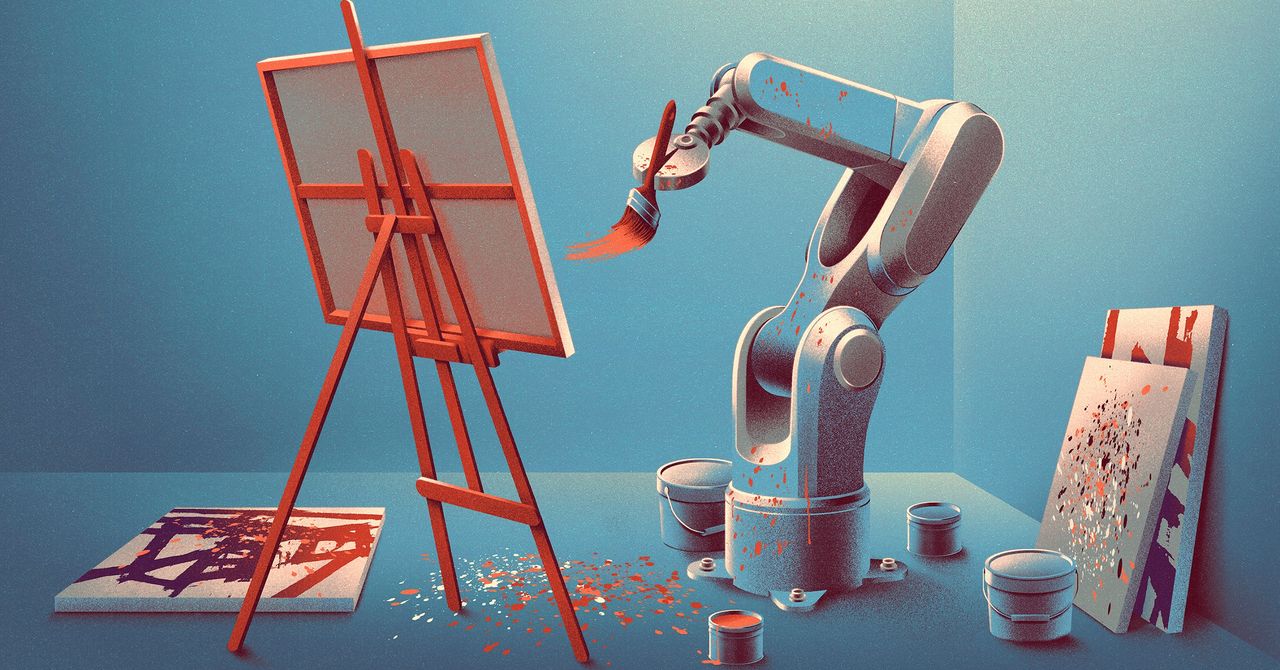
    To generate images, diffusion models use a process known as denoising. They convert an image into digital noise (an incoherent collection of pixels), then reassemble it. It’s like repeatedly putting a painting through a shredder until all you have left is a pile of fine dust, then patching the pieces back together. For years, researchers have wondered: If the models are just reassembling, then how does novelty come into the picture? It’s like reassembling your shredded painting into a completely new work of art.

    Now two physicists have made a startling claim: It’s the technical imperfections in the denoising process itself that leads to the creativity of diffusion models. In a paper presented at the International Conference on Machine Learning 2025, the duo developed a mathematical model of trained diffusion models to show that their so-called creativity is in fact a deterministic process—a direct, inevitable consequence of their architecture.

    By illuminating the black box of diffusion models, the new research could have big implications for future AI research—and perhaps even for our understanding of human creativity. “The real strength of the paper is that it makes very accurate predictions of something very nontrivial,” said Luca Ambrogioni, a computer scientist at Radboud University in the Netherlands.

    Bottoms Up

    Mason Kamb, a graduate student studying applied physics at Stanford University and the lead author of the new paper, has long been fascinated by morphogenesis: the processes by which living systems self-assemble.

    One way to understand the development of embryos in humans and other animals is through what’s known as a Turing pattern, named after the 20th-century mathematician Alan Turing. Turing patterns explain how groups of cells can organize themselves into distinct organs and limbs. Crucially, this coordination all takes place at a local level. There’s no CEO overseeing the trillions of cells to make sure they all conform to a final body plan. Individual cells, in other words, don’t have some finished blueprint of a body on which to base their work. They’re just taking action and making corrections in response to signals from their neighbors. This bottom-up system usually runs smoothly, but every now and then it goes awry—producing hands with extra fingers, for example.

    AIs creativity hidden Ingredients
    Share. Facebook Twitter Pinterest LinkedIn Tumblr Email
    Previous ArticleSmarter AI is supercharging the way we build batteries
    Next Article The MacBook Air Is the Perfect Laptop for Entrepreneurs, and This One is Just $200
    Techurz
    • Website

    Related Posts

    Opinion

    Cursor admits its new coding model was built on top of Moonshot AI’s Kimi

    March 22, 2026
    Opinion

    How WitnessAI raised $58M to solve enterprise AI’s biggest risk

    January 14, 2026
    Opinion

    Harness hits $5.5B valuation with $240M raise to automate AI’s ‘after-code’ gap

    December 11, 2025
    Add A Comment
    Leave A Reply Cancel Reply

    Top Posts

    College social app Fizz expands into grocery delivery

    September 3, 20252,288 Views

    A Former Apple Luminary Sets Out to Create the Ultimate GPU Software

    September 25, 202516 Views

    The Reason Murderbot’s Tone Feels Off

    May 14, 202512 Views
    Stay In Touch
    • Facebook
    • YouTube
    • TikTok
    • WhatsApp
    • Twitter
    • Instagram
    Latest Reviews

    Subscribe to Updates

    Get the latest tech news from FooBar about tech, design and biz.

    Most Popular

    College social app Fizz expands into grocery delivery

    September 3, 20252,288 Views

    A Former Apple Luminary Sets Out to Create the Ultimate GPU Software

    September 25, 202516 Views

    The Reason Murderbot’s Tone Feels Off

    May 14, 202512 Views
    Our Picks

    Cursor admits its new coding model was built on top of Moonshot AI’s Kimi

    March 22, 2026

    Delve accused of misleading customers with ‘fake compliance’

    March 21, 2026

    AI startups are eating the venture industry and the returns, so far, are good

    March 20, 2026

    Subscribe to Updates

    Get the latest creative news from FooBar about art, design and business.

    Facebook X (Twitter) Instagram Pinterest
    • About Us
    • Contact Us
    • Privacy Policy
    • Terms and Conditions
    • Disclaimer
    © 2026 techurz. Designed by Pro.

    Type above and press Enter to search. Press Esc to cancel.