

A long-dead Soviet spaceship is coming back to haunt us. Kosmos 482 was supposed to land on Venus 53 years ago, but a rocket malfunction left it trapped in a slowly-decaying orbit around Earth instead. After all that time, Kosmos 482 finally gets to land – albeit on the wrong planet.
The spacecraft is expected to fall to Earth sometime between May 7 and May 13, as Forbes’s Jamie Carter reports. Here’s the weird story behind this week’s blast from the past (from outer space).
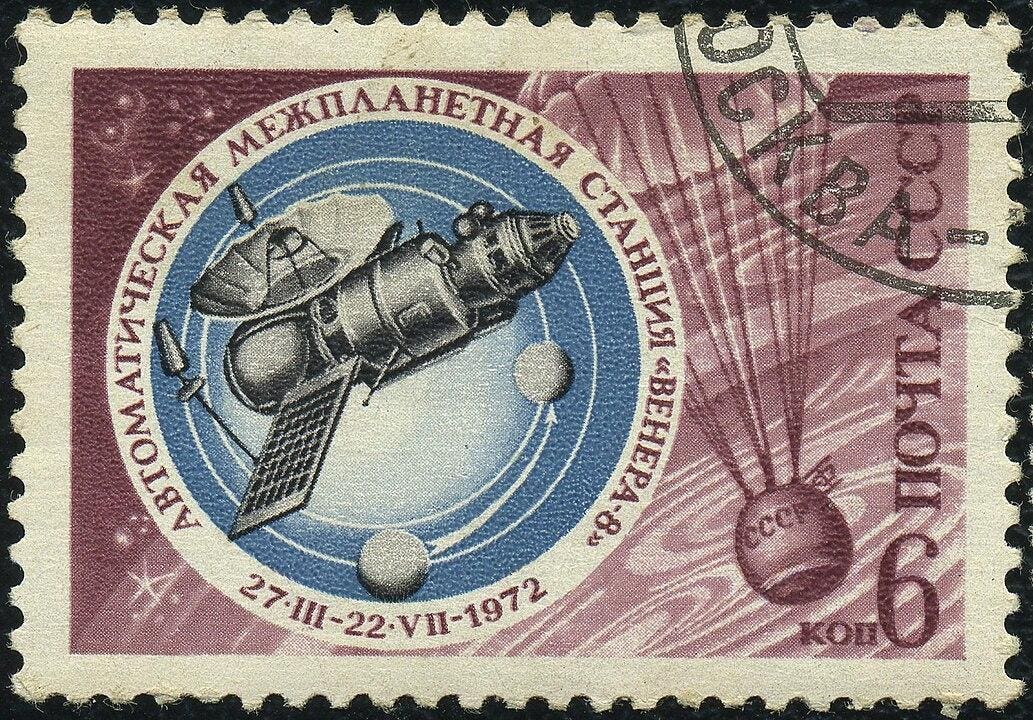
This Soviet stamp commemorates the Venera 8 mission to Venus. The USSR went all-out with its … More
By Post of Soviet Union – This image was scanned or photoreproduced by Andrew Butko. Contact infоrmation – e-mail: abutko@gmail.com. Other scans see here., Public Domain, https://commons.wikimedia.org/w/index.php?curid=4539047
What Went Wrong with Kosmos 482
The spacecraft now called Kosmos 482 should have been Venera 8 or Venera 9: part of a series of Soviet missions to Earth’s backwards-rotating evil twin sister planet, Venus. Between 1961 and 1984, the USSR sent 13 Venera missions to Venus. Venera 8 had launched on March 27, 1972, and its sister ship should have followed close behind. But, as engineers like to say, “space is hard,” and something went wrong.
After blasting off from Baikonur Cosmodrome in Kazakhstan on March 31, 1972, the craft should have briefly settled into what’s called a “parking orbit” around Earth (a parking orbit is sort of a rest stop for interplanetary space missions). Firing the Molniya rocket’s upper stage engine for a few minutes should have pushed the spacecraft out of parking orbit and onto a path toward Venus.
“Typically Soviet planetary missions were initially put into an Earth parking orbit as a launch platform with a rocket engine and attached probe,” explained NASA on its website for the spacecraft. “The probes were then launched toward their targets with an engine burn with a duration of roughly 4 minutes.”
But thanks to an incorrectly set timer, the engine cut off too early, leaving the spacecraft stuck in a wonky orbit around Earth instead of on its way to Venus. The Soviet Union covered their mistake by renaming the spacecraft: instead of becoming one of the Venera missions to Venus, the hapless spacecraft was designed Kosmos, the USSR’s catchall for its spacecraft in Earth orbit.
53 years later, Kosmos 482 is on its way home – but parts of it are already here.
Soviet Space Balls from Kosmos 482
Part of the Kosmos 482 spacecraft – a handful of round titanium pressure vessels, which may have been part of rocket engines, rained down on New Zealand a few days later, causing quite a stir and making into a New Zealand government report on UFOs which was released in 2011.
“South Island residents reported rumbling and lights in the sky on the night of the incident,” reported New Zealand news outlet The Press.
Ashburton, New Zealand, farmer Dennis O’Sullivan was just 17 years old when he discovered one of the spheres in his turnip field.
“I saw this mound in the paddock, and I thought it was a dead sheep,” he told The Press decades later. “I went closer, and there was this metal ball lying there next to a bit of a hollow about three feet away.” It turned out to be a titanium alloy sphere, marked with Russian labels. O’Sullivan hefted the 30 pound sphere and carried in his lap on the drive back to the farmhouse to call the police.
At least one of the spheres spent the night in jail after its apprehension by local police. John Lindores, who found the sphere on his property, told The Press the police “took it to Ashburton Jail and locked it up for the night.”
Under international treaty – signed not long before Kosmos 482’s ill-fated launch, at that – the spheres still belonged to the Soviet Union and should have been returned. But the USSR disavowed all knowledge of the spaceship parts scattered across Ashburton and the surrounding area. That left them as bizarre souvenirs for the stunned Kiwis on whose property they’d landed. Lindores loaned his, permanently, to the Ashburton Aviation Museum. O’Sullivan has kept his “in a corner of his lounge” for the last 53 years, after a failed attempt to sell it on eBay.
Kosmos 482: What Could Have Been
Venera 8, essentially an identical twin to Kosmos 482, launched just four days earlier on March 27. And unlike its ill-fated sibling, Venera 8 actually made it to Venus and landed on July 22, 1972. The insulated, pressured sphere drifted down through the thick Venusian atmosphere on an 8.2-foot-wide parachute and landed in area later named Vasilisa Regio, just south of the planet’s equator.
Before its landing, a refrigeration system aboard Venus 8 cooled the interior of the capsule so its instruments could hold out a little longer against the deadly heat of Venus (the temperature at the surface averages 900 degrees Fahrenheit during the day, which is hot enough to melt lead (and fatally overheat most electronics). Thanks to that extra cooling, the capsule’s insulation, and generally being tough as nails, Venera 8 managed to send home data from the hellscape of Venus for just over an hour before it finally succumbed.
The data Venera 8 sent home in its final, dying moments included information on the temperature, pressure, and chemical makeup of Venus’s atmosphere from the upper stratosphere to the surface. Venera 8 also revealed that if, somehow, you could stand on the surface of Venus, the lighting would look a lot like Earth on an overcast day – which means Venera 8 could have sent home pictures if anyone had given it a camera.
Venera 8 also became the first mission to study what the ground on Venus was actually made of. The local regolith (fine-grained dust made from crushed rock) turned out to look a lot like a volcanic rock called basalt.
Where Kosmos 482 Stops, Nobody Knows
What’s falling to Earth sometime in the next few days is a lot bigger than a 30-pound ball of titanium. The whole 1,091-pound landing capsule, once built to fall through the thick, hot atmosphere of Venus, will instead be plummeting through Earth’s atmosphere without a parachute. And unlike most space debris that falls back to Earth, Kosmos 482 was designed to survive exactly this kind of extreme ride through a planet’s atmosphere, which means it has a good chance of reaching the ground intact – for varying definitions of “intact.”
“Because the probe was designed to withstand entry into the Venus atmosphere, it is possible the probe (or parts of it) will survive reentry at Earth and reach the surface,” according to the NASA website.
The impact will inevitably do some damage, but Kosmos 482’s designers built it to survive acceleration 300 times the force of Earth’s gravity, along with pressure more than 100 times what you’re experiencing as you read this. It’s pretty sturdy, in other words, so even after the crash, it’s likely to be an extremely interesting artifact for space archaeologists and historians – if they can get their hands on it.
Like the titanium pressure vessels now adorning the Ashburton Aviation Museum and farmer O’Sullivan’s home in New Zealand, the lander itself is technically Russian property. However, it’s still not clear whether Russia will choose to recover its prodigal spaceship or relinquish its claim like its predecessor, the USSR, did in 1972.
It’s also not clear exactly where or when Kosmos 482 will come crashing back to Earth. Analysts like Marco Longbroek have been tracking the spacecraft for years, but its exact trajectory is hard to predict in any detail. All we know right now is that the lander could arrive anytime in the next week, and it could crash anywhere between 52 degrees north and 52 degrees south latitude. That covers portions of every continent except Antarctica, along with huge expanses of ocean.
“The time and location of atmospheric reentry should be known more accurately over the next few days, but the uncertainty will be fairly significant right up to reentry,” wrote NASA on its Kosmos 482 webpage.
