

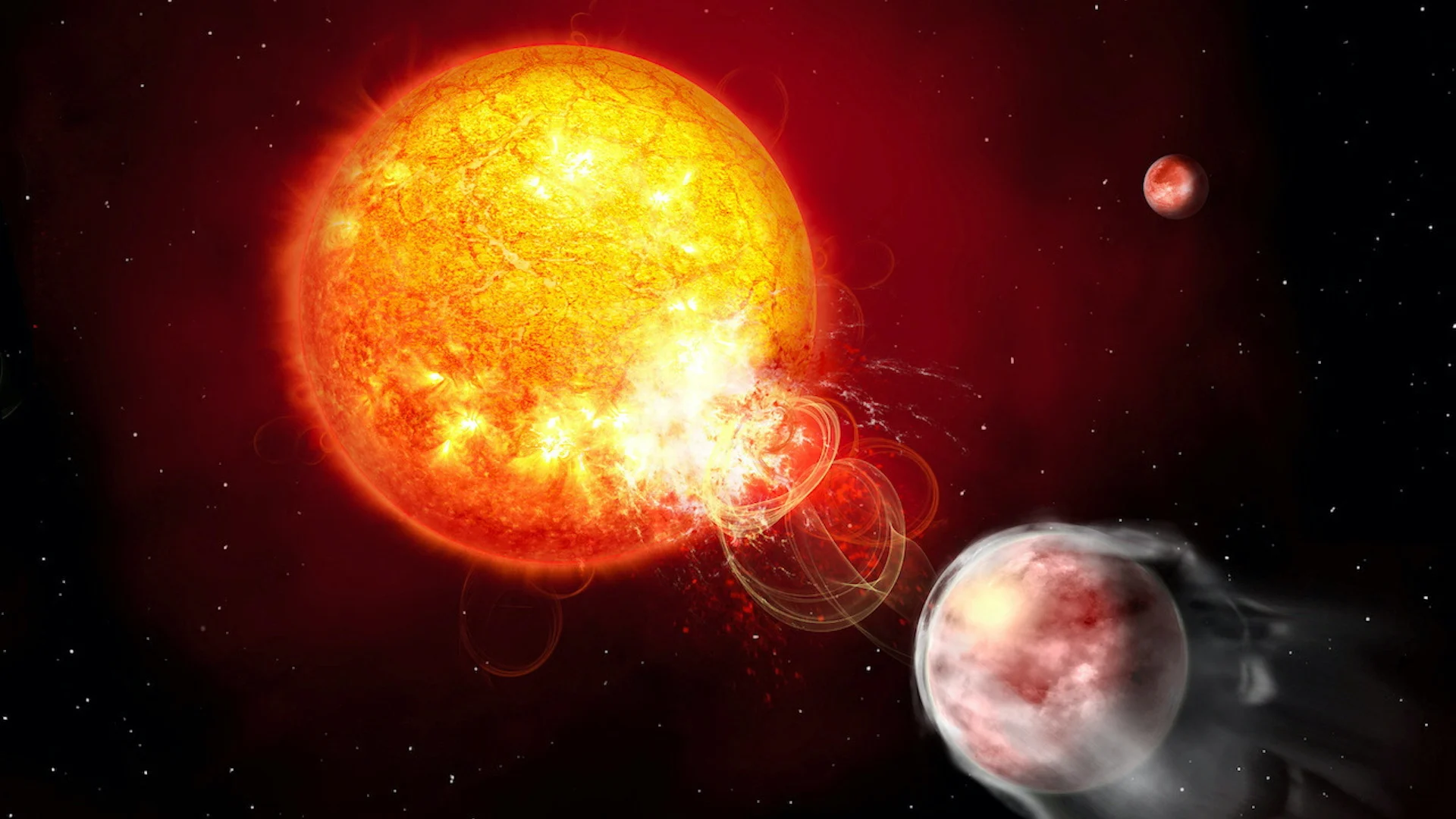
Scientists are tracking a large gas planet experiencing quite a quandary as it orbits extremely close to a young star—a predicament never previously observed.
This exoplanet, as planets beyond our solar system are called, orbits its star so tightly that it appears to trigger flares from the stellar surface—larger than any observed from the sun—reaching several million miles (kilometers) into space and possibly stripping much of this unlucky world’s atmosphere.
The phenomenon appears to be caused by the planet’s interaction with the star’s magnetic field, according to the researchers. And this star is a kind known to flare, especially when young.
“A young star of this type is an angry beast, especially if you’re sitting as close up as this planet does,” said Netherlands Institute for Radio Astronomy astrophysicist Ekaterina Ilin, lead author of the study published in the journal Nature.
The star, called HIP 67522, is slightly more massive than the sun and is located about 407 light-years from Earth in the constellation Centaurus. A light-year is the distance light travels in a year, which is 5.9 trillion miles (9.5 trillion kilometers).
This star and planet, as well as a second smaller gas planet also detected in this planetary system, are practically newborns. Whereas the sun and our solar system’s planets are roughly 4.5 billion years old, this star is about 17 million years old, with its planets slightly younger.
The planet, named HIP 67522 b, has a diameter almost the size of Jupiter, our solar system’s largest planet, but with only 5% of Jupiter’s mass. That makes it one of the puffiest exoplanets known, with a consistency reminiscent of cotton candy (candy floss).
It orbits five times closer to its star than our solar system’s innermost planet Mercury orbits the sun, needing only seven days to complete an orbit.
A flare is an intense eruption of electromagnetic radiation emanating from the outermost part of a star’s atmosphere, called the corona. So how does HIP 67522 b elicit huge flares from the star? As it orbits, it apparently interacts with the star’s magnetic field—either through its own magnetic field or perhaps through the presence of conducting material such as iron in the planet’s composition.
“We don’t know for sure what the mechanism is. We think it is plausible that the planet moves within the star’s magnetic field and whips up a wave that travels along magnetic field lines to the star. When the wave reaches the stellar corona, it triggers flares in large magnetic field loops that store energy, which is released by the wave,” Ilin said.
“As it moves through the field like a boat on a lake, it creates waves in its wake,” Ilin added. “The flares these waves trigger when they crash into the star are a new phenomenon. This is important because it had never been observed before, especially at the intensity detected.”
The researchers believe it is a specific type of wave called an Alfvén wave—named for 20th century Swedish physicist and Nobel Prize laureate Hannes Alfvén—that propagates due to the interaction of magnetic fields.
The flares may heat up and inflate the planet’s atmosphere, which is dominated by hydrogen and helium. Being lashed by these flares could blast away lighter elements from the atmosphere and reduce the planet’s mass over perhaps hundreds of millions of years.
“At that time, it will have lost most if not all the light elements, and become what’s called a sub-Neptune—a gas planet smaller than Neptune,” Ilin said, referring to the smallest of our solar system’s gas planets.
The researchers used observations by two space telescopes: NASA’s TESS, short for Transiting Exoplanet Survey Satellite, and the European Space Agency’s CHEOPS, short for CHaracterising ExOPlanet Satellite.
The plight of HIP 67522 b illustrates the many circumstances under which exoplanets exist.
“It is certainly no sheltered youth for this planet. But I am not sad about it. I enjoy diversity in all things nature, and what this planet will eventually become—perhaps a sub-Neptune rich in heavy elements that did not evaporate—is no less fascinating than what we observe today.”
—By Will Dunham, Reuters
The super-early-rate deadline for Fast Company’s Most Innovative Companies Awards is Friday, July 25, at 11:59 p.m. PT. Apply today.
