

Olivine is a rather unassuming rock. Olive-brown to yellow-green in color, this hard yet brittle mineral is thought to be the most abundant in Earth’s upper mantle. Chemically, olivine is magnesium iron silicate, though it contains other elements too. Economically, it’s close to worthless. Its limited industrial utility stretches to gemstones, metalworking, ceramics, and occasionally, as a gravel for road construction. At some mining sites, olivine is a waste product, stored in piles on the surface.
It’s certainly not an obvious choice as a source for battery materials.
But that’s exactly how it’s viewed by a group of New Zealand engineers. Christchurch-based Aspiring Materials has developed a patented chemical process that produces multiple valuable minerals from olivine, leaving no harmful waste behind. Perhaps most interesting to the energy sector is the rarest of its products—hard-to-source nickel-manganese-cobalt hydroxide that is increasingly required for lithium-ion battery production.
Sustainable Mineral Extraction Process
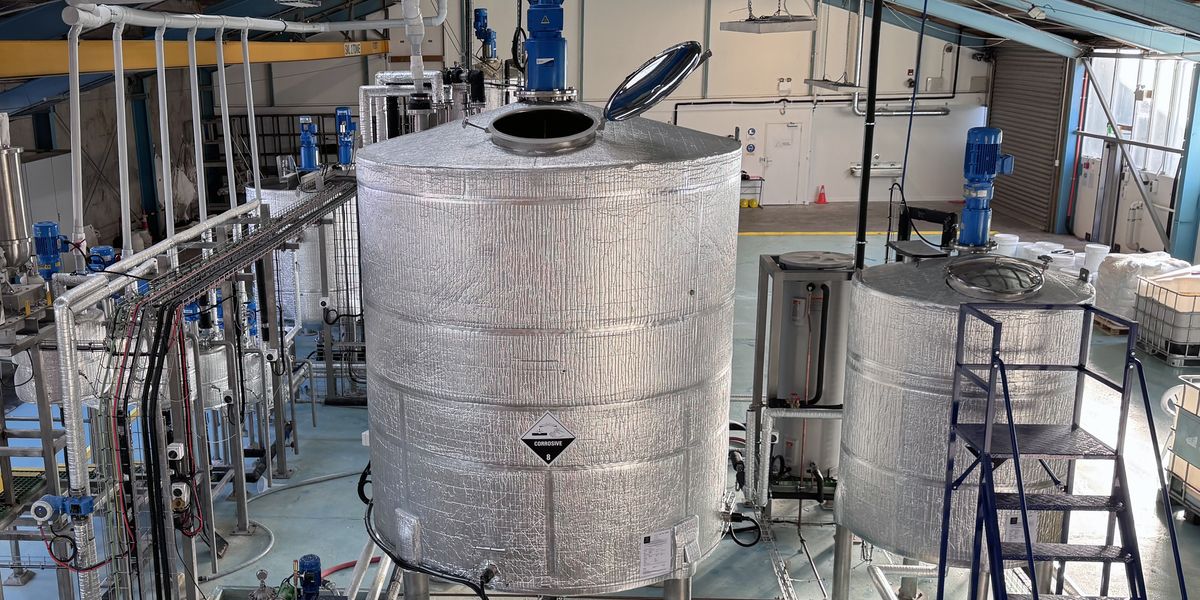
Aspiring’s pilot plant, which opened in February, is in an anonymous industrial estate east of the city. One corner of the main floor is dominated by a large stainless-steel tank, which is connected to a series of smaller tanks arranged in a stepped line. “Apart from our electrolysis system, the hardware is more typical of dairy plants,” says Colum Rice, Aspiring’s chief commercial officer. “The process is elegant, but not massively complicated. Our inputs are rock, water, and renewable energy, and our products come with no CO2 emissions.”
The rock is olivine ‘flour’; a fine, green-gray dust that is an unwanted by-product from refractory sand production. This is carried by screw conveyer into the largest tank, where it is combined with sulfuric acid. This acid leaching step “transforms it into kind of an elemental soup,” says Megan Danczyk, lead chemical engineer at Aspiring. From there, it passes down the reaction chain vessels, where through the addition of caustic soda and careful management of particle size and temperature, three products can be individually extracted.
Megan Danczyk, Aspiring Materials’ lead chemical engineer, holds a scoop of magnesium hydroxide.Aspiring Minerals
About 50 percent of what the process makes is silica that can be a partial replacement for Portland cement, the most common variety of cement in the world. About 40 percent is a magnesium product suitable for use in carbon sequestration, wastewater treatment, and alloy manufacturing, among other things. The final 10 percent is a mixed metal product—iron combined with small quantities of a nickel-manganese-cobalt hydroxide. The battery industry calls it NMC, and it is the go-to material for high-power applications.
Danczyk explains that at the end of the extraction process, they’re left only with a salty brine. “This goes to an electrolyzer, which recycles and regenerates the acid we use for digestion and the base we use to separate the products. It’s a closed loop. We’re using the whole rock, and we’re processing it at low temperature and ambient pressure.”
Right now, Aspiring does each separation consecutively, or as Rice put it, “silica, reload, NMC, reload, magnesium.” The plan is to add two more reaction chains in parallel, so that the process can run continuously, shortening the runtime from three days to one.
NMC Materials in Battery Manufacturing
NMC materials are already widely used in battery manufacturing; typically forming the cathode in high energy density lithium-ion batteries, or for those electrical systems that need to be frequently cycled, such as power tools, large-scale energy storage, and electric vehicles. “What we’ve been able to produce here matches the specs of what is currently used in the battery space,” says Danczyk.
Currently, most industrially relevant NMC materials are made by combining salts of their three main ingredients, and each of those regularly appear on critical minerals lists because of their growing importance in our modern world. The challenge with critical minerals is accessing them. Most of the planet’s nickel is sourced and refined in Indonesia. South Africa has the world’s largest manganese reserves, but exports almost all of it to China for processing. For cobalt, the largest producer is the Democratic Republic of the Congo, but again, it is refined in China. Concerns around supply monopoly, geopolitical instability, human rights violations, and environmental damage in these regions have been widely documented.
While NMC hydroxide represents the smallest fraction, (about one percent) of Aspiring’s outputs, it could still make a dent in future supply chains for battery materials. As Jim Goddin—who sat on the U.K. government’s expert committee that developed the country’s Critical Minerals Strategy in 2023—explains, the approach to securing supplies of these materials is changing.
“Economies are looking at how they can shore up supply, and diversify the supply chains, including collaborating with smaller producers who potentially offer more stability. The third branch is the circular economy, which is ensuring that materials they do have are used for longer or recovered for reuse.”
Aspiring is not the only company looking to extract more value from already-mined materials. Canadian company Atlas Materials is currently commercializing a similar closed-loop process that produces a similar set of products, but the starting point differs—rather than olivine, it focuses on serpentine.
“My understanding is that of these two raw materials, olivine is actually the more difficult to acid leach,” says Fei Wang, an assistant professor at Université Laval in Quebec City. “So that means it needs a higher energy input and will consume the acid more quickly.” Wang’s research also focuses on hydrometallurgical extraction of critical metals, but he is not involved with Atlas or Aspiring. “There’s no doubt that Aspiring’s technology is interesting, and represents a step forward in progress, but I have some concerns around the economics of it,” he adds.
For Goddin, the conversation should be broader than that. “From a European perspective, things are shifting towards cleaner, more sustainable production. There’s an increasing focus on providing data about the environmental impacts of the materials that are imported and consumed. Even if, say, Aspiring’s materials ended up being more expensive, they may be able to compete on those grounds. They’re extracting value from every component they produce, and with low to no waste. That’s likely to be a benefit for exporting to those markets.”
From Your Site Articles
Related Articles Around the Web
