

In 2022, California announced that it wanted to install 6 million heat pumps by 2030. So far, it has only installed about 2.3 million, which means to make that goal, it would need to average about 2,000 installs per day for the next five years. Hitting that target could be difficult, considering a typical mini split can take around a day to install and cost around $4,000 to $6,000 per zone, according to EnergySage.
“We’ve got to do something different,” Mary-Ann Rau, co-founder and CEO of Merino Energy, told TechCrunch.
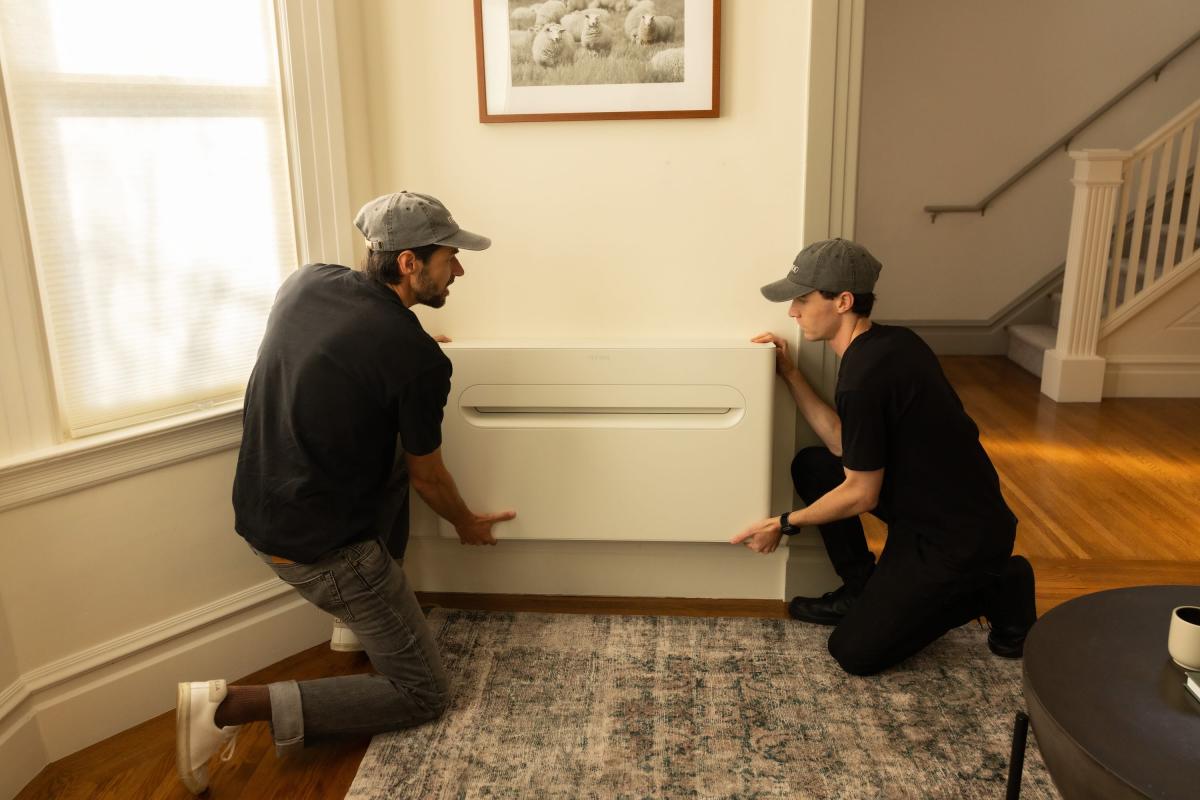
Merino Energy, which has been operating in stealth, wants to change both parts of the equation by simplifying the heat pump dramatically. The startup gave TechCrunch an exclusive peek at its new product, the Merino Mono, which costs $3,800, including the one-hour installation process.
Rau previously worked at Apple, where you may have seen her in a keynote or two introducing new AirPods, and Quilt, another heat pump startup. While at Apple, she worked to electrify her home in San Francisco. She installed solar panels, an induction stove, and an EV charger, but when it came time to install heat pumps, Rau “had total sticker shock.”
“That’s when I realized that if it was inaccessible for me — right, I’m privileged — it’s out of reach for the vast majority of Californians and Americans,” she said.
Typical heat pumps have two parts, an indoor heat exchanger and an outdoor condenser. Merino combines those into one unit which occupies as much space as a typical radiator under a window. It plugs into a standard 120-volt outlet, meaning that homeowners are less likely to need electrical upgrades. “If you can plug in a microwave and it works on that outlet, then the Merino Mono is gonna work on that outlet,” Rau said.
The Mono has all the usual stuff expected of the new generation of heat pumps: It’s Wi-Fi connected, it can sense when people are in the room, and different units in a household can coordinate their operation for efficiency and comfort. Rau said the company is even developing an integration with Oura Rings so that the heat pump can drop the temperature of the room by a couple degrees when the wearer is in REM sleep.
Techcrunch event
San Francisco, CA
|
October 13-15, 2026
To install the Mono, workers cut two holes in the wall, one to draw in air and another to exhaust it. The air in that loop flows over coils for the condenser, which then send refrigerant to the heat exchanger. There, another loop draws air from the room to heat or cool it. The only things visible from the outside of the home are the intake and exhaust ports and a condensate pipe.
By moving all the components to a single unit inside the house, Merino’s design is far simpler to install, Rau said. There’s no outdoor unit to connect to an indoor one, which can involve brazing copper lines and charging with refrigerant. “They’re very expensive from a labor perspective,” she said.
In miniaturizing the system, Merino has traded some efficiency, which may make the product more suitable for smaller living spaces. The Merino Mono has a SEER2 rating of 15.2, while the Quilt two-zone system hits 25. Large outdoor condensers simply do a better job. But the startup felt that for many applications, including apartments and condo buildings in dense urban areas, it made sense to keep everything indoors and as streamlined as possible. The Mono, Rau said, “is a solution where the cost is proportional to the problem that we’re trying to solve.”
The company is currently installing 48 heat pumps at the Civic Center Apartments, a low-income development in Richmond, California. For now, it’s focused on California as its initial market, although it has plans to expand to other states like Hawaii, Oregon, and Washington. So far, six installers have signed up in the Bay Area and Los Angeles. The company is taking preorders now for delivery later this year.
Rau hopes the simplified product will help heat pumps conquer the market. “If we can reduce the amount of time and complexity of installing a heat pump, then we can scale adoption,” she said.
