

Big companies are getting smaller, and their CEOs want everyone to know it. Wells Fargo has cut its workforce by 23% over five years, Bank of America has shed 88,000 employees since 2010, and Verizon’s CEO recently boasted that headcount is “going down all the time.” What was once a sign of corporate distress has become a badge of honor, with executives celebrating lean operations and AI-driven efficiency.
But while C-suite leaders tout “doing more with less,” CISOs are left with fewer resources, while every preventable security incident becomes exponentially costlier. With security teams already stretched thin and developer-to-security ratios reaching unsustainable levels, these workforce reductions push already distressed teams past their breaking point. Against this backdrop of workforce optimization, hardcoded secrets represent a particularly dangerous blind spot that can no longer be managed through manual processes and reactive firefighting.
The Numbers Don’t Lie
The credential crisis is already here. According to IBM’s latest research, 86% of breaches involve stolen or compromised credentials, with the average time to identify and contain these incidents stretching to a staggering 292 days.
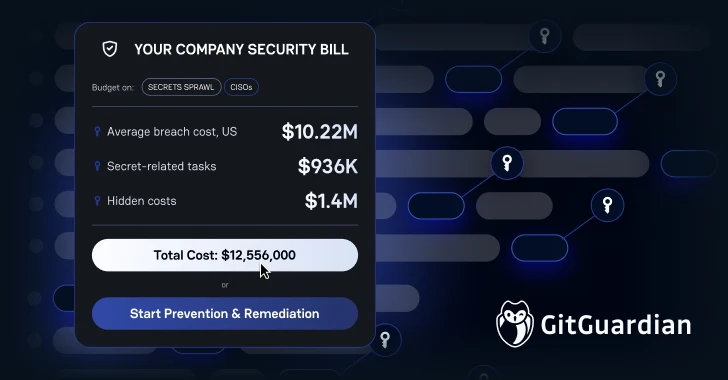
The financial stakes have never been higher. In the United States, breach costs surged to an all-time high of $10.22 million, driven by higher regulatory fines and detection costs. For credential-based incidents specifically, HashiCorp’s research shows these breaches carry a $750,000 premium, meaning US organizations face potential costs exceeding $11 million when hardcoded secrets are involved.
But the hidden costs may be even more devastating. Organizations waste nearly $1.4 million annually on managing secrets manually. This includes developer time spent on credential rotation and exposure investigation ($936,000) and security analysts triaging false positives and chasing down leaked credentials (>$500,000).
The real-world impact is already visible. Canva experienced days of downtime across multiple teams due to a single leaked secret, consuming engineering resources that should have been focused on product development.
Why Lean Teams Amplify the Risk
Workforce reductions mean longer mean-time-to-remediate incidents, and the 292-day average containment window becomes even more dangerous. Each security incident pulls already-stretched teams away from core business functions, creating costly context-switching overhead that lean organizations can’t afford.
The scope of the problem continues expanding even as teams shrink. Large organizations harbor thousands of unmanaged secrets scattered across code repositories, CI/CD pipelines, Slack channels, Jira tickets, and collaboration platforms.
HashiCorp’s research indicates that up to 40% of these secrets fall into high-risk categories, often providing direct production access.
This creates a multiplication effect: one hardcoded API key can enable lateral movement, supply chain compromise, and large-scale ransomware deployment. The recent s1ngularity attack demonstrates this perfectly: what began as a GitHub Action token-stealing pull request compromised Nx packages, stealing 2,349 credentials, and cascaded into attackers exposing 82,901 additional secrets by making over 10,000 private repositories public.
The Strategic Response: Precision Over Volume
GitGuardian’s approach to secrets security recognizes a fundamental truth: detection alone isn’t enough. Without effective remediation, alerts become expensive noise that overwhelms already-stretched teams. For CISOs managing learner security operations, this distinction is critical.
Secrets present a fundamentally different challenge than traditional vulnerabilities. While a developer can typically patch a code vulnerability independently, remediating exposed secrets requires understanding the broader infrastructure context—where the secret is used across multiple services, which systems depend on it, and who has the authority to rotate it. This often demands coordination between development, platform, and DevOps teams, each with its own priorities and workflows. Gathering this context manually becomes prohibitively expensive when security teams are already operating at capacity, turning what should be quick fixes into complex, multi-team investigations that can stretch for weeks.
Advanced platforms now shift focus from “What is exposed?” to “What is the magnitude of exposure?” by providing contextual information, including roles, permissions, ownership, and threat scope. This holistic approach directly addresses the false positive burden that costs organizations over $500,000 annually in wasted analyst time.
Cutting Remediation Time from Weeks to Hours
Effective remediation frameworks align perfectly with lean team constraints:
Proactive Detection: Platforms that implement both preventive scanning during commits and reactive scanning for existing leaks catch issues before they reach the 292-day average containment window.
Clear Ownership: Instead of broadcasting vague alerts, modern tools assign ownership for every secret, ensuring responsible developers receive notifications with full context. This eliminates time waste hunting down secret owners.
Informed Decision Making: Teams receive precise location data, understand what each secret unlocks, and know whether it’s still active. According to the Hashicorp research mentioned above, this targeted approach prevents the $936,000 annual productivity drain from manual investigation tasks.
Workflow Integration: Developers get clear remediation guidance directly within their existing tools, reducing the context switching costs that plague smaller teams. Advanced platforms now offer automated secret revocation capabilities and can generate code-fixing pull requests directly within version control systems, meeting developers exactly where they work rather than forcing them into separate security tools.
The ROI of Smart Remediation
By pinpointing specific files and lines of code where secrets are hardcoded, GitGuardian’s approach transforms the economics of incident response. Instead of developers spending hours searching codebases, they focus their efforts exactly where needed. Real-time remediation tracking provides security teams with visibility without manual oversight.
This precision approach directly tackles the core challenge facing downsized security teams: doing more with less while maintaining security posture.
Found this article interesting? This article is a contributed piece from one of our valued partners. Follow us on Google News, Twitter and LinkedIn to read more exclusive content we post.
