

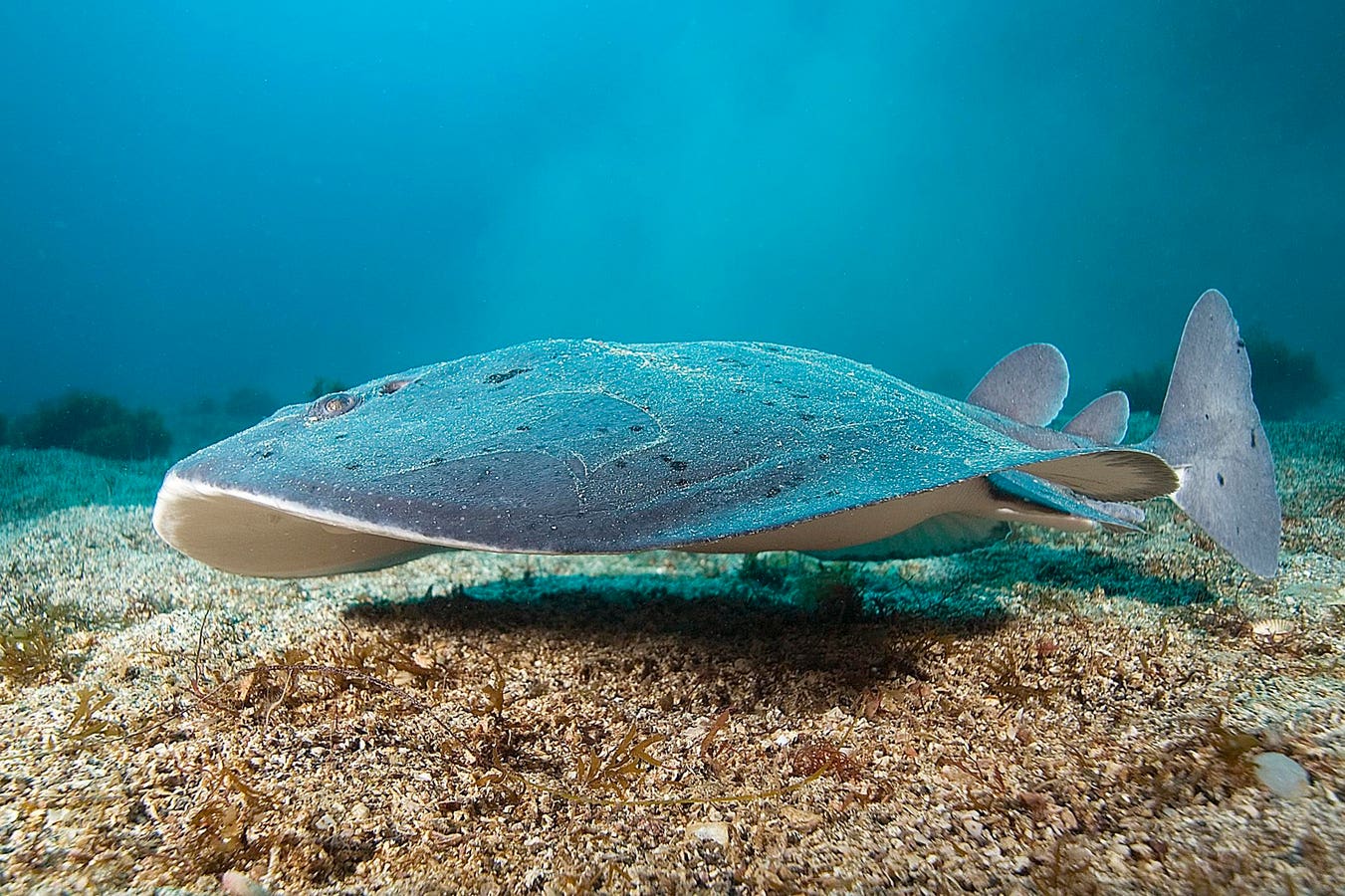
Unlike more agile or camouflaged species, torpedo rays tend to be slow-moving and often lie hidden … More
getty
The ocean is full of animals with clever survival strategies, from camouflage and armor to spines and toxins. But when it comes to dealing with top predators like sharks or large marine mammals, most of those defenses don’t hold up. That’s what makes the electric ray so fascinating. These animals, often called torpedo rays, can produce powerful electric shocks strong enough to stun prey. New research suggests those same electric pulses may help them avoid becoming a meal themselves — even from some of the most formidable predators in the ocean!
Using a mix of diver observations, biologging technology and in situ experiments off the coast of California, a team of scientists have gathered compelling evidence that electric rays can repel large sharks, including great whites and tiger sharks.
That’s no small feat.
Great whites can reach lengths over 20 feet (6 meters) and tiger sharks aren’t far behind, with equally powerful jaws and few natural predators. The idea that a relatively small animal like an electric ray — usually just 2 to 3 feet long (0.6 to 0.9 meters) — can send these ocean giants packing is both surprising and a little bit exciting. Torpedo rays, also known as electric rays, are a group of cartilaginous fish found in oceans around the world, including off the coast of California. These rays belong to the family Torpedinidae and include species like the Pacific electric ray (Tetronarce californica). Unlike more agile or camouflaged species, torpedo rays tend to be slow-moving and often lie hidden on the seafloor. Their flattened bodies house specialized electric organs made of modified muscle cells called electrocytes, which generate powerful bursts of electricity, typically used to incapacitate prey such as fish and squid.
Led by Dr. Yannis P. Papastamatiou of Florida International University, the researchers were studying the Pacific electric ray and tracking how often and how long these animals discharged electricity in different situations. It turns out, they behave differently depending on whether they’re hunting or defending themselves. When capturing prey, electric rays released longer and more frequent bursts of electricity than they did during defensive encounters. That’s likely because catching a fish requires a more sustained effort than giving a warning zap to a passing shark. Short bursts can also be reset more quickly, a useful feature when a threat may come back for a second attempt. But the energy behind these electric pulses doesn’t come cheap; the electric rays seem to rely on anaerobic metabolic pathways to produce them, meaning they burn through their energy stores quickly without using oxygen. This likely limits how often and how long they can produce shocks. Still, their strategy seems to work. The scientists noted how rarely electric rays appear in the stomach contents of large sharks and combined with their bold behavior observed in the wild (i.e. rays moving around without much sign of fear), it all suggests that the shock defense is more than just a flashy trick. It could be a major reason why sharks give them space.
Torpedo rays, also known as electric rays, are a group of cartilaginous fish capable of producing … More
getty
In the wild, divers have talked about seeing electric rays zapping curious sharks that got too close, sending them flinching or swimming off. Seem unlikely, though? Afterall, what makes a shark flinch? Well, while the voltage varies depending on the species and size of the ray, some electric rays can generate discharges up to 220 volts. That’s more than enough to startle even a seasoned predator! And unlike many marine animals that rely on running or hiding, electric rays often stand — or rather, float — their ground.
This kind of defense is especially interesting in an evolutionary context. Marine predators like sharks have been around for hundreds of millions of years and are highly efficient hunters. So any trait that allows a relatively slow, soft-bodied animal to avoid predation has to be taken seriously. Most animals with chemical defenses or spines still end up on the menu of large predators, even if they’re not the first choice, but electric rays seem to be an exception. Their ability to produce targeted, timed electric bursts appears to be one of the few strategies that truly works against sharks — something that could have big implications for how we think about shark repellents. Current shark deterrent technologies often try to mimic nature, using electric fields, magnets, or even visual patterns to keep sharks at bay. But not all of these are equally effective, especially when it comes to large, curious, or determined predators. But this new study offers a proof of concept from nature that real-time, short-duration electric pulses can trigger a strong avoidance response in even the biggest sharks. By observing how electric rays produce and deploy their shocks (i.e. how strong they are, how long they last, and when they’re used) scientists could fine-tune the next generation of shark repellent devices. A well-timed jolt may be far more effective than a constant low-level field. Perhaps this opens the door to designing smarter deterrent that only activates when a shark is nearby, conserving power and minimizing interference with other marine life?
While more research is needed to fully understand the range and effectiveness of these discharges, the results so far highlight just how sophisticated and specialized some ocean defenses can be. Nature has already figured out how to make a shark think twice. The next step is translating that evolutionary advantage into practical tools for human use — whether for protecting divers, reducing shark bycatch, or deterring sharks from coming too close to beaches. For now, it seems like the old rule still applies: don’t mess with something that can zap you. Even if you’re a shark.
