


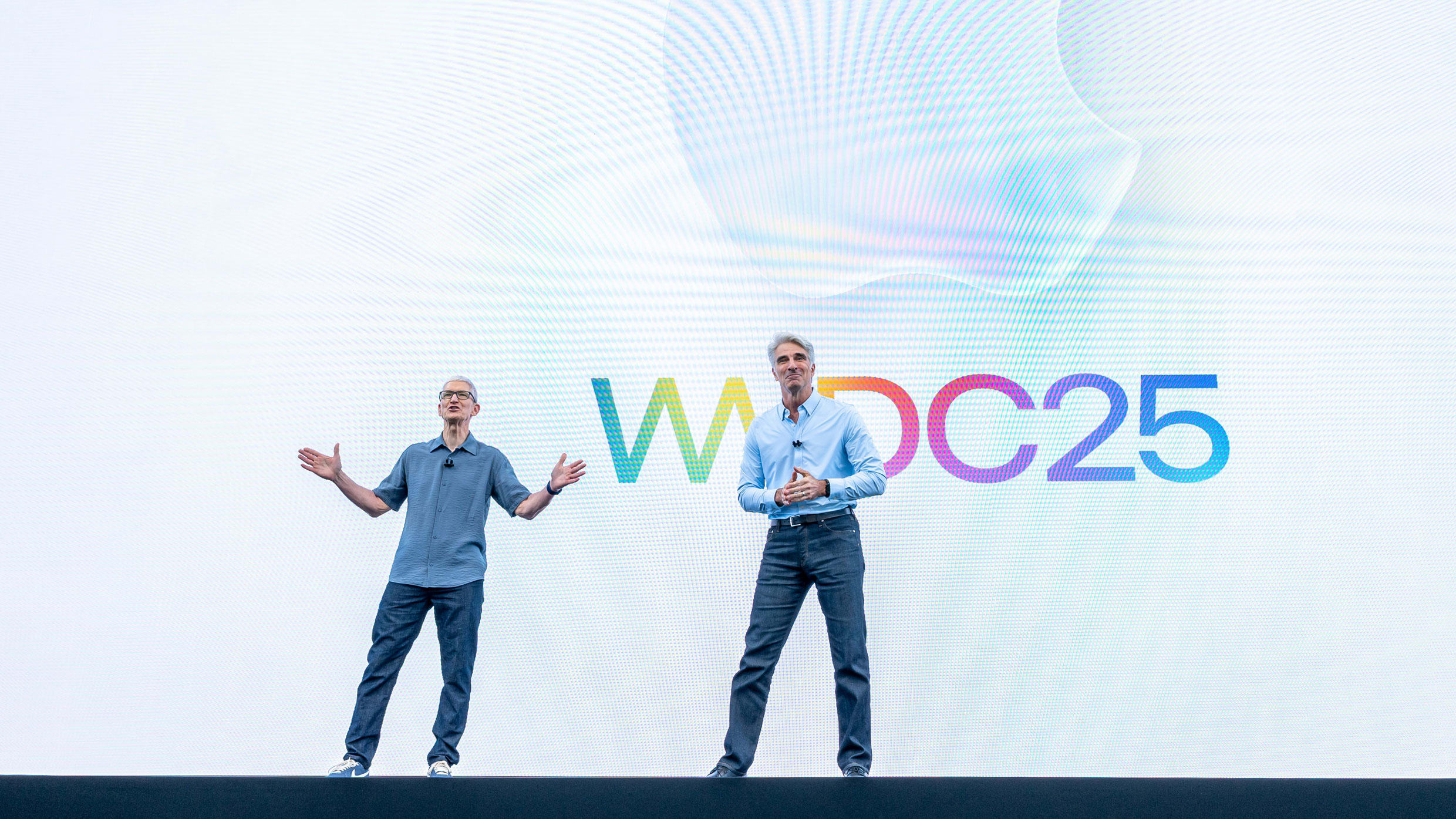
At Apple’s annual WWDC keynote, the highest-level subject is always the future of its software platforms. And the big news in that department usually stares us right in the face. In 2023, for example, it was the debut of Apple Vision Pro, the company’s entry into the headset market and its first all-new experience since the Apple Watch. Last year brought Apple Intelligence, its branded take on what AI should look like as a core element of computing experiences.
And then there was Monday morning’s WWDC 2025 keynote, as streamed online to millions and screened to a select audience of in-person attendees at Apple Park. After Apple’s embarrassing inability to ship the AI-infused update to Siri it showed off at WWDC 2024, it was hardly surprising that this year’s event didn’t bet everything on whipping up a further AI frenzy. That alone set it apart from last month’s Google I/O keynote, whose topics consisted of AI, AI, and more AI, with some AI drizzled on top.
[Photo: Apple]
Apple did introduce some new AI during the keynote—quite a bit of it. Overall, though, the event felt like an act of counterprogramming. Instead of positioning itself as a leader in AI—or at least quashing fears that it’s a laggard—the company seemed happy being itself. From the unified new design to old features (phone calls!) turning up in new places (the Mac!), it focused on giving consumers even more reasons to own and use as many of its products as possible.
Herewith a few of the impressions I took away from my morning at Apple Park:
Liquid Glass is classic Apple, in the Steve Jobs sense. In 2012, one of Tim Cook’s first dramatic moves after succeeding Jobs as CEO was to oust software chief Scott Forstall. That led to a reorganization that put Jony Ive in charge of design for software as well as hardware. Ive’s influence was seen in the iPhone’s iOS 7 upgrade the company shipped the following year. It ditched the lush skeuomorphism of the iPhone’s software up until that time for a far flatter look, bringing to mind the understated, Dieter Rams-like feel of an Ive MacBook, manifested in pixels rather than aluminum. Ive left in 2019, but the principles he instilled have informed Apple software ever since.
[Photo: Apple]
But now there’s Liquid Glass, a new aesthetic Apple is rolling out across its portfolio of platforms. It’s glossy, dimensional, pseudorealistic, and animated—a dramatic departure from iOS 7-era restraint, but reminiscent of both earlier iOS releases and also older Apple software all the way back to the first version of the Mac’s OS X in 2000. That was the one with buttons that Jobs said people would want to lick—a memorable design imperative that is suddenly relevant again.
As my colleague Mark Wilson writes, Liquid Glass isn’t about adding new functionality to Apple devices. It might not even be about making them easier to use—in fact, when an interface introduces transparency effects and other visual flourishes, legibility is at risk. It does, however, look cool in a way that’s classically Apple, and which the Apple of recent years had deemphasized.
The iPad has left limbo . . . for Macland. For years, Apple seemed to have reached a mental standstill with the iPad. The company clearly wanted its tablet to be something distinct from a Mac, but it also appeared to be short on ideas that were different than the Mac, especially when it came to building out iPadOS as a productivity platform. End result: The platform has foundered rather than matured.
[Photo: Apple]
With iPadOS 26, the iPad will finally see a lot of meaningful change all at once, and most of it is distinctly Maclike. It’s getting a menu bar. Windows that float and overlap. A more full-featured Files app and, for the first time, a Preview app. Even the quirky circular cursor gives way to a more conventional pointy one.
As an unabashed iPad diehard, I admit to my fair share of trepidation about all this. The iPad’s abandonment of interface cruft in favor of considered minimalism is a huge reason why I’ve been using one as my primary computer since 2011: I don’t like to wrangle windows or scour menus for the features I need, hidden among those I don’t. Maybe Apple has figured out how to retain what’s great about the iPad even as it gives in to the temptation to borrow from the Mac. But I’m alarmed by the apparent disappearance of the iPad’s foundational multitasking features in the first iPadOS 26 beta, and hope they’ll return before the software ships this fall.
VisionOS is still evolving, and that’s good. It’s been two years since Apple unveiled the Vision Pro and 17 months since it shipped. Rumors aside, we still aren’t any closer to clarity on how the $3,500 headset might lead to a product that caters to a larger audience than, well, people who will pay $3,500 for a headset. Even Tim Cook says it isn’t a mass-market product.
Still, Apple’s enthusiasm for spatial computing doesn’t seem to be flagging. As previewed during the WWDC keynote, VisionOS 26 looks downright meaty, with more realistic-looking avatars for use in video calls, features for watching movies and playing games with Vision Pro-wearing friends, widgets you can stick on a wall or place on a mantel in the real world, AI-powered 3D effects for 2D photos, partnerships with companies such as GoPro and Sony, and more.
None of these additions will prompt radically more people to spring for a Vision Pro in its current form. But assuming that the headset doesn’t turn out to be a dead end, Apple’s current investment could help a future, more affordable version offer compelling experiences from day one.
It’s still unclear whether ChatGPT is a feature or a stopgap. Apple’s own AI assistant, Siri, was acknowledged only at the start of the keynote, when Craig Federighi, senior VP of software engineering, mentioned last year’s announcements and the decision to delay the newly AI-savvy version until it meets Apple’s “high-quality bar.” Another AI helper did pop up several times during the presentation, though: ChatGPT. For example, it powers a new Visual Intelligence feature that will let users ask questions about the stuff on-screen in any app. The keynote’s example: Upon seeing an image of a mandolin in a social post, you can ask, “Which rock songs is this instrument featured in?”
Given that the new Siri features Apple revealed a year ago remain unfinished, adding a dash of ChatGPT here and there is an expedient way to maintain some AI momentum. But does the company see integrating the world’s highest-profile LLM-based assistant as an attractive user benefit in itself—or just a placeholder until it can offer similar technology that’s entirely under its own control? I’m still not sure. At WWDC 2024, Federighi also talked about incorporating other AI models, such as Google’s Gemini, but no news has emerged on that front since.
Even during a pivotal, unpredictable time for the tech industry, one of the WWDC keynote’s purposes remains straightforward. Apple needs to get consumers excited for the software it will ship in the fall, which isn’t necessarily synonymous with blowing them away through sheer force of AI breakthroughs. In a Bluesky conversation, one commenter suggested to me that people aren’t actually clamoring for AI at all—a take that has a whiff of truth to it even if it isn’t the whole story. Ultimately, users want pleasant products that help them get stuff done, whether in a personal context, a work environment, or somewhere in between.
After last year’s WWDC, assuming Apple will ship everything it brags about—at least in a timely fashion—is dangerous. But it’s easier to envision the confident vibe of this year’s keynote paying off, because so much of it involved the company playing in its comfort zone.
The final deadline for Fast Company’s Next Big Things in Tech Awards is Friday, June 20, at 11:59 p.m. PT. Apply today.
