


What Type of Air Fryer Should I Get?
Most people only have space for one extra oven that’s not their stove, so your choice is a function of what you value most—and the size of your kitchen counter.
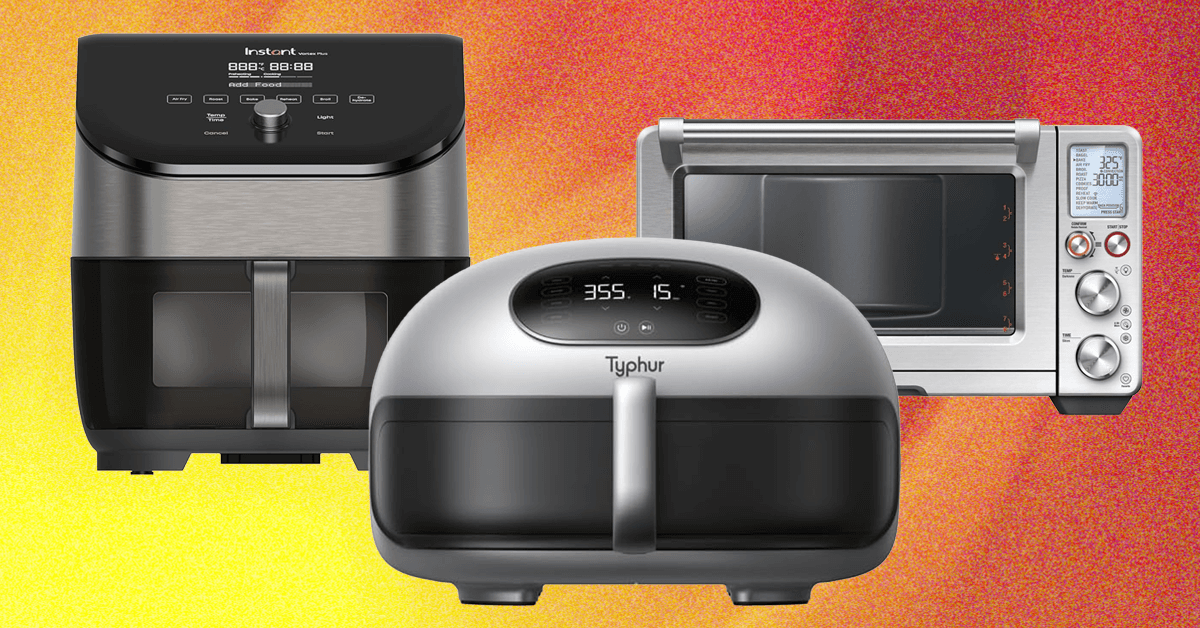
Basket air fryers such as our top pick can be a remarkably specialized devices, quickly and easily crisping up traditionally fried or sautéed foods like wings and french fries, but with a minimum of oil. Look up the best air fryer on Amazon or Google or Bing if that’s you, and a basket fryer is what you’ll see. A basket fryer’s shape is designed to maximize airflow and therefore both exterior crispness and distribution of heat—usually cooking significantly faster than traditional ovens. The air fryer baskets and cooking plates, usually made these days with PFAS- and PFOA-free nonstick surfaces, are also wildly easier to clean than the interior or racks in pretty much any traditional oven.
After the sudden advent of air fryers, makers of more traditional accessory and toaster ovens rushed to add air fryer baskets and “superconvection” fans to box-shaped ovens. Oven air fryers are less specialized, and so they may crisp less well or less quickly than a specialized basket fryer. But they may do a number of other things quite well, including bake a pizza from freshly proofed dough, rotisserie a chicken, toast bread, roast vegetables, broil chicken, and all the other things you might like an oven to do.
In short, they’re an oven. They do all the oven things, and also air fry. That said, oven fryers will likely cause you to spend a lot more time cleaning racks, drip pans, and air fryer baskets (shudder) and squinting while reaching in to scrub the sides of the oven walls.
A newer category is a combi air fryer, combining the whip-quick airflow of a basket fryer with a steam function that maintains moisture. As you might guess, this can cook meat like a charm and is still just as easy to clean as any basket air fryer. On the flip side, they can be a bit more expensive.
Just make sure you have room for the air fryer of your dreams on your kitchen counter and that the cooking capacity is sufficient for your needs: A 4-quart fryer should be enough for singletons. A 6-quart fryer is generally good for four portions of whatever you’re cooking in it. Larger, often dual-basket fryers add even more capacity for large families, but this size can come at the expense of preheating speed and airflow or temperature accuracy.
Photograph: Matthew Korfhage
As with any kitchen device, we cooked a range of meat, fish, and vegetables in the air fryers we tested. But we paid special attention to traditionally fried foods that best showcase what makes air fryers distinctive.
For each fryer, we tested, tasted, and compared the air fryer staples of wings, french fries, brussels sprouts, and frozen breaded chicken—assessing the even cooking, moistness and crispness of each.
For wings, we tested whether a fryer could attain a lovely, skin-cracklingly crispy exterior without overcooking the wings, ideally within 18 minutes at 400 degrees. A french fry basket was an excellent test of how evenly the fryer cooked across the basket surface. Veggies can be touchy in an air fryer, and so brussels sprouts were often an excellent test of whether airflow was too intense, drying out the interiors of the sprouts and singeing their exteriors. For frozen nuggets and fingers, we made sure we got crisp breading and no sogginess.
We used a wireless meat thermometer to test the accuracy of each air fryer’s thermostat, the consistency of temperature within the cooking chamber, and how fast each air fryer preheated. An accurate thermostat turned out to be a rare and wonderful thing, where air fryers are concerned, but our top picks performed better than the error range of many thermometers.
We judged each air fryer on its versatility of functions and cooking, its ease of cleaning, and the intuitiveness of its control panel. We also looked into our hearts to assess the overall pleasantness of using each air fryer, and whether we’d be happy to have it in our life.
Finally, we checked the decibels on each device using a phone app, to make sure you won’t have to live inside an airplane hangar to get a nice basket of fries.
How much oil do I need in my air fryer?
Go easy on the oil. The beauty of an air fryer is that it offers a healthier way to cook with the similar crispy finish you’d get in a deep fryer, but with far less oil. So take advantage and limit the amount of oil you consume by using an oil sprayer that evenly coats your food without drenching it. A shake midway through the cycle also ensures that your food gets evenly coated in oil for better results.
What size air fryer should I get?
A 4-quart air fryer can be enough for up to two people, while a 6-quart-plus air fryer is better for families of four or more.
An air fryer can work as a convenient alternative to your built-in oven—and potentially save you time and money off energy bills, because you won’t have to heat up your whole oven. But if you find yourself having to use your air fryer multiple times to cook a complete meal, this defeats the purpose.
Unfortunately, air fryers can be bulky, so checking you have enough countertop space above and around your air fryer is a must, both to give the air fryer room to breathe when it’s in heating up and for ensuring you have enough room to prep your meals.
How do you calculate cooking time for something that doesn’t have an air fryer recipe?
When you’re converting oven recipes for your air fryer, remember that an air fryer cooks faster because it speeds up heat exchange with the food. So air fryers may reduce standard cooking times dramatically.
If you’re not sure how long to cook in your air fryer, try reducing the temperature by 50 degrees Fahrenheit and cooking for 20 percent less time than you would in a standard oven. And check your food midway through the cycle to ensure things are cooking away evenly, turning or shaking as needed. But honestly, literally every basic food has an air fryer recipe online. Try it. Think of an edible thing that doesn’t involve liquid, and Google it with the word “air fryer”
How to Clean a Basket Air Fryer
Air frying is healthier than deep frying, but it still involves blasting fat-misted air all over every available surface. Seems messy. But cleaning your air fryer is pretty easy. Nearly every basket air fryer nonstick coating. Sometimes this means a non-PFAS version of PTFE, better known as Teflon. Sometimes this will be a ceramic nonstick coating, as is true of our top-pick Typhur Dome 2 and pretty much all Ninja air fryers.
The real key is to actually bother to clean the baskets. Every time. Same as you would any other dish you put food in. Don’t reheat an air fryer with yesterday’s gunk or slick oil on it. It’ll bake in, and your air fryer will smoke or stink, and turn gross. Most of the time smoke comes out of an air fryer, it is probably not because you have a faulty air fryer. It’s because you heated up old rancid fat, or other awfulness.
Anyway, the process is pretty easy:
- Wait for the air fryer baskets to cool down. They’re hot. Don’t burn yourself, it’s not worth it. Eat your food. Enjoy it. Talk to your family. Come back after dinner, when the basket’s nice and cool.
- Pull out the basket or baskets entirely. Pull out any cooking grates or space dividers from the basket. Wash with a sponge or rag, and warm soapy water. Soak if need be. Some air fryer baskets are designated dishwasher safe, but I don’t use this even if the manual says I can. It’s nonstick. You’re gonna wear out your nonstick coating if you keep it up.
- If you really want to go for it, also swipe the heating element and air fryer interior with a damp (non-soapy) cloth. That said, I mostly don’t do this. Some air fryer evangelists say you should. But if you think you splattered oil up to the heating element, take a little wet rag to it. Some ovens, like our top-pick Typhur Dome 2, have a self-cleaning function that can burn off grease and such—meant to be used once a month or so. Other ovens can just be run at 450 degrees.
- Do the same on the exterior, where you put your grubby, sticky fingers. You know how you touched the food, and then you touched the air fryer? Now there’s food on the air fryer. Ew.
- Dry stuff. Or just wait. If you don’t dry things before you put them away, they get weird. That’s just how it is.
Other Air Fryers We Like
Photograph: Matthew Korfhage
Philips Series 3000 6-quart air fryer for $120: So, this is a terrific air fryer. As with most fryers from the air fryer’s first maker, the temp control is unimpeachable. The funny little peekaboo window is nice to monitor cooks, and the generous 6-quart capacity should suffice for most families (though there’s a 7-quart Series 3000 XXL model with even more room). I don’t love the overall beepiness and the presets (air fryer chicken legs instead of wings?) that don’t seem optimized for American food tastes, though the compact control panel is much appreciated. But otherwise this is a quite-well-engineered air fryer that keeps it simple, and I both like and recommend it—though the comparable 2000 series fryer performs about as well for a little less money.
Photograph: Matthew Korfhage
Instant Pot Vortex Slim for $140: This 6-quart fryer has nearly the same excellent performance, and much of the same functionality, that we like in our top Instant Pot pick. But its lack of cooking window and odor-erase filter keep it lesser in our hearts. That said, the Slim’s got a slimmer and deeper profile, about an inch less broad than the Vortex Plus. In some kitchens, this inch will matter.
Photograph: Matthew Korfhage
Philips 3000 Series Dual Basket Air Fryer for $200: Big double-basket fryers are always a compromise. You give up some temp accuracy, and there’s a bit of inevitable heat bleed between baskets. They also tend to preheat slower. This one is pretty accurate when one basket’s going, but can cook a bit hot when both are really rolling. That said, I like the notion of splitting a double fryer into asymmetric baskets, making room for a big main course and then a little french fry side. It’s smart. Philips often makes smart decisions. Once you figure it out (it’ll take a second), the options to either match basket cooks—or time both baskets to finish at the same time—are also well managed.
Cosori 9-Quart Dual Air Fryer With Wider Double Basket for $170: This Cosori air fryer was a previous pick among large, dual-basket fryers, prized for its intuitive controls and a dual-basket syncing feature that’s now become common among two-basket fryers. We now recommend the Instant Pot 9-quart fryer, among large fryers.
Gourmia 6-Quart Window Air Fryer for $70: The Gourmia budget appliance brand has a dizzying array of options, styles, and store-specific models. Of all the Gourmia air fryers we tested, this Target-only model performed best. Temp accuracy is not fully optimal, but not so far off it troubles me. And I wish its window didn’t steam up. But the mix of a window for easy viewing and good airflow—which is to say, crispy wings—makes this a reasonable purchase at its low price. I’d still get the slightly more expensive Philips 6-quart, though.
Air Fryers We Don’t Recommend
Fritaire Nontoxic Air Fryer for $200: This looked promising—a large and charmingly retro-styled air fryer with a borosilicate glass bottom, a nearly plastic-free interior, a self-clean function, and an option on a rotating rotisserie spit. Wild! Alas, our union was not to be. Temps were haywire on the device we tested, ranging up to 90 degrees higher than settings, the exterior also got painfully hot, and the rotisserie tumbler and spit involved a separate battery-powered motor attachment and more parts than the collected works of Bulwer-Lytton. Fritaire representatives said the device was certified by international bodies for its temperature claims, and are looking into whether the model we received was part of a small production batch with a faulty thermostat.
Photograph: Matthew Korfhage
Midea Flexify Toaster Oven Air Fryer for $149: On the one hand, this price is tough to beat for a 26-quart, French-door toaster oven fryer. On the other, the performance matches the price, with an unreliable thermostat, a lot of heat leakage through the doors and sides, and bread toasting that mostly involves scorching the bottom of the bread through the grate.
Photograph: Matthew Korfhage
Ninja Doublestack XL 2-Basket for $250: On the one hand, this 10-quart Ninja offers a dramatic amount of cooking space with a relatively small footprint, plopping two 5-quart baskets atop each other. Each basket also has a crisper rack, offering the potential of putting together a four-component meal. We had good results placing wing flats atop the crisper, and letting them drip onto the drums beneath for a mix of extra-crispy and extra-juicy wings. But this stacked design also means putting the heating elements and fans in the back of each drawer rather than the top, leading to uneven cooking throughout the basket and equally uneven air circulation. Cooking with multiple zones also required difficult and often confusing recipe conversions, and cook times stretched quite long.
Cosori DualBlaze 6.8-Quart for $180 and Cosori TurboBlaze 6-Quart for $120 are a bit like Jack Sprat and his wife. The DualBlaze runs too hot, and the TurboBlaze runs too cold. WIRED previously had the DualBlaze as a top pick, in part for a phone app that’s now a common feature across the category. On recent testing, we’re now more concerned about the wonky thermostat.
Ninja Doublestack XL Countertop Oven for $380: This doublestack looked like a versatile design, dropping a toaster oven atop an already spacious air fryer oven with a clever door design allowing the compartments to open together or separately. The reality was disappointing. The shut-off button on the top oven malfunctioned, meaning I had to turn the power off completely to shut off the top oven. And temperatures were all over the map. If the temp at the back of the main oven was 400 degrees Fahrenheit, the temp near the door might be 345, leading to wildly uneven cooking. And while Ninja touts FlavorSeal technology to keep odors and aromas from traveling between the top and bottom oven, the same was not true of heat: Heat from the bottom oven freely traveled into the top oven and vice versa. Also, toast burned even at medium-low settings.
Power up with unlimited access to WIRED. Get best-in-class reporting that’s too important to ignore for just $2.50 $1 per month for 1 year. Includes unlimited digital access and exclusive subscriber-only content. Subscribe Today.
