


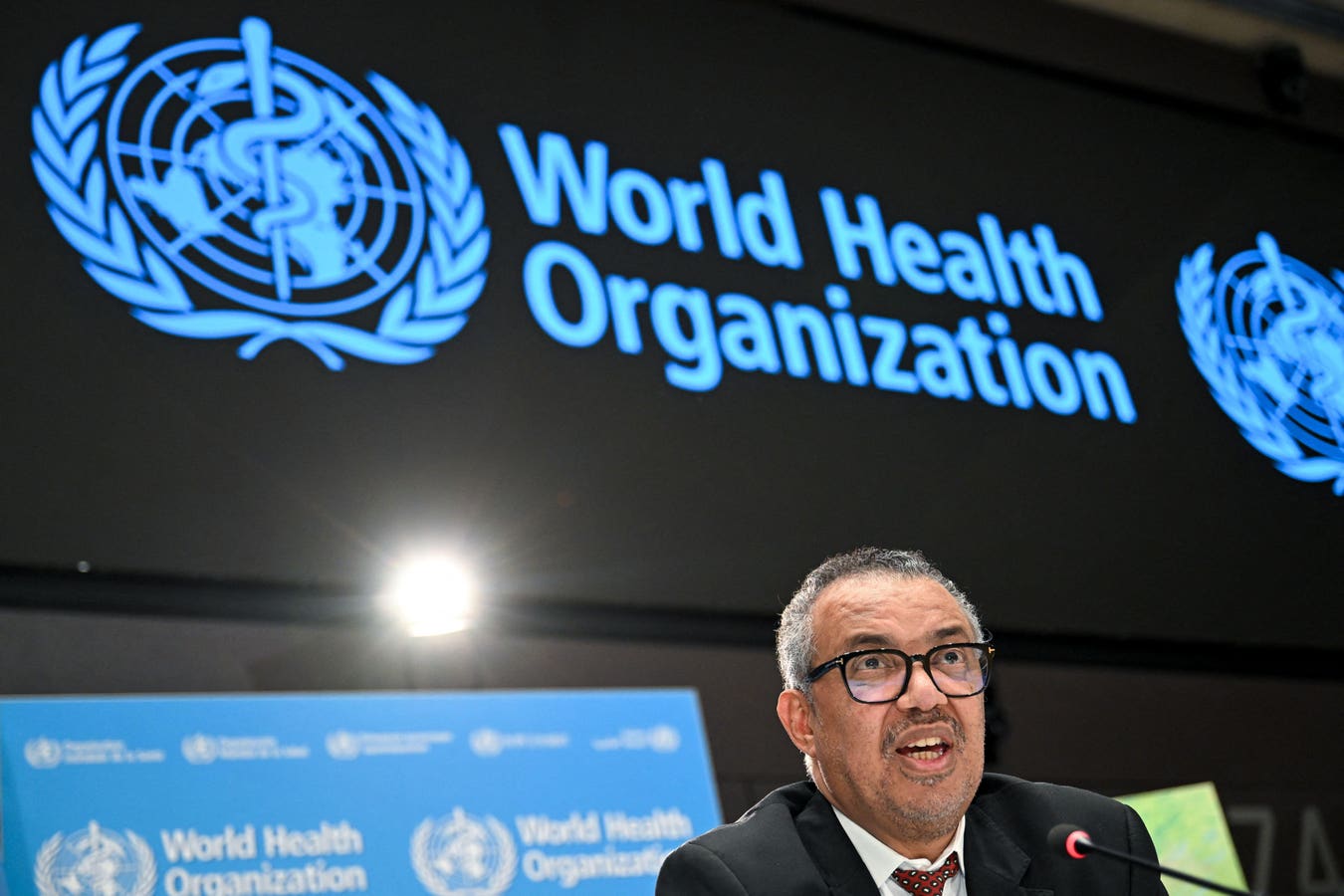
World Health Organization (WHO) chief Tedros Adhanom Ghebreyesus looks on during a press conference … More
AFP via Getty Images
At the May annual meeting of the World Health Organization’s members in Geneva, Switzerland, officials and delegates spoke of the potential disruption that could be caused by the organization’s budget crisis. They expressed concerned about possible program cuts that could lead to substantial increases in burden of disease and deaths globally.
The biggest source of the financial difficulties is the United States, as under President Trump the country is pulling its long-standing funding from the WHO and other global health initiatives, including ones like the U.S. Agency for International Development which was established 64 years ago.
In Jan., Trump signed an executive order that begins the process of withdrawing the U.S. from the WHO. Terminating U.S. membership severely challenges the WHO’s ability to carry out its global public health mission. This is because of the important role the U.S. has played in funding the organization. Throughout the 77-year history of the WHO, the U.S. has been by far its most important sponsor. The U.S. contributed $1.2 billion to the WHO in 2023. For the two-year budget ending in 2025, the U.S. donated $958 million, or nearly 15%, of the WHO’s budget. Under U.S. law, the country must give the WHO one year’s notice and must meet its financial obligations to the organization for 2025. And so, the U.S. is set to formally exit the WHO in 2026. This has led to the WHO cutting its 2026–2027 budget by 20% to $4.2 billion.
In turn, this opens the door for China to become the world’s largest funder of WHO. China announced it would give $500 million, in part to fill the void the U.S. has left. Its previous contribution was just $39 million.
The WHO is also raising mandatory member contributions by 20%. At the same time, others are attempting to close the funding gap. WHO said it has secured over $170 million in new commitments from multiple countries and organizations. Drug maker Novo Nordisk, for example, is pledging almost $58 million through its philanthropy foundation.
The WHO is a subsidiary organ of the United Nations. As a specialized U.N. agency, the WHO is responsible for international public health. Here, its role is to coordinate with all 194 member states in a wide range of public health activities, such as managing disease outbreaks and surveillance, vaccination campaigns, water sanitation projects and support for countries dealing with health emergencies. International cooperation has proven vital for managing pandemics and other global health threats.
From its inception in 1948, the WHO has spearheaded numerous programs that have saved tens of millions of lives. One of the first major projects the WHO was involved in was a global immunization campaign that eventually led to the eradication of smallpox in 1980. And since 1977, the WHO Essential Medicines List—which is revised and updated every two years—has been a vital guide for many nations in their medication procurement policies. Essential medicines are intended to be available in all healthcare systems, at all times, in adequate amounts, and in the appropriate dosage forms.
Currently, no other organization has the capacity to coordinate international rapid response efforts, to share medical research and innovation and to disseminate critical intelligence. This includes among other activities, the entity’s instrumental work on multiple Ebola crises in Africa and worldwide measles outbreaks, as well as seasonal influenza strain sequencing used to develop annual flu shots. The WHO is also indispensable in efforts to eradicate HIV, malaria, tuberculosis and dozens of neglected tropical diseases, such as leishmaniasis, Dengue fever and river blindness. NTDs refer to a diverse group of parasitic and bacterial diseases that cause significant morbidity and mortality in more than one billion people around the globe, which disproportionately affect poor and marginalized populations.
The WHO’s roadmap for NTDs, drawn up in London in 2012, contains goals on public-private partnership commitments with respect to the distribution of existing treatments, drug donation programs and R&D funding of new pharmaceutical development. There has been significant progress in the implementation of large-scale prevention of disease and treatment of patients suffering from NTDs. This improvement could be reversed in the face of budget cuts.
The U.S. became a WHO member through a 1948 joint resolution passed by both houses of Congress. According to Lawrence Gostin, expert in public health law, Trump’s action notifying the U.N. that the U.S. is withdrawing violates American law because it does not have explicit approval of Congress to leave WHO. Nonetheless, there doesn’t appear to be anything stopping the Trump administration from moving ahead with its plan.
Perhaps the administration is motivated by the fact that many Republicans in Congress maintain their opposition to the WHO, saying it hasn’t adopted needed reforms. Lawmakers point to the organization’s alleged inability to demonstrate independence from the political influence of certain WHO member states, ironically including China, which will now wield more power. Legislators also objected to the U.S. signing on to the world’s first pandemic treaty, a proposed legally binding agreement designed to prevent, prepare for and respond to future global pandemics.
As the U.S. retreats from international health entities like the WHO, it appears that China is stepping in. China looks to supplant the U.S. leadership role with respect to influencing global health policy.
