


It took Johnny Galvatron and his small team of neophytes six years to make The Artful Escape, a musical narrative game that debuted in 2021. With Mixtape, the team has been working on it for about two years.
Annapurna Interactive published the game from Galvatron, a former star from the Australian band The Galvatrons, even though it focused on a somewhat cursed genre of music games. It did well enough for Annapurna, despite its recent troubles, to publish Galvatron’s second game.
With Mixtape, Galvatron is back with a zany title that probably no one else would dare to make. I played a 20-minute demo of the game at the recent Summer Game Fest Play Days and then I interviewed Galvatron. The demo about the coming-of-age music game starts with a trio of teenagers on their last day together before they separate and head off on their own adventures after high school.
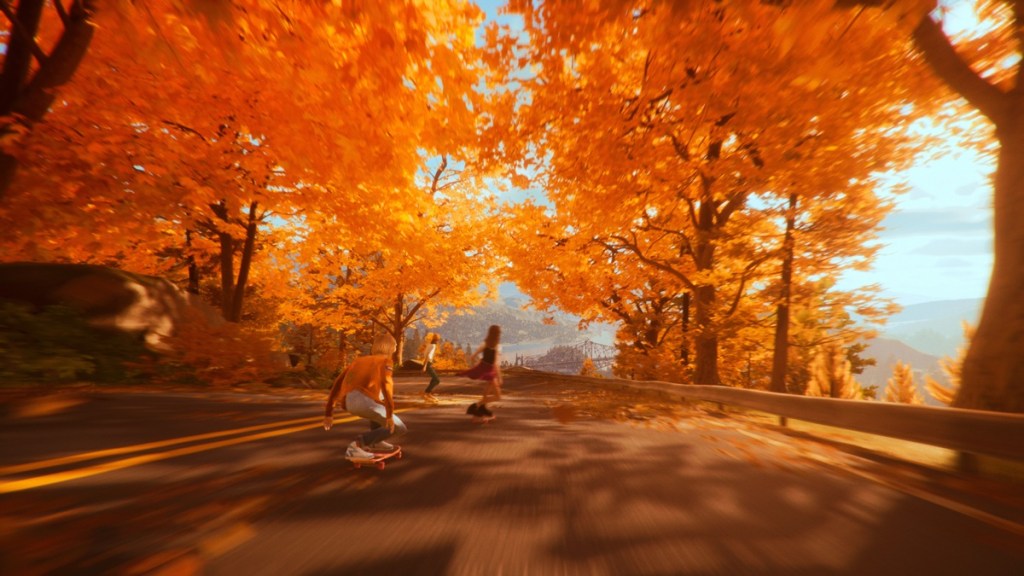
They’re skateboarding down a mountain road in their hometown, which they call “Big Suck,” and have to yell out “Car!” when they see an approaching car. To the tune of a Devo song, they make it down the hill — a good portion of which you as the player have to guide the skater to safety. And then they stop at the main character’s house.
There’s a scene when two teens kiss and you have to take control of their tongues and make sure they are appropriately mixing together. That part was hilarious, and made me feel like I really needed to play the rest of the game. Of all the games I saw at Summer Game Fest, this was one of the most delightful.
It features music from Devo, Roxy Music, Lush, The Smashing Pumpkins, Iggy Pop, Siouxsie and the Banshees, Joy Division, the Cure and many more. You get to play through a mixtape of memories, set to the soundtrack of a generation.
The game will release soon on PC, PlayStation 5, and Xbox Series X|S. It will be available day one through Xbox Game Pass (Series X|S, Windows). Mixtape was part of the Day of the Devs: Summer Game Fest 2025 selection and was exhibited at the Tribeca Games Festival in New York.
Here’s an edited transcript of our interview.
Johnny Galvatron is founder of Beethoven & Dinosaur, the creator of Mixtape.
Johnny Galvatron: Mixtape is our second game as Beethoven and Dinosaur. We made Artful Escape, which was another music game. More about performing music. We wanted to do a game–basically I just wanted to show people “That’s Good” by Devo, which is my favorite Devo song. We started with the track list, first of all. I wanted to have this really good, deep cut mixtape, and then try to weave this narrative through the songs and the emotions of the songs. Try to use the medium, try to use gameplay to express things that I usually express through games, like betrayal or teenage freedom. It’s more about using the medium to try to evoke these kinds of feelings, rather than something that’s difficult.
GamesBeat: Somehow I thought there was something after Artful Escape.
Galvatron: Nope, just this one. Round two. We’ve been working on this for two years, maybe a bit more than two and a half.
GamesBeat: Artful was longer, right?
Galvatron: Artful was like six years. I had no idea what I was doing. I’d never made a game before. No one on the team had made a game before. Annapurna held our hands the whole way and let us get the game done, get it to a space where we loved it. Big thanks to Annapurna.
Three teens on their last night together in Mixtape.
GamesBeat: When I first saw it I thought it looked like Life is Strange. But then you see the movement, and it’s very different. How did you come up with that kind of style?
Galvatron: With a triple-A game you can start with a blank slate and build up what your art style is going to be. In indie dev, when you have a small, dedicated team of just four or five artists, you start with them. They form the core principles, and then you start to build. It’s important with narrative games, story-based games, that you understand the sum of the parts. How the music is going to work, how the cinematography is going to work, the gameplay. You can bring the art style to sit in that. You can cut it like a diamond going into a fitting. That’s the art style you should be aiming for. Start with your team, build on what they’re good at, and then finesse it into something that supports the story. It’s kind of golden and nostalgic. I think it’s very pretty.
GamesBeat: Were there any particular inspirations for it?
Galvatron: Obviously the music, first of all. A lot of movies, like Wayne’s World and Dazed and Confused. A lot of hangout movies. I wanted to not only show these great moments of the teenage experience, but also the idleness. Players call it “The Big Suck.” If you can get just the hanging out right, if you can get the pacing of that to feel good, then I think that’s a big part of getting the game right.
If I could draw any comparison in games, it would be What Remains of Edith Finch. Something that was like a series of vignettes. And you can go all the way to the other side with Wario Ware, where you have a collection of small games. But I don’t know if I have a direct comparison.
GamesBeat: You didn’t have as dark a vision for this one.
Galvatron: No. I like making games that are hopeful, that are kind and sweet. Hopefully we can get that across.
GamesBeat: What kind of reactions have you seen to it?
Galvatron: It’s been ridiculous today. People have really loved the demo. It’s a really tight demo. I felt good about it coming in. It’s been amazing to see people play it, to see them do a horrible kiss. That’s been hilarious to watch. It’s been great.
Teens plotting their last night before parting ways.
GamesBeat: It’s three or four hours, the full experience?
Galvatron: The playthroughs we’ve been doing, if you go around and look at everything, it’s about five hours.
GamesBeat: How did you find a story to tell in that time window? There aren’t that many games that are just four or five hours. Maybe Journey?
Galvatron: To me that’s one of the greats of all time. I think it’s about starting with music. Because you’re looking at it more of a musical sense, pacing it in more of a musical sense, you can have these stretches. You can have this time of idleness, which is hard to get right, but I think we have gotten it right in Mixtape. We would draw the narrative beats from the mixtape. We would swap them around. Sometimes we’d have this bit of the game here. Then we’d try changing the mixtape. All of those emotional beats, getting that in the right order and paced well. The story was always constantly moving. It would be like if you were making a mixtape.
GamesBeat: How did you select the music? Were you able to get a license for everything you wanted?
Galvatron: It’s all just music I love. I got every song I asked for. There were some that I just didn’t bother asking for, though. I didn’t bother asking for Pink Floyd. I wasn’t going to get “Wish You Were Here.”
GamesBeat: But your taste in music was what it fit to. You weren’t looking for the most popular stuff.
Galvatron: No. You don’t compromise on what your musical taste is. Sometimes we would look and decide that we needed a different song for a certain emotional beat, but most of the time it was just the greatest hits of my playlist.
GamesBeat: Did you think about trying any new songs, original songs?
Galvatron: We thought about it, but I loved that the character, Stacy Rockford, the protagonist, is so caught up in the music. She talks about the music, when it was recorded, and it’s almost–she’s like a VH1 presenter sometimes. I wanted to have that history there for it to be genuine, to have that genuine musical love and connection through using real songs. Not always, but sometimes it can be off-putting to have made-up acts.
GamesBeat: Is there anything in particular that Annapurna helped you with this time around?
Galvatron: There’s always joys in being with Annapurna, the opportunities they give you. Look, that’s my game up there. That’s crazy. Going to Summer Games Fest and Day of the Devs. They always give me notes. There’s old and new Annapurna, and obviously they have incredible teams. I’ve said this about Annapurna before, but it’s like this little library of people you can check out. You need a technical person to come help you, or you need someone who knows financing to come help you. If you have a problem with character art there’s someone else you can talk to. They’ve been fantastic for us. They’re the only people we’ve made games with.
GamesBeat: What was the pitch like for this one? Before you had anything to show, what were you able to communicate to convince somebody?
Galvatron: We had some good esteem there after Artful Escape. Artful Escape had done well. We quickly put together what we call a horizontal slice, which was the whole game with me doing all of the voices. Sometimes it would just say what was going to happen. Sometimes it would just be the most basic skateboarding downhill, just to get the vibe right. It was an interesting pitch, the horizontal slice. It was like an animatic storyboard, almost.
That looks like the arm of a parent, or a cop.
GamesBeat: It’s so unusual that I just wonder how someone would get it.
Galvatron: Before they play it?
GamesBeat: “This is what we intend to do.” “Wait a minute, I don’t get it. There’s never been a game like this.”
Galvatron: Well, thank you. Please write that.
GamesBeat: What made you settle on the skateboarding scene as the beginning of the game?
Galvatron: I’ll tell you a reference at the start. The reference at the start, when they’re walking toward the camera, walking sideways and stuff, that opening cinematic? That’s definitely a hard reference to the end credits of Buckaroo Banzai, the Peter Weller movie from the ‘80s. That’s my first reference.
I do just love having a little window of time in games to introduce the player to the world in a very casual way, to let them experience it. There are some games that do that really well. The one that comes to mind is Arkham Asylum. You just have this slow walk at the start as they’re taking the Joker in and you meet all the different characters. I love a little introduction like that. I just wanted people to listen to Devo and cruise into the world, get that vibe.
GamesBeat: I’m old enough to have discovered what CDs were for the first time. I made mixtapes. That resonated with me. That these songs are you.
Galvatron: Also, when you’re 17, how much you define yourself and other people by the music they like. It seems so important at the time.
GamesBeat: Do you feel like games and music is your specialty now? The music game space, or music-related.
Galvatron: We’ve made two games and they’re both pretty musical games, I’ll give you that. I toured a lot when I was young man, toured the world. I hated it. Hated touring. I liked the music aspect. The thing about the music I liked the most is being in the studio. That’s what making a game is like. I love being locked away around all the analog equipment. Now it’s digital. But that’s the experience I like. I guess there’s a homebody to many artists and to many game developers. I definitely fit that category.
GamesBeat: How big did your team grow to over this project?
Galvatron: It was 12 people.
GamesBeat: That’s a question everyone has today. How can you make a game with a small number of people? We’re getting a bunch of games coming up that are astoundingly made by small groups.
Galvatron: It feels very much like when music studios came out of these $200,000 desks, to suddenly all being on your home computer. You get new genres popping up, new artists popping up as the medium is democratized. You’ll see that more and more with games. You’ll see that more with AI. You’ll see new ideas coming out. You’ll see a wider variety of stories that keep emerging, which is why it’s such an exciting space to be in.
GamesBeat: Did AI help you in any way with this?
Getting into trouble.
Galvatron: No. Never say never, but I feel like–we work with a lot of traditional artists. I don’t feel great about AI. But I’m no expert.
GamesBeat: What do you feel has been different about launching this project versus your last one?
Galvatron: The game itself is a lot more marketable than Artful Escape. Artful Escape was this weird side-scroller. Maybe some people are turned off by that initially. We’ve had a lot more engagement on Mixtape. It’s become a lot more popular, and more quickly, than Artful Escape.
GamesBeat: I only got to see 20 minutes here. What else do you think is going to appeal to people about the rest of the game? Without totally spoiling anything.
Galvatron: What I enjoy in games a lot is variety. I think there’s some great variety in the game – the music, the moments, the mini-games. There’s a really good level where you toilet-paper a house. I think people are going to like that level.
GamesBeat: Are you concerned about a kind of Ferris Bueller effect, where they get more done in 24 hours than somebody could normally do in a year?
Galvatron: Totally! It’s more dreamy than Ferris Bueller. Ferris Bueller presents itself as stuck in reality, whereas I think this is more of a music video. You can bend the rules of time and space a little. Hopefully we don’t Ferris Bueller it quite beyond that.
