


Current Climate brings you the latest news about the business of sustainability every Monday. Sign up to get it in your inbox.
© 2025 Bloomberg Finance LP
The phaseout of federal support for most types of large-scale clean energy with President Trump’s budget, along with his administration’s efforts to dramatically boost production and use of climate-warping fossil fuels, is gloomy news for many environmentalists, cleantech startups and investors. The Trump Administration is also making it harder to build new wind and solar projects on federal land.
Look beyond Washington, however, and the story is far more upbeat.
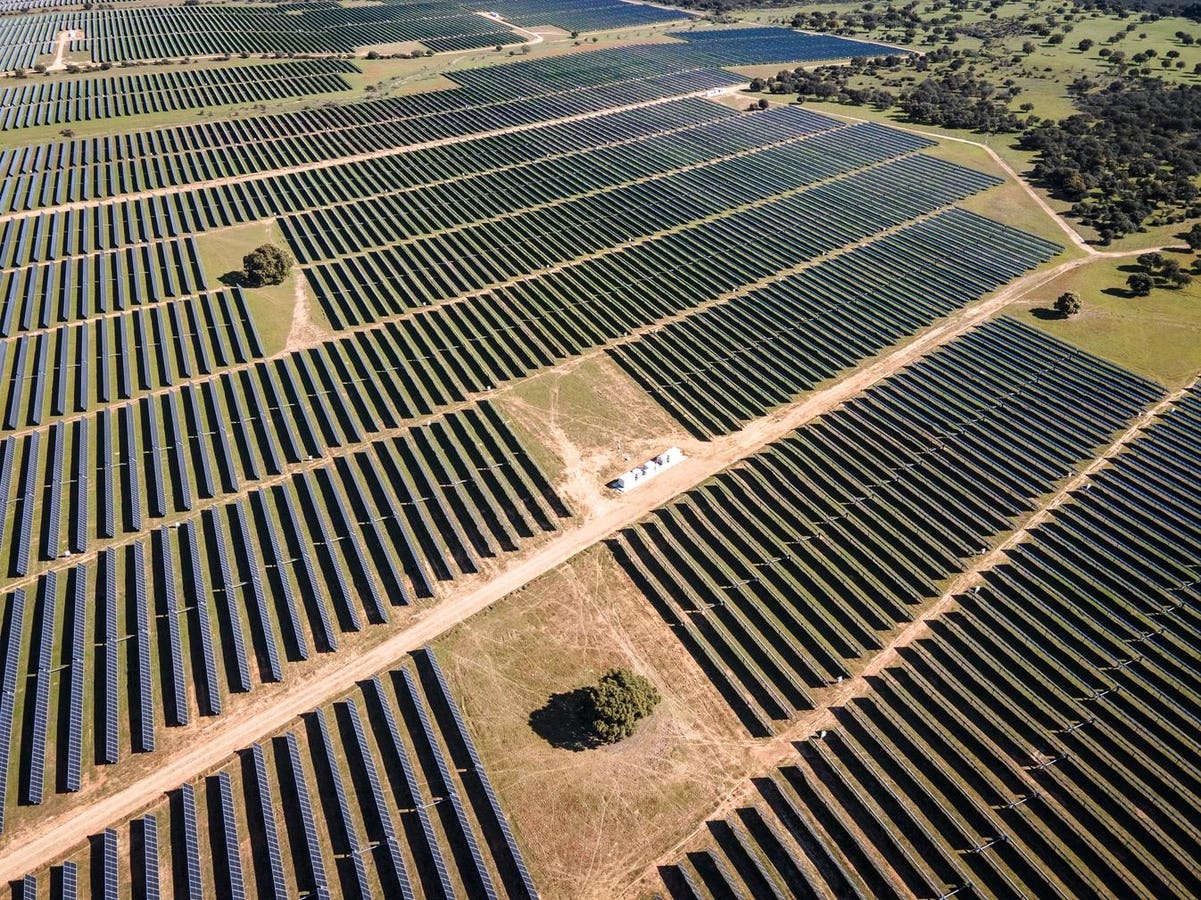
Electricity produced worldwide from renewable sources will likely pass coal-fired power for the first time this year and grow steadily through the end of the decade, the International Energy Agency estimates. By 2030, global electricity generation from solar, wind and other sources should top 17,000 terawatt-hours, up nearly 90% from 2023–enough to power both China and the U.S., according to the IEA.
Within the U.S., California now gets 67% of its electric power from renewable and zero-carbon sources, including solar, wind, hydro and nuclear. That figure should only increase in the next few years: the state added 7,000 megawatts of clean energy capacity to its grid in 2024, along with massive amounts of battery storage capacity. More than 20,000 megawatts of new clean energy is already under contract to be added by 2030, according to the state.
“The world’s fourth-largest economy is running on two-thirds clean power–the largest economy on the planet to achieve this milestone,” said California Gov. Gavin Newsom.
Meanwhile, the EU estimates that renewable energy now accounts for a quarter of electric power production in its member countries and should reach 45% by the end of the decade. China, already the world’s top producer of solar panels, wind turbines, batteries and electric cars, is moving even faster. In May alone, it installed 93 gigawatts of solar capacity and 26 gigawatts of wind power. Though the country remains the world’s biggest source of carbon emissions, especially due to its heavy use of coal, that could soon change as its solar and wind capacity keeps growing. Sales of electric vehicles in China, already the world’s biggest market for them, will likely also surpass those of gas-powered cars for the first time this year.
The loss of U.S. incentives for solar power–and the manufacturing to support it is particularly problematic given how rapidly it’s growing globally, adding to concerns that China and other countries will gain an insurmountable lead in the technology. It’s also bad news for the country, which is staring down the barrel of an energy crisis thanks to power-hungry data centers fueling AI. That’s because solar and wind are not only cheaper to build than fossil fuels or nuclear, these plants are also more likely to be completed on time and on budget.
“It took from the invention of the photovoltaic solar cell, in 1954, until 2022 for the world to install a terawatt of solar power; the second terawatt came just two years later, and the third will arrive either later this year or early next,” environmental writer Bill McKibben said in the New Yorker.
Fortunately for the planet, even if the U.S. pace of new renewable power production slows in the next few years, there’s no sign the rest of the world will follow suit.
The Big Read
Aerial view of industrial battery units storing electricity in the desert. In the distance are solar panels and mountains.
getty
GM Supplying Batteries For Data Center, Energy Grid Packs
General Motors, which has poured billions of dollars into producing electric vehicle batteries at U.S. plants, is partnering with Redwood Materials to use some of its cells for stationary energy storage systems for the power grid as well as AI data centers.
The Detroit-based automaker, which already supplies battery scrap materials to Redwood for recycling, plans to supply both new and used U.S.-made battery cells that Redwood will package as large stationary packs, the companies said. The move comes after Reno-based Redwood, founded by Tesla cofounder and current board member JB Straubel, last month created a new unit to supply energy storage packs called Redwood Energy.
“The market for grid-scale batteries and backup power isn’t just expanding, it’s becoming essential infrastructure,” said Kurt Kelty, GM’s battery chief. “Electricity demand is climbing and it’s only going to accelerate.”
Finding additional uses for battery cells beyond EVs can help GM maximize its investment in R&D and production of that technology as Trump Administration policies, distilled in the just-enacted One Big Beautiful Bill Act, darken the outlook for not only EV sales but large-scale wind and solar projects. Pursuing new applications for cleaner, less-polluting energy technology is exactly what many investors are encouraging companies to do.
Read more here
Hot Topic
The Ocean Conservancy
Riccardo Farina of The Ocean Cleanup on working with AWS and using AI to battle the Great Pacific Garbage Patch
How big a problem is plastic in the ocean?
There is more than 200 million pounds of trash estimated to be in the ocean, with many more entering every year. The debris causes damage to marine life; it will break down into microplastics entering the food chain. Recent studies have also highlighted that floating plastic limits the ability of the ocean for carbon sequestration, which is crucial for climate regulation.
Moreover, plastic entering the ocean from a river also affects the global community and damages ecosystems such as mangroves. This is a manmade problem and an environmental challenge that we are on a mission to solve. We’re a nonprofit. We’re a data-driven organization. Most importantly, we’re also project-based. We envision a future where ocean cleanup is not needed anymore and we can go out of business. We can dissolve.
To achieve this goal, we have a dual strategy: removing the legacy plastic in the middle of the ocean and also preventing the inflow of plastic into the ocean via rivers. In the initiative that we have announced with AWS, we mainly focus on the ocean.
What is AWS doing to help?
In the ocean, we’re tackling the great Pacific Garbage Patch, an area two times the size of Texas located between San Francisco and Hawaii. There is a bit of a general misconception that there is a floating island of plastic, which would make our job very easy. But actually, the plastic is very widespread over a large area. A key challenge is actually identifying areas with high concentrations of plastic.
We have already developed the hardware of the solution, which is a floating barrier that has been shown to be capable of continuously harvesting a large amount of plastic. To date, we have removed more than 1 million pounds of trash from that environment. However, a key challenge is to identify what we call hotspot areas, areas with high concentrations of plastic.
The collaboration with AWS will enable us to better detect, track and identify and predict areas in the Pacific with the highest concentrations of plastic. Together we’ll develop and deploy a machine-learning and artificial intelligence platform that will be able to predict where the plastic will be, so we can steer our operations and our ships and increase the efficiency of our operations and of our efforts. AWS will provide us with a variety of technologies such as IoT, satellite imagery, computational modeling power and also deploying drones and GPS trackers to collect better data, which will be combined with publicly available data and data that we have in-house. Then by leveraging high computational power, we want to develop a steering tool so we can predict where the highest concentrations of plastic are and we can increase the efficiency of our operation. With AWS, we’ll be able to drastically accelerate our efforts.
We also want to have a net positive effect on the environment and we want to make sure that whenever we harvest plastic, in no way are we damaging marine species. Currently, we have an environmental observer on board monitoring with an underwater camera the interaction our system has with marine life species. We’ll work together with AWS to develop an AI infrastructure that will be able to automate as much as possible this procedure so we can allocate more resources to the plastic removal initiative.
What are you doing with the collected plastic trash?
We recycle that material into pellets. In 2021, we released our first product, a pair of sunglasses … to show the world that it’s possible to turn trash into treasure. Now we’re moving to an approach where we partner with a third party so they can have access to our catch and can turn it into long-lasting products to show to the world that it is indeed possible to give second value to this unique material–and also to raise awareness to our mission.
When it comes to rivers, the process is a bit different, but we partner with the local waste management infrastructure. Our responsibility lies with intercepting the trash and then ensuring that it’s properly handed over to the local waste management infrastructure. We are also exploring ways to repurpose that material into long-lasting products. Last year, we repurposed the catch coming from our Interceptor 006 in Guatemala to produce a limited edition LP of the latest Coldplay album.
The plastic we collected from the ocean has been repurposed for a limited edition trunk liner for the Kia EV3 model–Kia is one of our global partners.
What Else We’re Reading
EPA killing its scientific research arm. The office provides independent research that underpins nearly all of the agency’s policies and regulations (New York Times)
U.S. threatens to abandon the International Energy Agency over green-leaning energy forecasts (Bloomberg)
The science behind Texas’s catastrophic floods. The disaster has the fingerprints of climate change all over it (Yale Climate Connections)
U.S. EV sales slipped 6% in the second quarter but hit a record high in the first half. Third-quarter sales may spike before federal tax credit expires (Cox Automotive)
GM to make lower-cost battery cells at Tennessee plant. The automaker is rolling out production of lithium-iron-phosphate at its Spring Hill, Tennessee facility (Reuters)
EPA tries to halt the closure of Colorado coal-fired power plants after meeting with local utilities (Inside Climate News)
Three electric vehicle leaders emerge amid U.S. retreat. Smart public policy can spark innovation and these countries are deploying long-term strategies (Forbes)
More From Forbes
